Unlocking the AI Agent Economy: Insights from Ethereum’s Visionaries on Trustless Infrastructure
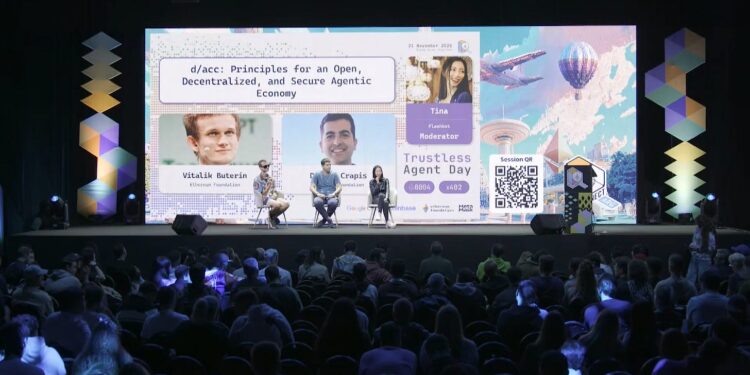
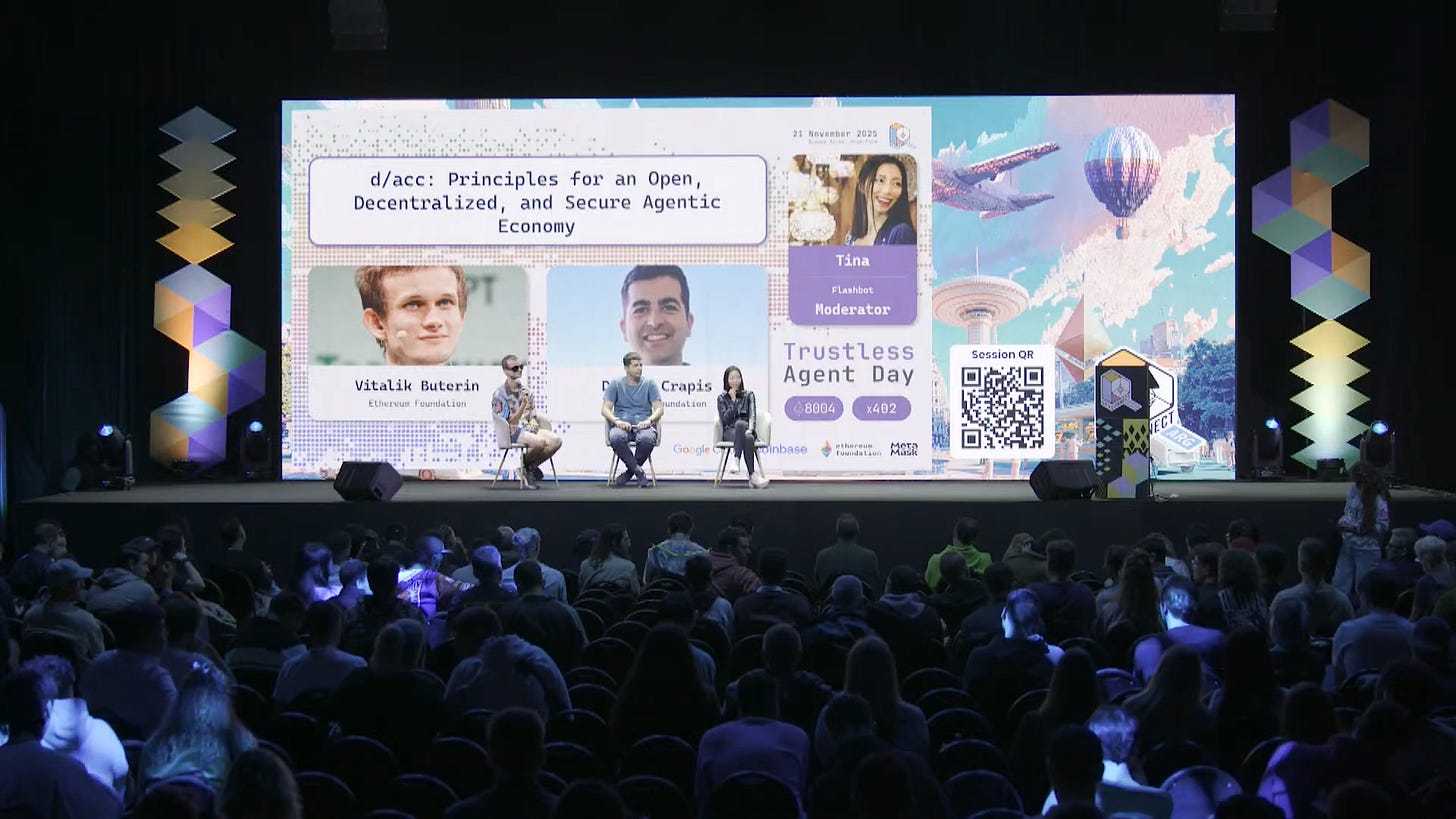
The recent Ethereum Devconnect hosted a pivotal event, “Trustless Agent Day,” which convened leading minds at the forefront of the Web3 and AI convergence. The culminating panel, expertly moderated by Tina from Flashbots, featured an illuminating discussion with Ethereum co-founder Vitalik Buterin and Davide Crapis, head of the Ethereum Foundation’s dAI team.
This wasn’t merely a technical discourse; it was a profound exploration into the foundational architecture of our future digital society. As AI Agents become increasingly central to economic activity, critical questions emerge: What infrastructure, trust models, and privacy safeguards will be essential?
The Foundational Pillars: Payments and Discovery (x402 & ERC-8004)
The conversation anchored itself on two crucial protocols: x402, designed for seamless payments, and ERC-8004, enabling robust service discovery. Together, these form the bedrock of a burgeoning AI Agent economy.
Vitalik’s Vision: Reimagining Micropayments for the AI Era
Vitalik Buterin articulated his enthusiasm for the transformative potential of micropayments, now made truly feasible by AI. He highlighted that while humans struggle with the cognitive burden of evaluating tiny transactions (“should I pay 4 cents or 11 cents?”), AI Agents can make such decisions in milliseconds. This shift paves the way for a highly efficient “pay-for-what-you-consume” economic model.
Crucially, Vitalik underscored that this high-frequency payment system must be built on robust privacy. Without it, an Agent’s myriad query records could inadvertently expose sensitive user behavioral patterns. Integrating Zero-Knowledge Proofs (ZK) is therefore paramount. Imagine a user pre-funding an account (e.g., $5) for 5,000 queries, where each on-chain transaction remains unlinkable to the others, safeguarding user privacy.
Davide Crapis and ERC-8004: From Payments to Trust
While x402 addresses the “how to pay” dilemma, Davide Crapis introduced ERC-8004 to tackle the equally vital question of “who to trust.” Davide observed that as micro-transactions to web services and AI via x402 gained traction, the fundamental challenge of verifying service trustworthiness became apparent.
The ERC-8004 (Trustless Agent Standard) emerged as a decentralized service discovery mechanism, far beyond a simple whitelist. It empowers service providers to register their capabilities on-chain. Davide delineated two categories of trust:
- Soft Trust: Derived from historical performance, accumulated reputation, and independent audits.
- Hard Trust: Guaranteed by cryptographic proofs or cryptoeconomic incentives.
ERC-8004 standardizes the format for this critical information, enabling AI Agents to autonomously locate, evaluate, and verify service providers within a decentralized network.
The Elephant in the Room: Bridging Idealism and Reality
Before delving further into future possibilities, moderator Tina opened the floor to the audience, fostering a candid discussion about “the elephant in the room”—the industry’s most glaring yet often unaddressed pain points.
The Agent’s “Role-Playing” Conundrum
Developer Shaw offered a piercing critique: “We don’t truly have usable Agents yet.” He argued that most contemporary Agents, trained predominantly on text data from platforms like Reddit, possess theoretical knowledge (e.g., “how to bake a cake”) but lack real-world, practical execution experience. When these Agents attempt complex tasks like market trading or prediction, they operate “out of distribution.” Shaw contended that, to a degree, the industry is engaged in an “expensive LARP” (Live Action Role-Playing), still awaiting the emergence of Agents with genuine end-to-end capabilities.
The Dual Burden: Costs and Inherent Biases
Another developer, Tim, highlighted the unsustainable economic model: the exorbitant cost of inference. Every minute decision call incurs significant expense. For the x402 vision to materialize, the cost per decision must plummet to less than 10% of the transaction fee. Many startups, he noted, are currently subsisting on the free tiers offered by cloud service providers.
Andrew Miller further dampened enthusiasm for reputation systems, citing historical evidence that they often favor incumbents and are susceptible to manipulation. He proposed that a potential solution lies in utilizing Trusted Execution Environment (TEE) sandboxes, allowing open-source Agents to securely evaluate the trustworthiness and security of their closed-source counterparts.
Why Blockchain? The Inherent Home for AI Agents
Despite these challenges, the panelists firmly asserted the indispensable role of blockchain in fostering the Agent economy, offering reasons that extend far beyond mere payment facilitation.
On-Chain Games and Synthetic Assets: A New Frontier
Vitalik presented an intriguing perspective: blockchain serves as the natural substrate for “on-chain games”—not just entertainment, but market interactions viewed through a game-theoretic lens. He posited that Agents, unlike humans, don’t require identity-based trust; they thrive in anonymous, trustless environments where strategic interactions are paramount. More profoundly, Agents are adept at comprehending and managing highly complex synthetic assets—financial instruments composed of diverse underlying baskets, often unintuitive for humans but perfectly logical for machine algorithms. This capability could catalyze the emergence of entirely new, Agent-exclusive financial markets, distinct from human-centric ones.
Enhanced Security Through Constrained Delegation
Davide Crapis emphasized blockchain’s role in providing “hard rules” for security. As humanity increasingly delegates decision-making authority to AI (a process he termed “agentification”), a robust safety mechanism becomes critical. Smart contracts enable “constrained delegation”—for instance, allowing a DeFi Agent to execute arbitrage strategies while hardcoding a “no withdrawals to external addresses” rule at the smart contract level. This code-enforced constraint offers a level of security and control unattainable with traditional Web2 APIs.
Privacy: Not a Feature, But a Fundamental Hygiene
On the critical subject of privacy, Vitalik put forth a powerful axiom: “Privacy is not a feature; it’s a hygiene habit.” He argued against viewing privacy as an add-on or a novel product enhancement, but rather as a fundamental commitment to “no longer leaking data.”
Prioritizing User Privacy Over Service Privacy
Vitalik’s stance on privacy priorities was unequivocal: user privacy unequivocally outweighs service privacy. He articulated a vision where users are not subjected to constant scoring and tracking, yet service providers (Agents) maintain transparent and publicly verifiable reputation records. He even theorized the use of ZK technology for “negative reputation proofs”—allowing users to cryptographically attest to their interaction history, including any negative feedback, without disclosing their specific identity. This innovative approach would uphold system integrity while meticulously protecting individual privacy.
Scaling Privacy: The Role of TEE and Anonymization
Addressing the performance bottlenecks of ZK in inference computation, the discussion highlighted Trusted Execution Environments (TEE) as a pragmatic interim solution. While TEEs introduce hardware costs, they offer a viable bridge between current capabilities and future ideals. Vitalik further suggested that anonymization, through mechanisms like mix-nets that obscure the origin of requests, remains an underestimated strategy. Even if content cannot be fully encrypted, anonymization significantly enhances user protection against targeted analysis.
The Future Computing Landscape: The Potential Demise of Laptops?
Peering 5 to 10 years into the future of infrastructure, Vitalik offered a provocative prediction: the eventual disappearance of the laptop. He posited that the current “local-first” computing architecture, while inherently trustworthy, is economically inefficient due to underutilized computational power (personal demand is often pulsed, leaving hardware idle and consuming energy).
The emerging trend, he argued, is the decoupling of computation from the user interface (UI). As smartphones, smart glasses, watches, and even brain-computer interfaces become ubiquitous, UI forms will become highly fragmented. The computational core, Vitalik predicts, will increasingly detach from personal end-user devices.
This paradigm shift presents a monumental challenge: the need for a new operating system or foundational architecture that enables users to securely leverage remote computational power while maintaining the same level of trust and confidence as if it were running locally.
From Protocol Specifications to Real-World Applications
Concluding the discussion, Davide Crapis announced the imminent launch of ERC-8004 on the Ethereum mainnet within weeks. He described the preceding months as “Season 1″—a phase of community collaboration and standard establishment. The next phase, “Season 2,” will focus on solidifying infrastructure (e.g., browsers, SDKs) and incubating “killer applications.”
Vitalik offered a concrete suggestion for aspiring “trustless” AI product developers: live translation presents a perfect entry point. While current encrypted communication platforms secure data transmission, their translation functionalities often rely on centralized cloud services, representing a significant privacy vulnerability in the end-to-end chain.
This panel transcended a mere technical exposition of ERC-8004 and x402. It was a profound and timely examination of how cryptography and decentralized networks can safeguard human sovereignty and privacy in an era where AI is rapidly reshaping our digital existence.
Disclaimer: This article provides general market information and insights for reference only. It does not constitute investment advice, nor does it necessarily reflect the views or positions of the author or publisher. Investors should conduct their own research and make independent investment decisions. The author and publisher bear no responsibility for any direct or indirect losses incurred from investment actions based on this content.