
Bitcoin’s recent rally appears to be stalling, with its price action eerily mirroring the bear market conditions of March 2022, according to leading on-chain data analytics firm CryptoQuant. As demand wanes and capital momentum cools, investor sentiment has plunged into an “icy grip of extreme pessimism,” signaling that the current correction may be far from over.
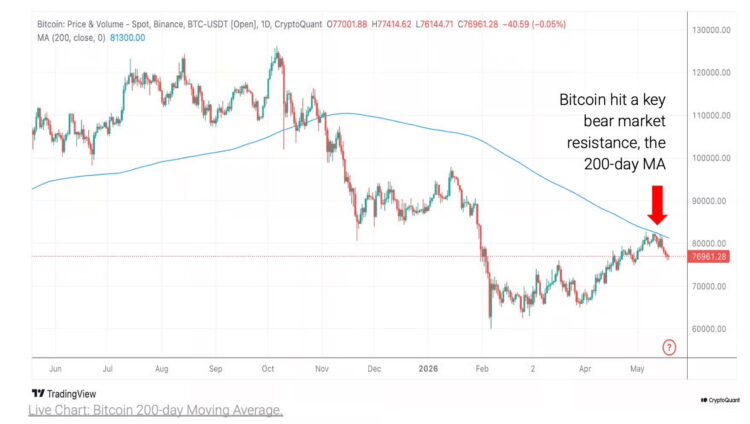
In a report released on Wednesday, Julio Moreno, Head of Research at CryptoQuant, highlighted Bitcoin’s recent rebound, which encountered significant resistance upon approaching its 200-day moving average, near the $82,400 mark. Following this rejection, the cryptocurrency retreated to a low of $76,000.
Moreno emphasized that this price trajectory “perfectly replicates” the bleak conditions observed during the March 2022 bear market. Back then, Bitcoin rallied 43% from its trough only to falter at the 200-day MA, subsequently entering a prolonged downtrend. This time, after surging approximately 37% from its April 2024 lows, Bitcoin has once again collided with this formidable technical barrier. He further elaborated:
In a bear market paradigm, the 200-day moving average consistently acts as the critical demarcation line between a ‘relief rally’ and the ‘resumption of a downtrend.’
Moreno asserted that in both March 2022 and the current market cycle, Bitcoin’s inability to decisively breach the 200-day moving average serves as the strongest technical signal, historically indicating that the “bear market structure remains firmly intact.”
The Chill of Reduced Demand: Bitcoin Buying Activity Freezes
Beyond the technical resistance, analysts are increasingly concerned by a parallel deterioration in demand. Julio Moreno attributes Bitcoin’s robust rally in April and May primarily to speculative buying originating from the derivatives market. However, as Bitcoin pushed past the $82,000 threshold, this fervor for perpetual futures contracts abruptly decelerated, prompting traders to secure profits and close positions.
Concurrently, the spot market, often favored by retail investors, witnessed an even more rapid contraction in buying interest than the derivatives sector. Even institutional capital from Wall Street has begun to retreat, with US Bitcoin spot ETFs shifting from a buying spree to net selling. While these ETFs famously accumulated a staggering 64,000 BTC within a 30-day period in early May, recent data reveals a net outflow of approximately 4,000 BTC.
Commenting on this swift and aggressive selling wave, Bitfinex analysts asserted that it underscores how the brief rally earlier this year was built upon a fragile foundation of “structurally insufficient capital.”
Furthermore, the “Coinbase Premium Index,” a key barometer for US capital flows, has consistently remained in negative territory throughout the April-May rebound and subsequent pullback. Julio Moreno clarifies that a negative premium (discount) signifies that the significant forces of US institutional and retail investors have yet to re-enter the market. Historical patterns suggest that truly sustainable Bitcoin bull markets are almost invariably accompanied by robust support from a positive Coinbase Premium.
The $70,000 Threshold: A Pivotal Defense Line Where Unrealized Gains May Reset, Offering a Potential Reversal Point?
Amidst a barrage of bearish indicators, CryptoQuant’s “Bull Score Index” has taken a dramatic plunge, collapsing from a previously healthy level of 40 into the 0-20 range, firmly placing it within the “extremely pessimistic” territory.
Julio Moreno notes that this aligns perfectly with data observed during Bitcoin’s decline to the $60,000-$66,000 range in February-March 2024. Historically, when this index hovers between 0 and 20, it often presages either “further price capitulation” or an “extended period of consolidation.”
So, where should the bulls establish their next defensive stronghold? Julio Moreno suggests that if the current price correction continues its downward trajectory, the $70,000 mark will emerge as a crucial battleground, determining the market’s immediate fate.
This price point also corresponds to the “realized price for traders.” In previous bear market phases and during relief rallies, this metric has repeatedly acted as a pivotal support and resistance level. Should Bitcoin’s price retreat to the vicinity of $70,000, short-term traders’ unrealized profits would effectively be wiped out, potentially turning into losses.
Paradoxically, Julio Moreno believes this scenario could reduce the market’s inclination to sell, thereby encouraging long-term capital to enter and “buy the dip,” ultimately contributing to price stabilization.
As of this report, Bitcoin is trading at approximately $77,859, reflecting a modest gain of about 1% over the past 24 hours, yet the prevailing market sentiment remains one of cautious observation.
Disclaimer: This article is for informational purposes only. All content and opinions are for reference only and do not constitute investment advice. They do not represent the views and positions of the author or BlockTempo. Investors should make their own decisions and transactions. The author and BlockTempo shall not be held responsible for any direct or indirect losses incurred by investors through their transactions.




