
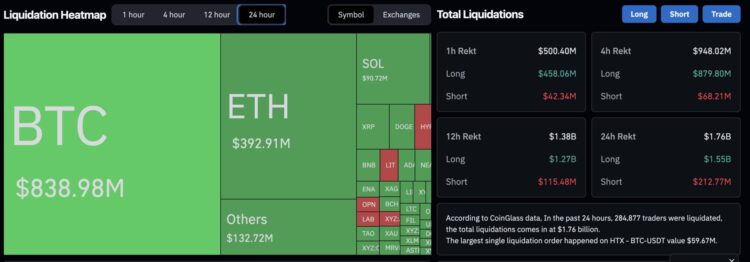
The cryptocurrency market has once again been rocked by significant volatility. Bitcoin experienced a sharp sell-off this morning (June 4th), plummeting below the crucial $62,000 mark. This dramatic decline not only represents its steepest fall in months but also triggered a staggering $1.7 billion in forced liquidations of leveraged positions, sending ripples of panic across the market.
According to CoinGlass data, today’s total liquidation cascade amounted to $1.78 billion, with an overwhelming $1.544 billion stemming from long positions. The intensity of these liquidations was particularly pronounced over the past 12 hours, tallying $1.398 billion, of which $1.262 billion were long positions.
Bitcoin traders bore the brunt of these losses, with approximately $853 million in positions settled within the last 24 hours. Ethereum positions also faced substantial liquidations, exceeding $397 million.
Institutional Retreat and Record ETF Outflows
This market “bloodbath” unfolds against a backdrop of persistent institutional weakness. Data from SoSoValue reveals an accelerated withdrawal of capital from Wall Street. This week alone, a hefty $1 billion has been pulled from US Bitcoin spot ETFs, extending a recent trend of significant outflows. This marks the longest continuous net outflow streak in the history of Bitcoin ETFs, signaling a notable shift in institutional sentiment.
Surge in Hedging: $50,000 Puts Dominate Options Market
As Bitcoin’s downward momentum proves difficult to halt, investors are increasingly flocking to the options market in search of hedging strategies. Deribit data highlights that the most actively traded contract over the past 24 hours was a put option (bearish option) set to expire on June 26th with a strike price of $50,000. This suggests that traders are either positioning themselves for a deeper market correction or proactively acquiring inexpensive “tail risk” insurance against a low-probability, high-impact catastrophic crash.
Furthermore, put options with strike prices of $65,000 and $55,000 also witnessed substantial buying activity. Intriguingly, among the top five most popular contracts, only one was a bullish call option, featuring an ambitious strike price of $80,000.
The widespread emergence of bearish positions unequivocally indicates a defensive posture among market participants. The majority of traders are either directly betting on Bitcoin’s continued depreciation or strategically employing hedging tactics to mitigate potential losses.
The “Capital Crowding-Out Effect”: A Macroeconomic Headwind
Cryptocurrency research firm Presto Research posits that Bitcoin’s recent downturn is less a reflection of a lack of positive catalysts within the crypto market itself, and more a consequence of a “capital crowding-out effect” within the broader global capital markets.
The firm’s report notes that every significant Bitcoin pullback observed this year has almost invariably coincided with a simultaneous rally in both gold and artificial intelligence (AI) concept stocks. This phenomenon is attributed to cooling investor expectations regarding interest rate cuts by the U.S. Federal Reserve (Fed). As a result, capital is gravitating towards AI stocks, which offer compelling growth narratives, and traditional safe-haven asset gold.
Presto Research underscores that if this “capital crowding-out effect” persists, the key to Bitcoin’s resurgence into a bullish phase may not hinge on developments within the cryptocurrency industry. Instead, it will likely depend on when inflation concerns finally subside and when global capital is once again prepared to embrace “highly liquidity-sensitive” risk assets.
In this environment of receding capital flows, investors are urged to exercise extreme caution, fasten their seatbelts, and diligently manage their leveraged risks.
Disclaimer: This article is intended to provide market information only. All content and views are for reference purposes only and do not constitute investment advice. They do not represent the views and positions of BlockTempo. Investors should make their own decisions and trades. The author and BlockTempo will not be liable for any direct or indirect losses incurred by investors as a result of their trading.




