By: Nancy, PANews
Hyperliquid, a burgeoning force in decentralized finance, is not only expanding its reach to ‘Wall Street’ but also intensely reshaping its internal ecosystem dynamics. The platform’s HIP-3 initiative, designed to empower permissionless market deployment and diversify tradable assets, has rapidly propelled Hyperliquid into the spotlight as a new frontier for crypto enthusiasts and “weekend warriors” alike.
However, this explosive growth within the HIP-3 market has triggered a brutal consolidation. Trade.XYZ, leveraging its first-mover advantage, has established a near-monopoly, capturing over 90% of the market share. This dominance has left little room for other ecosystem projects, with several, including Felix and Ventuals, announcing their unfortunate closure.
HIP-3 Soars Past $300 Billion in Volume, Trade.XYZ Commands Over 90%
The introduction of HIP-3 has unequivocally ushered in a new era of growth for Hyperliquid. Data from the Hyperscreener dashboard reveals that Hyperliquid’s total perpetual (Perp) trading volume reached an impressive $8.77 billion in the past 24 hours. Crucially, the HIP-3 market alone contributed approximately $3.5 billion, accounting for a substantial 39.9% of the platform’s overall volume. This means nearly $4 out of every $10 in perpetual contract trading on Hyperliquid originates from HIP-3.
Since its launch last October, HIP-3 has amassed an astounding cumulative trading volume exceeding $319.8 billion in just over half a year—a growth trajectory far surpassing initial market expectations. Yet, this expansion isn’t fostering a diverse ecosystem; instead, it’s fueling a pronounced “winner-take-all” effect, with Trade.XYZ absorbing nearly all the incremental market share.
Examining open interest further underscores this trend. As of June 16, Hyperscreener data shows the HIP-3 market’s cumulative open interest at approximately $29.4 billion. Of this, Trade.XYZ alone accounted for $28.7 billion, representing a staggering 97.6% market share. In stark contrast, other projects like DreamCash, HyENA, Ventuals, and Felix collectively hold less than 1%, rendering their contributions almost negligible.
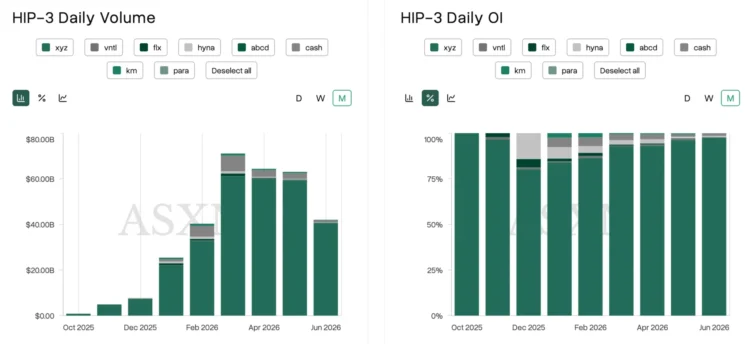
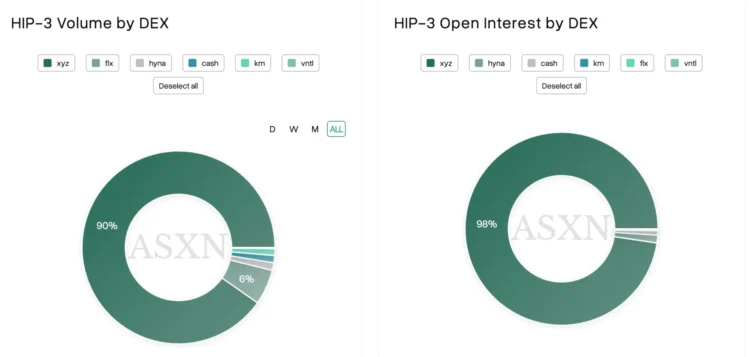
The historical cumulative trading volume paints a similar picture: Trade.XYZ consistently maintains around 90% of the market. DreamCash follows in a distant second with approximately 6%, leaving the remaining projects to vie for a meager sub-5% share. The first half of June saw this concentration intensify, with Trade.XYZ’s market share climbing to 96.65%. The combined share of the other seven markets, including Felix Exchange, Ventuals, and HyENA, dwindled to just 3.35%, with some projects barely registering above 0.1%.
This disparity becomes even more evident when analyzing asset trading activity. This month, the total cumulative trading volume for all assets on HIP-3 reached $11.21 billion. Remarkably, Trade.XYZ’s core product, XYZ100 (an index tracking the top 100 companies), single-handedly contributed $10.64 billion, effectively underpinning the vast majority of trading activity across the entire HIP-3 market.
User activity also shows a clear divergence. This month, Trade.XYZ attracted over 46,000 unique trading addresses, while most other markets struggled to draw more than a few hundred, and some even fewer than a hundred. In terms of transaction frequency, Trade.XYZ processed over 22.03 million trades, dwarfing other markets that typically saw tens to just over a hundred thousand transactions—a monumental gap.
In essence, the current growth narrative of HIP-3 is, to a significant degree, the growth story of Trade.XYZ.
The HIP-3 Shakeout: Ecosystem Projects Face Elimination
As Trade.XYZ continues to monopolize market liquidity, HIP-3 is evolving from an open arena of innovation into a brutal elimination round dominated by a few powerful players. This shift makes it increasingly difficult for new entrants to carve out a viable space.
Recently, several HIP-3 projects have announced their cessation of operations. Last week, Charlie, co-founder of the Hyperliquid lending protocol Felix, revealed that Felix’s HIP-3 DEX and all associated spot markets would begin a phased shutdown on June 19, with full delisting by June 20. Traders were urged to close their positions before this deadline. While Felix’s lending and spot stock operations remain unaffected, the team plans to refocus on its core products. A future return as a HIP-3 deployer isn’t ruled out, should new user growth avenues emerge.
In his post-mortem, Charlie acknowledged Felix’s initial success, having generated approximately $3 billion in trading volume and significant fee income through its early adoption of crude oil, gold, and silver markets. However, the launch of similar USDC-denominated markets by Trade.XYZ swiftly eroded Felix’s market share.
Charlie attributes Trade.XYZ’s rapid moat-building to several strategic advantages: choosing the more liquid USDC over USDH, seizing the crucial first-mover window for HIP-3 deployment, aggressively expanding market offerings, and leveraging brand effects and a liquidity flywheel fueled by airdrop expectations. With USDH gradually fading, maintaining HIP-3 deployment no longer offered a differentiated competitive edge, prompting Felix to scale back its operations.
Felix is not an isolated incident. Shortly thereafter, Ventuals, a prominent platform for trading private company stocks on Hyperliquid, also announced its gradual cessation of operations. The Ventuals team will integrate with another development team within the Hyperliquid ecosystem. The platform will progressively close markets for OpenAI, Anthropic, commodities, and indices. vHYPE holders will be able to redeem HYPE at a 1:1 ratio and claim staking rewards. Ventuals also confirmed the termination of its points and referral programs, explicitly stating no token issuance.
During its operational tenure, Ventuals disclosed it had accumulated over 500,000 HYPE and facilitated over $650 million in trading volume, positioning itself as one of the most innovative applications within the Hyperliquid HIP-3 ecosystem.
While Ventuals did not publicly detail its reasons for closing, market consensus points to Trade.XYZ’s relentless absorption of liquidity for popular assets, coupled with the inherent liquidity and pricing challenges of Pre-IPO assets, as significant factors in its eventual exit.
High Barriers to Entry Intensify HIP-3 Ecosystem Pressure
Beyond the intense competition from dominant players, the very deployment mechanism of HIP-3 itself is further constricting the survival space for newcomers.
Under HIP-3 rules, any team aspiring to launch a DEX must first stake a substantial 500,000 HYPE as a security deposit. At current valuations, this amounts to approximately $35.89 million, and the funds must remain locked for a minimum of 183 days post-deployment. Furthermore, while the first three assets deployed by any team are exempt from auction, subsequent assets require acquisition of deployment rights via a Dutch auction. The minimum starting bid for these auctions is 500 HYPE (currently valued around $36,000, a significant decrease from 1750 HYPE in January), with the HYPE paid in the auction being directly burned by the protocol.
For new entrants, the combination of high upfront investment, escalating expansion costs, and a protracted payback period is becoming an increasingly unsustainable burden, especially with liquidity overwhelmingly concentrated among top players. It is worth noting that Hyperliquid announced in May this year its intention to gradually lower the 500,000 HYPE staking threshold.
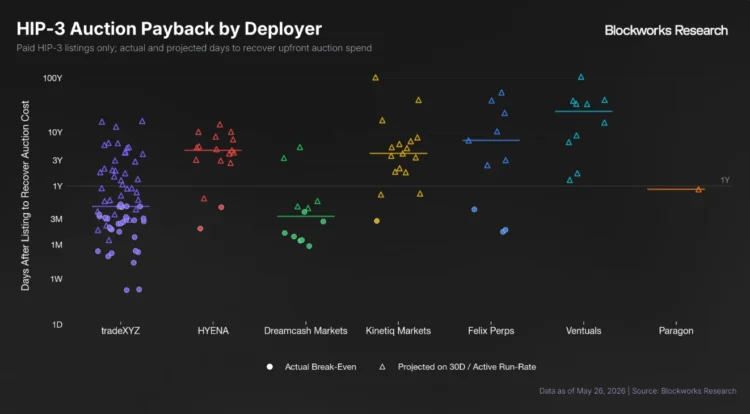
According to Shaunda Devens, an analyst at Blockworks Research, most HIP-3 deployers, excluding Trade.XYZ, experience an annualized return on their staked HYPE of barely 1% or even less. The median payback period for their market auction costs stretches to a staggering four years. Trade.XYZ, however, stands as a stark exception, boasting an estimated HYPE staking return of 74% and a median auction cost payback period of just five months.
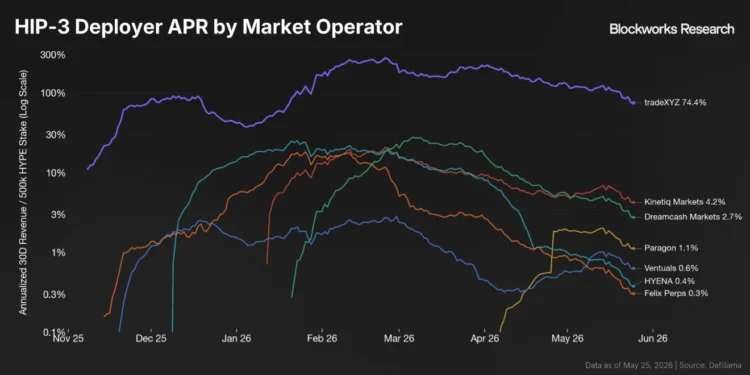
This illustrates that Trade.XYZ’s success is not solely a product of its offerings but also a powerful, self-reinforcing network effect. Increased user engagement drives greater liquidity, which in turn attracts more assets, further solidifying its market position. Conversely, peripheral deployers, facing abysmal returns, lack both the incentive to expand and the motivation to stake more HYPE or participate in market auctions.
For Hyperliquid, this situation presents inherent risks.
Undeniably, Trade.XYZ has significantly expanded Hyperliquid’s market reach and serves as HIP-3’s most successful blueprint. However, if the power to list popular assets and the associated liquidity remain concentrated in a single deployer, HIP-3’s competitive landscape will stagnate at the top, hindering its evolution into a truly open and diverse ecosystem.
In the long run, this concentration could stifle innovation and potentially confine Hyperliquid to a singular narrative centered on perpetual contracts. In an increasingly competitive Perp DEX landscape, relying solely on perpetual trading may prove insufficient to cultivate a rich on-chain application ecosystem and sustainable network effects. Notably, Hyperliquid has already ventured into the burgeoning prediction market through HIP-4, signaling an intent to broaden its business scope.
Charting a Sustainable Future: Proposed Solutions
To address these challenges, Shaunda Devens has proposed two key mechanism optimizations aimed at enhancing market creation sustainability and bolstering HYPE’s value capture capabilities.
- Tiered Exchange Mechanism: This proposal suggests allowing new deployers to launch HIP-3 DEXs with a lower HYPE staking threshold than the current 500,000. These lower-tier DEXs would come with corresponding limitations, such as reduced open interest caps, lower leverage multiples, and stricter risk control protocols. As deployers increase their HYPE staking, they would progressively unlock higher-level functionalities.
- Adjusted HIP-3 Market Auction Economic Model: Devens recommends modifying the fee structure to benefit new deployers. This could involve allowing deployers to retain up to 100% of trading fee revenue until their new market recovers its auction costs. Alternatively, fees could be prioritized for deployers until the DEX’s cumulative revenue covers auction costs, after which the standard 50:50 protocol-deployer revenue split would be reinstated.
Conclusion: Balancing Growth and Decentralization
For Hyperliquid, HIP-3 has unequivocally demonstrated the viability of decentralized market creation. Trade.XYZ’s resounding success not only validates strong product demand but also stands as a crucial growth engine for Hyperliquid in its current phase.
However, true resilience and a healthier open ecosystem may require more than just relying on a single “super application” to continuously siphon liquidity. A sustainable future for Hyperliquid hinges on fostering an environment where innovators at all stages and of all types can thrive, consistently giving rise to new assets, novel trading mechanisms, and diverse business models.
This content is provided for informational purposes only and does not constitute investment advice. All views and opinions expressed are for reference only and do not represent the stance of PANews. Investors should make their own decisions and trades. Neither the author nor PANews will be liable for any direct or indirect losses incurred by investors from their trading activities.