Author: Nancy, PANews
World Chain’s Ascendant Trajectory: Navigating the L2 Landscape with AI Hype and Real User Demand
The Layer 2 (L2) landscape has become an increasingly cutthroat arena since Vitalik Buterin recalibrated its roadmap earlier this year. While titans like Base, Arbitrum, and OP Mainnet fiercely contend for market attention and liquidity, a significant number of mid-tier and emerging L2s have found themselves struggling, with many projects facing existential challenges.
Amidst this intensifying L2 differentiation, World Chain has charted a remarkably independent growth trajectory. Despite a still-nascent on-chain application ecosystem, consistent real-world user activity fuels its high-frequency interaction demands. Furthermore, riding the wave of AI fervor, the WLD token has recently demonstrated a distinct and impressive upward rally.
The WLD Rally: A Confluence of Catalysts
As investment in the AI sector continues to surge, Worldcoin has emerged as a prime target for market capital. Data from CoinGecko reveals that WLD has climbed an impressive 136.1% over the past 30 days, significantly outperforming the majority of mainstream crypto assets.
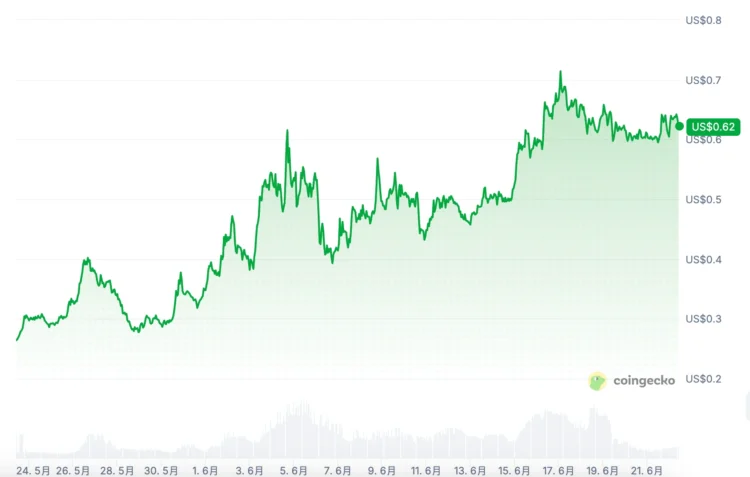
This remarkable rally in WLD is primarily propelled by a combination of strong market expectations and substantial capital inflows.
Firstly, significant institutional holdings have bolstered market confidence. Nasdaq-listed Eightco Holdings publicly holds approximately 283 million WLD tokens, representing about 8.4% of the circulating supply, and has integrated them into its treasury asset allocation. Given Eightco’s indirect equity stake in OpenAI (an investment of roughly $90 million), this connection has further fueled market speculation regarding the potential value of its WLD holdings.
Secondly, strategic incentive programs have invigorated WLD’s trading activity. Late last month, the integration of Oku Trade into World App, coupled with the launch of a WLD token swap competition, directly stimulated user engagement. Dune data highlights a dramatic surge in WLD’s single-day DEX trading volume, which at one point surpassed $11 million – a multi-fold increase from its previous long-standing range of several hundred thousand dollars.
A more critical catalyst stems from anticipated improvements in WLD’s tokenomics. Under a recently announced adjustment plan, the daily unlock amount for WLD is slated to decrease by approximately 43% from July 24, 2026, falling from around 5.1 million to 2.9 million tokens. Specifically, community unlocks will be halved from 3.2 million to 1.6 million, while team and investor unlock rates will drop by 32%, from 1.9 million to 1.3 million tokens daily. This revision is widely perceived by the market as a significant alleviation of medium-to-long-term supply pressure, effectively mitigating expectations of continuous downward pressure.
Finally, the growing anticipation surrounding AI giant OpenAI’s potential IPO has extended its influence, further intensifying market enthusiasm for AI-related narratives. As a cryptocurrency project co-founded by OpenAI CEO Sam Altman, Worldcoin has naturally garnered heightened market attention, attracting a fresh wave of speculative capital.
Surging On-Chain Activity, Bridged Liquidity Dominance
In parallel with WLD’s price appreciation, World Chain has experienced a corresponding surge in on-chain activity.
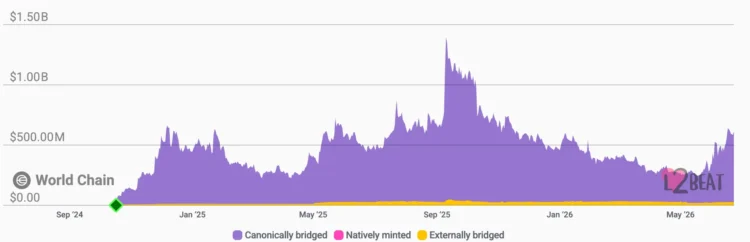
Analyzing capital inflows, the current growth spurt is predominantly driven by bridged Total Value Secured (TVS). According to L2BEAT data, World Chain’s TVS has exceeded $610 million, marking an impressive 122.6% increase over the past 30 days. Standard cross-chain bridge assets account for the lion’s share, contributing approximately $557 million, a quarterly rise of 118.4%, making them the primary engine of recent capital expansion.
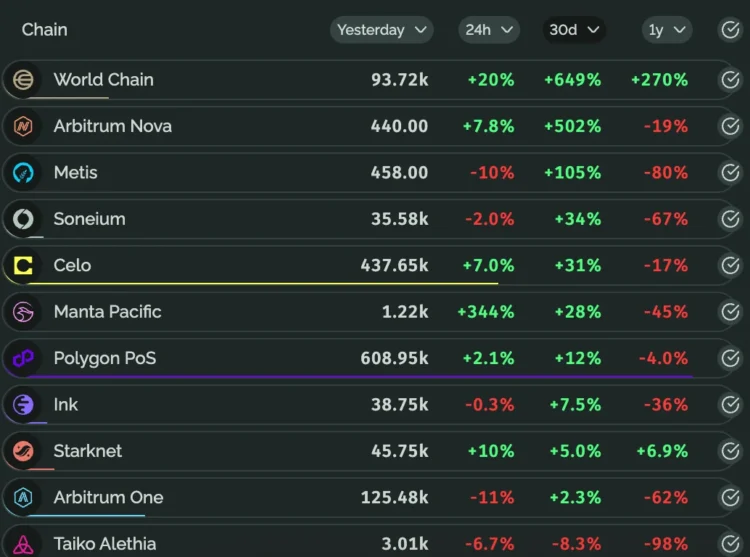
Accompanying this influx of capital is a remarkable increase in on-chain user engagement. GrowThePie data indicates that World Chain’s active daily addresses skyrocketed by 649% in the last 30 days. In contrast, established L2s such as Polygon, Base, Arbitrum One, and Celo recorded limited or even negative growth during the same period.
However, this surge in activity has not yet translated into a large-scale expansion of World Chain’s native ecosystem. Unlike Base, which benefits from Coinbase’s vast user base, or Arbitrum, with its mature DeFi ecosystem, World Chain remains in the early stages of ecosystem development. It has yet to cultivate native protocols that exhibit significant network effects or high-frequency use cases.
DeFiLlama data as of June 22 shows World Chain’s Total Value Locked (TVL) at only approximately $40.42 million, a scale that pales in comparison to other leading L2s. While it has nearly doubled in the past 30 days, this incremental liquidity is predominantly concentrated in Morpho Blue-related vault configurations, with this single protocol accounting for about 93% of World Chain’s TVL.
This suggests that a substantial portion of bridged capital currently functions as static assets, not yet effectively deployed in DeFi lending, DEX trading, or complex application interactions. Consequently, the depth of on-chain capital utilization and its conversion efficiency into dynamic economic activity remain constrained.
World Chain: A Blob Consumption Powerhouse
Despite the limited external applications, World Chain’s unique position as a purpose-built L2 for Worldcoin, coupled with the activity of tens of millions of real users, means that large-scale internal transactions are consistently driving up its Blob consumption, establishing it as a high-frequency L2.
Blobs are crucial for Layer 2 Rollups, enabling them to publish transaction data to the Ethereum mainnet at exceptionally low costs, thereby ensuring data availability. Since Ethereum’s Dencun upgrade in March 2024, the mainnet has processed over 19.53 million Blobs. Among the numerous Layer 2 solutions, World Chain has rapidly ascended to become the second-largest Blob consumer, a robust performance that even surpasses many established L2s like Arbitrum.
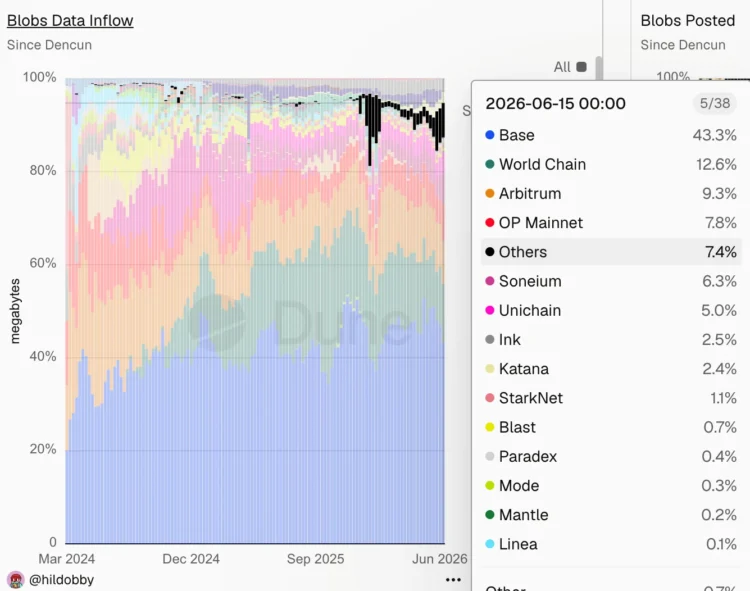
According to the latest statistics from Dune Analytics, since its operational launch, World Chain has cumulatively submitted over 2.63 million Blobs to Ethereum, consistently ranking among the network’s leaders, second only to Base. Over the past 24 hours, it has averaged 106 Blob submissions per hour, equating to approximately 13.3MB of data written to Ethereum hourly, with a Blob fill rate as high as 99%. This demonstrates a leading edge in data packaging efficiency compared to most L2s.
World Chain also exhibits strong competitiveness in terms of cost and operational efficiency. Over the last three days, its Data Availability (DA) fees amounted to approximately $304, with historical cumulative fees exceeding $2 million. This is notably more efficient compared to established L2s like Base (cumulative approximately $6.45 million) and Arbitrum (cumulative approximately $3.51 million). Furthermore, it submits a batch to Ethereum approximately every 3 minutes and 45 seconds, with each submission transaction typically containing 3 Blobs, underscoring a high frequency of on-chain interaction.
In terms of Blob data inflow, World Chain quickly joined the ranks of top performers shortly after its inception and has maintained a leading position. As of June 15, its Blob data inflow constituted 12.6% of the total network volume, second only to Base’s 43.3%, firmly securing its second-place standing. Mainstream L2s such as Arbitrum One, Soneium, OP Mainnet, and Unichain all trail behind.
While many L2s grapple with growth challenges, World Chain’s prominence in Blob consumption is not merely a result of the cost and throughput advantages offered by its underlying OP Stack architecture, which allows it to efficiently handle on-chain activity. More critically, the migration of tens of millions of real World ID users to its dedicated chain has generated a continuous demand for high-frequency transactions. Driven by scenarios like identity verification, subsidized Gas, and reward claims, World Chain sustains robust data demand and Blob consumption even in the absence of a fully mature ecosystem.
From High-Frequency L2 to Sustainable Ecosystem
However, the long-term success of an L2 is ultimately determined not by short-term capital inflows or speculative fervor, but by its capacity for sustainable economic activity. World Chain’s ultimate goal must be to effectively convert its externally bridged assets into genuine on-chain liquidity and a self-sustaining ecosystem. Only then can it truly evolve from a high-frequency L2 into a mature network with intrinsic economic vitality.
(The above content is an authorized excerpt and reprint from our partner PANews. Original Article Link)
Disclaimer: This article is intended solely to provide market information. All content and views are for reference only and do not constitute investment advice. They do not represent the opinions or positions of BlockBeats. Investors should make their own decisions and conduct their own transactions. The author and BlockBeats will not bear any responsibility for direct or indirect losses resulting from investor transactions.