
By: Nancy, PANews
As global AI stocks finally emerge from a period of intense volatility to stage a long-awaited collective rebound, a dramatic turn of events has unfolded on Wall Street. Leopold Aschenbrenner, once hailed as the “AI Stock Whisperer,” has reportedly stumbled just before the dawn.
Recent international reports indicate that Aschenbrenner’s hedge fund, Situational Awareness, suffered catastrophic losses during the sharp correction in AI equities. Consequently, a significant portion of its stock portfolio has been acquired by Citadel, the investment behemoth led by Ken Griffin.
In a high-stakes game of leveraged capital, this rising star investor’s journey on Wall Street has been abruptly cut short, just two years after launching his fund. His perceived cognitive edge, extensive network, and even the tailwinds of the AI era ultimately proved insufficient to withstand the relentless forces of deleveraging and a liquidity crunch.
Fallen Before the Rebound: Citadel Acquires Billions in Distressed Assets
The narrative persists, but the positions are gone. On July 30th, the Financial Times reported that Leopold Aschenbrenner’s hedge fund, Situational Awareness, was urgently seeking additional capital from investors. This move came after the fund incurred substantial losses from a significant pullback in AI-related stocks. Concurrently, it offered some investors the option to purchase assets directly from its portfolio.
In a letter dated July 24th to his investors, Aschenbrenner acknowledged that the fund “was not spared” from recent market turbulence, particularly impacted by a downturn in Asian technology stocks. Paradoxically, he contended that this correction presented the most compelling investment opportunities since early 2025, encouraging investors to inject further capital by August 1st.
“If you’ve been waiting for the right moment to increase your position, this might be it,” he wrote, attempting to rally support.
However, the market refused to follow his script. That week, AI stocks continued their precipitous decline.
The Wall Street Journal, citing sources familiar with the matter, reported that Situational Awareness engaged in urgent negotiations with several major institutions. Prominent multi-strategy funds, including Millennium, reportedly participated in the bidding, while major brokers like Goldman Sachs and JPMorgan coordinated the asset sale.
Ultimately, on July 30th, news broke that Ken Griffin’s investment firm, Citadel, had finalized a deal to acquire the majority of Situational Awareness’s listed stock holdings. This transaction, reportedly involving approximately $16 billion in public equity assets, stands as one of Wall Street’s largest emergency asset sales in recent years.
Just months prior, Situational Awareness was celebrated as one of Wall Street’s most promising AI-focused hedge funds. In under two years, with a lean team of only eight members, its assets under management (AUM) surged from an initial $5.5 billion to over $45 billion. By the end of June this year, the fund had boasted an astonishing net return of 439% for the first half.
Leopold Aschenbrenner, thrust into the spotlight, was widely regarded as the new generation of investment stars in the AI era. His viral 165-page AI prediction paper, “Situational Awareness,” combined with his “boy genius” persona, dramatic dismissal from OpenAI, elite network, and stellar fund returns, made the then 25-year-old a coveted figure. Both institutional and retail investors on Wall Street eagerly “copied his homework,” meticulously scrutinizing his holdings.
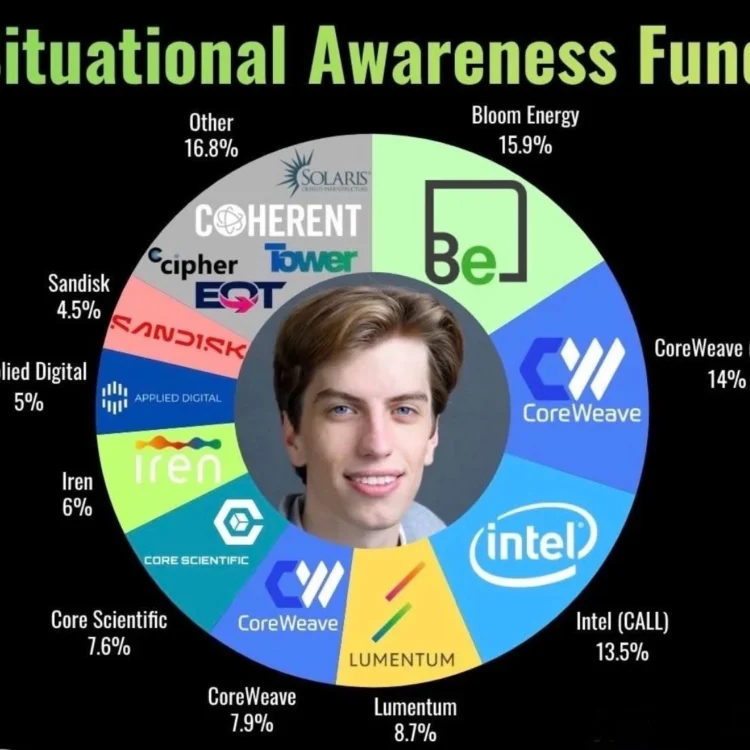
Yet, “Mr. Market” ultimately delivered a harsh lesson to this AI investment prodigy. Despite the current violent rebound in AI stocks, Aschenbrenner, one of the most fervent evangelists of the AI narrative, became a tragic casualty of the preceding downturn. Situational Awareness’s asset base has now plummeted to approximately $10 billion.
Nevertheless, Aschenbrenner has not entirely exited the arena. His fund continues to operate, retaining substantial private assets, including an estimated $5 billion stake in Anthropic, alongside some public market positions.
Adding another layer of intrigue, Aschenbrenner’s fiancée, Avital Balwit, whom he was set to marry this weekend, serves as Chief of Staff to Anthropic CEO Dario Amodei. This connection has led observers to speculate whether this young investor might leverage such ties for a potential comeback.
The Fall of an AI Star: Speculation Mounts as Citadel Enters the Fray of Leveraged AI Bets
When a young, high-profile AI-focused hedge fund, once a darling of retail investors, crumbles and offloads a substantial portion of its holdings to a seasoned Wall Street player, speculation naturally swirls. The other protagonist in this unfolding drama, Citadel Securities, often dubbed a “vulture” by market observers, quickly became a focal point of discussion.
On one hand, Citadel’s long-standing proficiency in acquiring assets from forced sellers is a hallmark of its operational style. When other hedge funds or institutions face immense losses, margin calls, or liquidity crises, forcing emergency divestments, Citadel frequently steps in swiftly. It acquires vast quantities of assets at discounted prices, capitalizing on distress.
Historical precedents abound. In 2006, Citadel acquired energy portfolios from Amaranth Advisors after it suffered massive losses in natural gas trading. In 2007, facing margin pressure and a liquidity crunch, Sowood Capital sold nearly its entire credit portfolio to Citadel at a significant discount. The same year, Citadel provided financial support to a struggling E*Trade, taking over some of its problematic assets. This pattern has now recurred with Situational Awareness, with a significant market rebound occurring shortly after Citadel’s discounted acquisition.
Citadel operates like a patient hunter, waiting for its prey to appear. What has particularly fueled market debate is the suggestion that Citadel Securities, an affiliated entity, might have played a “covert” role, indirectly accelerating market instability.
Just before the Federal Reserve’s interest rate decision this past Wednesday, Frank Flight, Citadel’s head of macro strategy, issued a report. He posited that the new Fed Chair, Kevin Warsh, would be inclined to bolster inflation-fighting credibility and reassert central bank independence by implementing an unexpected rate hike, moving away from past over-reliance on “forward guidance.” In a sensitive period marked by extreme volatility in AI-related stocks and pressure on leveraged funds, this prediction of a “surprise hike” was perceived by some market participants as an additional catalyst for panic. The Fed, however, ultimately maintained stable interest rates.
Ultimately, Leopold Aschenbrenner’s downfall was precipitated by highly concentrated sector bets, with risks amplified by approximately 4x leverage. Over the past two years, Situational Awareness had committed virtually all its capital to the AI industry supply chain. During an upward cycle, leverage acted as an accelerator, driving astonishing returns and forging Aschenbrenner’s “AI Stock Whisperer” reputation. But as the market turned, that same leverage transformed into a fatal weapon. The fund’s heavy positions in AI data centers, power, storage, and GPU cloud-related assets experienced significant declines during the AI downturn. This sharp portfolio drawdown quickly triggered margin calls, culminating in the urgent liquidation of most of its positions. To compound matters, Leopold’s fund also held short positions in software stocks perceived to be negatively impacted by AI; ironically, these stocks rallied as AI stocks fell, effectively hitting the fund from both sides.
In a sense, Citadel’s emergency intervention also mitigated potential cascading sell-off risks in the broader market. By rapidly acquiring a large block of distressed positions at a discount, it prevented forced sellers from further depressing prices amid liquidity dry-ups, thereby somewhat cushioning wider panic and market impact.
The truth is, the risk wasn’t confined solely to Situational Awareness. A recent Goldman Sachs report to clients highlighted that the cumulative increase in hedge fund gross leverage during the first five months of this year represented the largest expansion since the bank began tracking this data in 2016. The reversal in AI sentiment has triggered leverage alarms, with the Financial Times recently revealing that several banks have demanded additional collateral from funds with highly concentrated sector holdings.
Ironically, in a 2024 interview, Aschenbrenner himself stated that avoiding collapse was his first and second priority. He emphasized that betting on AGI not only required correctly identifying the big direction but also the ability to withstand the impact of short-term individual missteps, along with precise timing and sequencing of bets. Yet, transitioning from a 439% year-to-date profit to a multi-billion dollar asset liquidation took him merely about a month.
This epic defeat is perhaps the most brutal lesson Leopold Aschenbrenner has paid for. He foresaw the future of AI but underestimated the raw power of market volatility. Those who truly navigate market cycles successfully rely not just on foresight but crucially on stringent risk control, emotional discipline, and the ability to survive extreme market conditions. Dancing on the razor’s edge of leverage, even with the right direction, can still lead to a fatal misstep.
(The above content is an excerpt and reproduction authorized by partner PANews. Original Link)
Disclaimer: This article is for market information purposes only. All content and views are for reference only and do not constitute investment advice. They do not represent the views and positions of BlockTempo. Investors should make their own decisions and trades. The author and BlockTempo will not bear any responsibility for direct or indirect losses incurred by investors’ transactions.