The narrative of Bitcoin mining companies pivoting to artificial intelligence (AI) is no longer novel; in fact, it’s rapidly becoming an industry norm. Yet, as more miners flock to this burgeoning sector, Wall Street’s enthusiasm for the AI transformation story is beginning to wane, leading to a reduction in valuation premiums.
Blocksbridge Consulting recently highlighted a noticeable cooling in market response to AI/High-Performance Computing (HPC) infrastructure investments by mining firms. Even substantial AI hosting contracts are struggling to replicate the early market excitement they once generated. Data indicates that initial AI business announcements historically triggered significant stock price volatility, with an average absolute fluctuation of 24.1%. More recent similar announcements, however, have seen this average drop to approximately 10.2%.
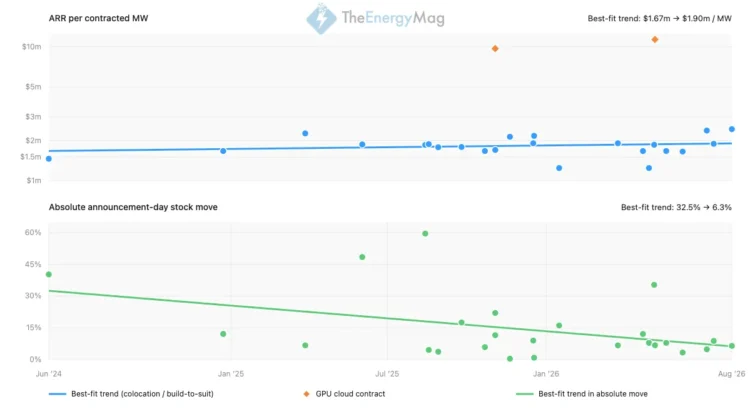
Despite this shift in market sentiment, the intrinsic commercial value of AI/HPC hosting services continues to climb. Annualized revenue from such leases has risen from an early average of about $1.67 million per megawatt to roughly $1.9 million.
This evolution signals that the market is moving beyond mere AI transformation slogans. Investors are now scrutinizing factors like tenant quality, project delivery capabilities, capital expenditure, and the tangible realization of future cash flows. For Bitcoin miners, the AI pivot has transitioned from a “storytelling” phase to a critical “business model validation” stage.
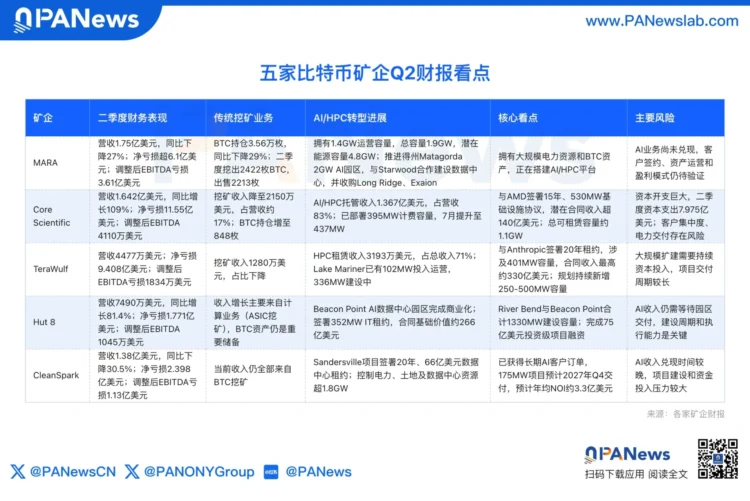
With Q2 financial reports now public, Bitcoin miners’ AI transformation efforts are facing renewed scrutiny. PANews analyzed the latest earnings from five leading Bitcoin mining companies, revealing diverse progress. Some firms remain in the construction phase, with AI operations yet to generate revenue. Others have successfully leveraged AI/HPC hosting to secure new income streams, even beginning to restructure their core businesses. Overall, many still grapple with declining revenue, widening losses, and substantial capital investment, indicating that the promise of AI-driven cash flow remains a future prospect rather than a present reality.
Secondary market performance reflects this increasingly rational investor outlook. Over the past month, most Bitcoin mining company stocks have experienced corrections, partly influenced by a broader downturn in the global AI sector. Even significant AI/HPC lease announcements or operational advancements have met with a relatively muted market response.
MARA: Expanding Losses, AI Revenue Yet to Materialize
Over the past month, Marathon Digital Holdings (MARA) shares have declined approximately 11.6%, dropping about 5.25% on the day of its Q2 earnings release.
MARA’s latest quarterly report reveals that its traditional Bitcoin mining operations continue to face industry headwinds, leading to narrowing profit margins. Its significant investments in AI/HPC infrastructure are largely still in the developmental stage, with commercialization and revenue generation yet to be realized.
In Q2, MARA reported revenues of approximately $175 million, a 27% year-over-year decrease from $238.5 million in the same period last year. The company posted a net loss exceeding $610 million, a stark contrast to the $810 million profit reported in the prior year. Adjusted EBITDA also plummeted to a loss of $361 million, down from a $1.245 billion profit, primarily due to a $343 million digital asset impairment driven by Bitcoin price declines.
MARA’s financial report outlined a “three major infrastructure” strategy encompassing Bitcoin mining, power resources, and AI computing infrastructure.
Regarding mining, MARA held 35,577 BTC at the end of Q2, a 29% decrease from 49,951 BTC a year ago. The company mined 2,422 Bitcoins and sold 2,213 during the quarter at an average price of roughly $73,000. Its combined cash and BTC assets stand at approximately $2.5 billion.
For its AI/HPC transformation, MARA aims for 1.4 GW of operational capacity by June 2026, with current total capacity at 1.9 GW and potential energy capacity reaching 4.8 GW. A key element of this strategy is the Matagorda County, Texas project, planned for up to 2 GW of power capacity and designed as an AI/HPC computing campus, with construction projected to commence in 2027. MARA is also collaborating with Starwood on data center development and has acquired Long Ridge energy assets and French HPC operator Exaion (with projected annual revenues in the single-digit millions).
To support its energy infrastructure expansion, MARA established a new $100 million credit facility, collateralized by 18,750 BTC. This move enhances the liquidity and capital efficiency of its Bitcoin holdings, providing crucial funding for future infrastructure investments.
However, AI/HPC currently contributes almost no revenue to MARA. During the earnings call, MARA management acknowledged this, stating that the first half of the year focused on scaling and platform transformation. The second half will be dedicated to execution, including signing client agreements, bringing new assets online, and validating the platform’s profitability.
Core Scientific: AI Dominates Revenue, Resumes BTC Accumulation
Core Scientific’s stock saw a modest decline of approximately 3.04% over the past month, with a slight uptick of 0.05% on its Q2 earnings release day.
The latest quarterly report indicates a significant shift for Core Scientific: its traditional mining business now represents a much smaller portion of revenue, while its AI/HPC infrastructure has become the primary revenue driver, largely fulfilling its commercialization promise.
In Q2, Core Scientific reported revenues of approximately $164.2 million, a substantial 109% year-over-year increase. Despite a net loss of about $1.155 billion, the company achieved an adjusted EBITDA of approximately $41.1 million and a gross profit of $70 million, yielding a gross margin of about 43%.
Core Scientific is rapidly reducing its reliance on mining income. Q2 mining revenue fell to approximately $21.5 million, accounting for only about 17% of total revenue. Notably, the company’s Bitcoin holdings increased from 547 BTC at the end of Q1 to 848 BTC, adding 301 BTC in the quarter. This marks a reversal from previous periods where BTC was sold to fund AI/HPC transformation.
The surge in revenue was primarily fueled by the AI/HPC infrastructure segment. Q2 hosting revenue reached approximately $136.7 million, a dramatic increase from $10.6 million in the prior year, now representing about 83% of total revenue. The company has deployed roughly 395 megawatts of billing capacity, expanding to 437 megawatts by mid-July, translating to an annualized hosting revenue of approximately $635 million. Core Scientific also announced a 15-year infrastructure agreement with AMD, covering 530 MW across five data center campuses, with potential base contract revenue exceeding $14 billion. The company’s total leasable customer power capacity stands at approximately 1.1 gigawatts, with potential contract revenue exceeding $24 billion.
This transformation, however, comes with significant capital expenditure. The miner’s Q2 capital expenditure reached $797.5 million for data center construction and land acquisition, with net investment outflows exceeding $1.18 billion in the first half of the year. While the company secured funding through methods like issuing $3.3 billion in senior secured notes, this has increased its interest burden and significantly leveraged its balance sheet. Shareholder equity remains negative, and equity debt volatility persists. Furthermore, hosting revenue is highly concentrated among a few clients, making project progress, power acquisition, and supply chain stability critical to delivery timelines and revenue realization.
Core Scientific’s management, during the Q2 earnings call, asserted that the inflection point for transformation has passed. The company is now focused on efficiently delivering computing capacity, rigorously managing project timelines, and responsibly allocating capital to consistently create value for clients and shareholders.
TeraWulf: HPC Drives Revenue as Transformation Delivers Results
TeraWulf’s stock experienced an approximate 12.97% decline over the past month, falling about 4.29% on the day of its Q2 earnings release.
In Q2, TeraWulf’s traditional Bitcoin mining operations also saw reduced contributions due to industry cycles. However, its AI/HPC transformation has begun to yield tangible results, generating significant revenue.
TeraWulf’s Q2 report showed total quarterly revenues of approximately $44.77 million. Notably, Bitcoin mining revenue accounted for only about $12.8 million, while HPC leasing revenue reached approximately $31.93 million, comprising about 71% of total revenue. Net loss expanded to approximately $940.8 million, primarily driven by a $755.7 million loss from changes in the fair value of warrants. Adjusted EBITDA was a loss of $18.34 million. As of June 30, the company held approximately $3 billion in cash and restricted cash, indicating robust liquidity.
Operationally, the Lake Mariner data center campus is progressing well, with 102 MW of critical IT capacity operational by early July and another 336 MW under construction. Construction costs per MW of critical IT remain within the guided range of $8 million to $10 million. Following the delivery of CB-3, Google’s $600 million credit support for Fluidstack’s lease obligations became effective. TeraWulf is also pursuing an application for an additional 250 MW of power capacity. The Lake Hawkeye campus, spanning 183 acres, has a potential capacity of approximately 320 MW of critical IT load but is not expected to be operational before 2029.
Post-quarter, TeraWulf signed a 20-year data center lease with Anthropic for approximately 401 MW of critical IT capacity at its Justified campus in Kentucky. This agreement is projected to generate about $19 billion in revenue over the contract term, potentially reaching $33 billion if Anthropic exercises two five-year renewal options. Initial deliveries are anticipated in the latter half of 2027.
Additionally, TeraWulf sold a 50.1% stake in the Abernathy joint venture for approximately $530 million and acquired the Muskie Data Campus in Kentucky, securing a power service agreement for up to 1 GW. FERC has approved the acquisition of the Morgantown power station in Maryland, clearing regulatory hurdles for its Chesapeake Data Campus subsidiary, which can expand to 1 GW, with data center operations expected to commence around 2030. TeraWulf reiterated its annual goal of signing 250 to 500 MW of new critical IT capacity, prioritizing opportunities with stable power, clear customer demand, and scalable infrastructure.
TeraWulf CEO Paul Prager emphasized the company’s transition from platform construction to scaled execution, highlighting a replicable model centered on controlling power-advantaged infrastructure, securing long-term credit-backed customers, and phased capacity delivery.
Hut 8: Revenue Surges Amidst Losses, First AI Campus Commercialized
Hut 8’s stock declined approximately 6.3% over the past month, with a sharper drop of about 9.74% on its Q2 earnings release day.
In Q2, Hut 8 reported revenues of approximately $74.9 million, an impressive 81.4% year-over-year increase. The primary growth driver was its computing business, particularly ASIC mining, which contributed about $72.5 million. Digital infrastructure revenue stood at $1.3 million, and power revenue at $1.2 million. Despite strong top-line growth, the company recorded a net loss of approximately $177.1 million, largely due to $138.6 million in unrealized losses on digital assets. Adjusted EBITDA, however, rose by 149% year-over-year to $10.45 million.
On the commercialization front, Hut 8 successfully commercialized Beacon Point, its first gigawatt-scale AI data center campus. Post-quarter, it secured a second 352 MW IT lease, bringing the total value of its contract base period to approximately $26.6 billion, with an estimated average annual Net Operating Income (NOI) exceeding $1.75 billion, covering 949 MW of contracted IT capacity. Both the River Bend and Beacon Point campuses have a combined 1,330 MW of power capacity under construction, with initial data hall deliveries targeted for Q2 and Q3 2027, respectively. As of the end of Q2, Hut 8’s total development pipeline reached approximately 8,660 MW.
Financially, Hut 8 completed $7.5 billion in investment-grade project financing within the quarter, including $3.3 billion for the River Bend campus and $4.25 billion for Beacon Point’s first phase. These non-recourse and non-dilutive arrangements set a precedent for investment-grade construction financing for single-sponsor data center projects, providing robust capital for large-scale development.
Hut 8 CEO Asher Genoot emphasized that the company’s core mission has shifted from securing orders to project delivery. The focus is now on rapidly converting contracted capacity into operational assets and stable cash flow, thereby solidifying its transition from a mining company to an AI infrastructure provider.
CleanSpark: Mining Revenue Dips, $6.6 Billion Lease Shines
CleanSpark’s stock saw an approximate 2.16% gain over the past month, but fell about 5.56% on the day of its Q2 earnings release.
For its fiscal Q3 2024, CleanSpark reported revenues of $138 million, a 30.5% year-over-year decrease. The company posted a net loss of $239.8 million, a significant turnaround from a $257.4 million net profit in the prior year. Adjusted EBITDA also dramatically shifted from a $377.7 million profit to a $113 million loss.
As of June 30, CleanSpark held $202.6 million in cash and Bitcoin assets valued at approximately $814.9 million. Net long-term debt stood at $1.78 billion, with working capital at $761 million. While CleanSpark maintains strong asset reserves and financing capabilities, its ongoing expansion of data center and computing power infrastructure demands substantial capital investment.
Crucially, all of CleanSpark’s revenue this quarter was derived from Bitcoin mining operations; AI/HPC-related businesses have not yet contributed any substantial income.
However, the quarter’s most significant highlight was the signing of a 20-year, $6.6 billion data center lease agreement for CleanSpark’s Sandersville project with an undisclosed global technology company. CleanSpark disclosed that this project involves high-specification data center construction, with costs estimated at $10 million to $12 million per MW. The 175 MW capacity translates to a total investment of approximately $1.75 billion to $2.1 billion, projected to generate an average annual Net Operating Income (NOI) of about $330 million. Revenue realization, however, is contingent on construction completion, with deliveries expected to commence as early as Q4 2027. CleanSpark confirmed that the necessary equity funding for the project is secured, and procurement and prepayment arrangements for critical long-lead equipment are finalized, ensuring adherence to the planned operational timeline.
Compared to some mining companies still largely articulating their AI vision, CleanSpark benefits from an established foundation of scaled power resources, land reserves, and data center operational expertise. The company currently controls over 1.8 GW of power, land, and data center assets across the United States.
The latest financial results from these mining companies underscore a pivotal moment in their AI transformation journey. For investors, the focus has shifted from grand AI narratives to concrete operational metrics. For Bitcoin miners, possessing power, land, and computing resources merely provides an entry ticket; ultimate valuation reassessment will hinge on project delivery capabilities, client quality, and the demonstrable realization of future cash flows.