
SBF’s Appeal Denied: 25-Year Sentence and $11 Billion Forfeiture Officially Upheld
New York, NY – In a decisive blow to FTX founder Sam Bankman-Fried (SBF), the U.S. Second Circuit Court of Appeals has officially issued its mandate, cementing the rejection of his appeal against his criminal conviction and 25-year prison sentence. This critical development, announced on August 4, formally enacts the court’s June decision and returns jurisdiction to the U.S. District Court for the Southern District of New York, signaling a significant step towards the finality of his legal battle.
Second Circuit Mandate Solidifies Original Verdict
The issuance of the mandate means that the Second Circuit’s prior ruling, which unanimously upheld SBF’s original conviction and sentence, is now fully effective. SBF was found guilty by a jury in November 2023 on seven counts of fraud and conspiracy, stemming from the illicit diversion of FTX customer funds to his affiliated trading firm, Alameda Research.
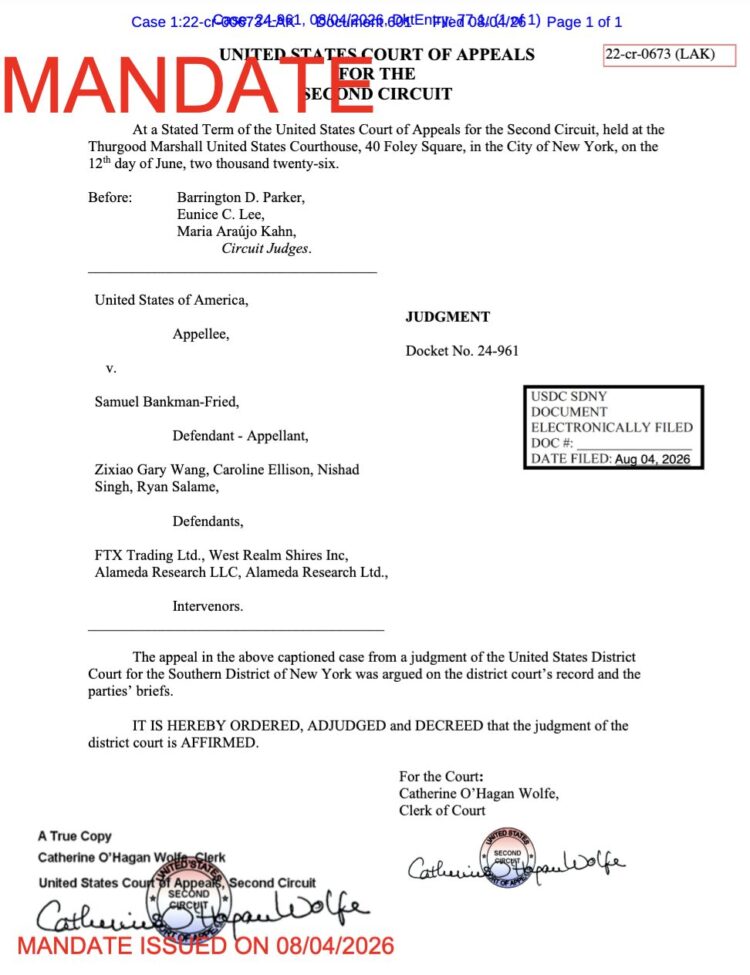
U.S. District Judge Lewis Kaplan had sentenced SBF in March 2024 to a substantial 25-year prison term, followed by three years of supervised release. Additionally, a staggering forfeiture order of approximately $11 billion in assets was imposed. The three-judge panel of the Second Circuit had previously affirmed this judgment in June, and the latest mandate serves as the formal execution of that ruling.
SBF’s Defense Regarding FTX Repayment Unequivocally Rejected
A central pillar of SBF’s appeal hinged on the argument that the trial court had improperly restricted the defense from presenting evidence suggesting FTX possessed sufficient assets, potentially allowing customers to be fully repaid. His legal team contended that subsequent asset recovery efforts indicated customer losses might not be permanent, a factor they believed could have swayed the jury’s perception of fraudulent intent.
However, the Second Circuit Court of Appeals unequivocally rejected this line of reasoning. The court maintained that the act of fraud was complete the moment customer funds were illicitly transferred to Alameda without authorization. SBF’s personal belief that he might be able to return the funds at a later date did not alter the fundamental legal nature of the misappropriated assets. The appellate panel further concluded that the trial court committed no errors in evidence admission or jury instructions that would warrant overturning the conviction.
$11 Billion Forfeiture Order Stands, All 7 Felony Convictions Affirmed
Beyond the prison sentence, the appellate court also upheld the substantial $11 billion forfeiture order. SBF’s original conviction encompassed a total of seven serious felony counts: two counts of wire fraud, two counts of conspiracy to commit wire fraud, conspiracy to commit securities fraud, conspiracy to commit commodities fraud, and conspiracy to commit money laundering. All these convictions have been fully affirmed.
The U.S. Department of Justice had previously highlighted the immense scale of SBF’s illicit activities, accusing him of misappropriating billions in FTX customer funds, defrauding FTX investors of over $1.7 billion, and misleading Alameda lenders to the tune of more than $1.3 billion. The collapse of FTX in 2022, triggered by a liquidity crisis and subsequent bankruptcy filing, exposed the intricate web of financial mismanagement and corporate governance failures, marking it as one of the most significant cryptocurrency criminal cases in U.S. history.
Path to Justice: General Appeal Concludes, Supreme Court Review Remains a Long Shot
With the Second Circuit Court of Appeals’ official mandate now issued, SBF’s standard appellate process within that court has reached its conclusion. Both his 25-year prison sentence and the $11 billion forfeiture order remain firmly in place. While this marks the end of one chapter, SBF still retains the option to petition the U.S. Supreme Court for a writ of Certiorari, requesting a review of his case. However, such petitions are rarely granted, making this a challenging, albeit available, judicial recourse.
Another potential, yet highly improbable, avenue would be to seek presidential pardon or commutation. Notably, former President Trump stated in January that he had no plans to pardon SBF. Furthermore, in July, the U.S. Senate unanimously passed a non-binding resolution explicitly opposing any form of pardon, commutation, or clemency for SBF. As federal appellate procedures conclude, any future alteration to SBF’s current sentence would necessitate either a higher-tier judicial intervention or an executive act of clemency, both of which appear increasingly unlikely given the circumstances.




