Author: Nancy, PANews
Fomo’s Unstoppable Rise: How a Social Trading Platform Became a Bear Market Powerhouse
In a crypto bear market where many projects struggle for survival and growth, a select few manage to defy the odds. Fomo stands out as one of these rare success stories, rapidly ascending to become a top-tier “crypto cash machine.”
With a lean team of just 17 individuals, Fomo has, in little over a year, amassed $94 million in funding. More impressively, it has transformed a social trading product into a pivotal on-chain trading gateway, even prompting established players like Pump.fun to actively compete for its users. In the absence of a bull market’s tailwinds, how did Fomo achieve such profound product-market fit (PMF), and what strategies propelled its remarkable counter-cyclical growth?
Soaring Transaction Volume: Fomo Emerges as a Leading On-Chain Powerhouse
While many in the crypto space are hunkering down for a prolonged “winter,” Fomo has rapidly accelerated, positioning itself as one of the few platforms consistently generating substantial trading revenue. It has effectively transitioned from a niche tool to a significant on-chain trading hub.
According to Dune Analytics, as of August 12th, Fomo has facilitated approximately 28.64 million cumulative transactions, with a total trading volume exceeding $4.69 billion. This impressive activity has generated over $31.79 million in cumulative transaction fees.
Fomo’s growth trajectory reveals a pivotal inflection point towards the end of Q2 2026, with an explosive surge occurring within a matter of weeks. Previously, its weekly trading volume typically ranged from several million to tens of millions of dollars. However, by July of this year, volumes began to expand dramatically, quickly reaching hundreds of millions. In the latest recorded trading week, Fomo’s weekly volume surpassed $550 million, setting a new all-time high.
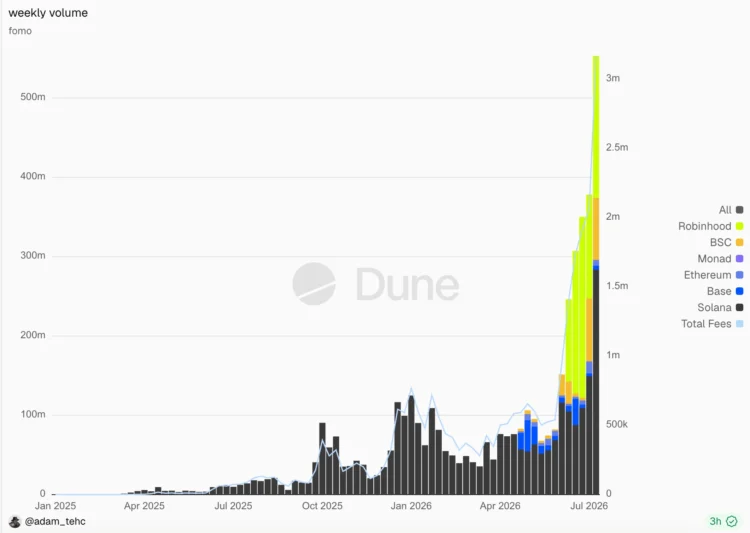
This remarkable growth isn’t attributable to activity on a single blockchain. Prior to May 2026, Solana accounted for nearly all of Fomo’s trading volume. Subsequently, Fomo expanded its operations to networks like Base, BNB Chain, and Ethereum. While these chains contributed to overall volume, their incremental impact was relatively modest compared to the next major catalyst.
The true driver behind Fomo’s explosive growth was the launch of the Robinhood Chain mainnet. A massive influx of new trading liquidity swiftly flowed into Fomo, propelling the platform’s trading volume to unprecedented levels. “On Robinhood Chain, one out of every two active wallets is from Fomo,” revealed Se Yong Park, co-founder of Fomo. In the most recent week, Robinhood Chain contributed approximately 32.4% of Fomo’s total trading volume, a figure that at one point peaked at 64.8%.
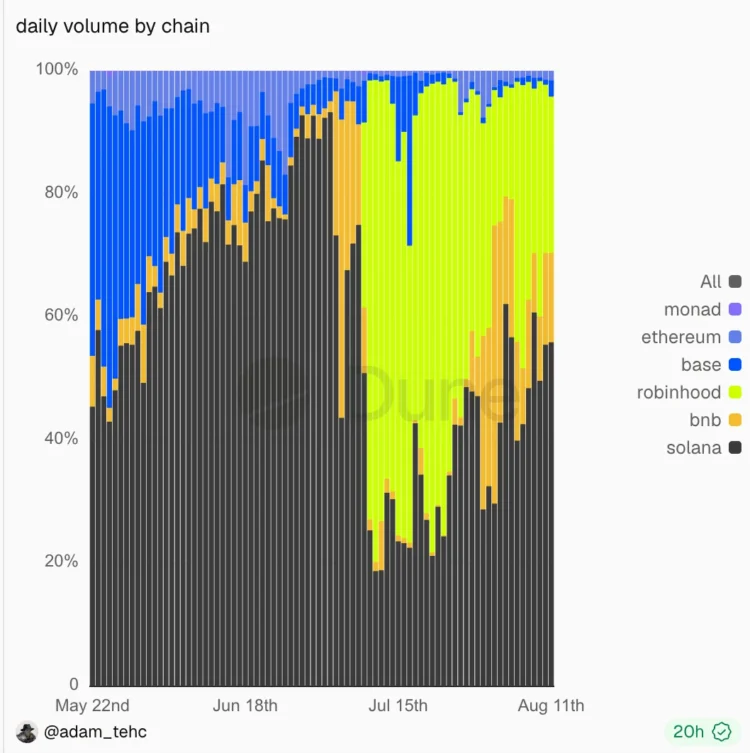
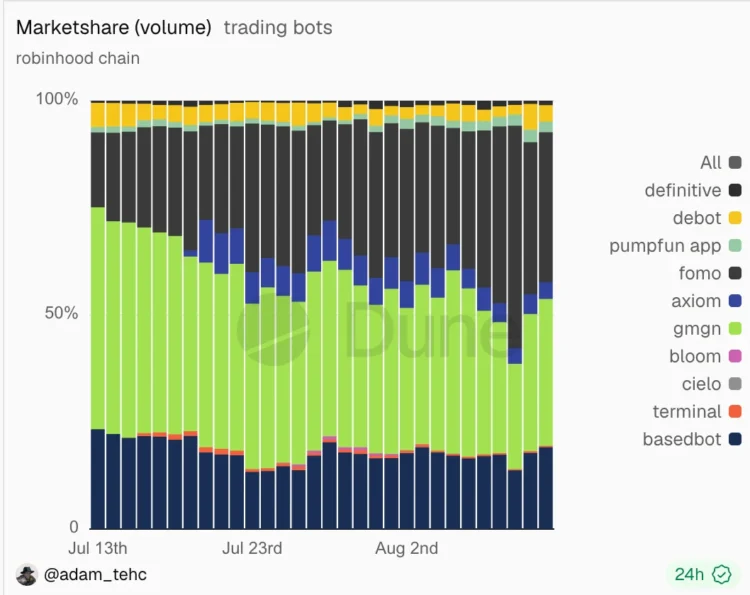
Even more compelling is Fomo’s dominant position within the Robinhood Chain ecosystem. Dune data from August 11th shows Fomo accounting for 35% of the trading volume across all trading bots on Robinhood Chain. Furthermore, it boasts the highest number of daily active wallets, representing over 92.9% of Robinhood Chain’s total. This illustrates a symbiotic relationship: Robinhood Chain provided Fomo with a fresh wave of users, and Fomo, in turn, rapidly became the core trading gateway for this nascent blockchain.
Interestingly, Solana has recently re-emerged as Fomo’s largest traffic source, contributing approximately 51.2% of the latest trading volume. Within the Solana ecosystem, Fomo has also grown into a formidable competitor to Pump.fun, the largest meme coin launchpad. Recent reports even suggest direct “trade wars” between the two, with Pump.fun allegedly attempting to poach Fomo users with lucrative offers and secure exclusive traffic agreements, while also rolling out social trading features similar to Fomo’s. This rivalry underscores Fomo’s evolution beyond a mere trading tool into a highly competitive on-chain trading portal.
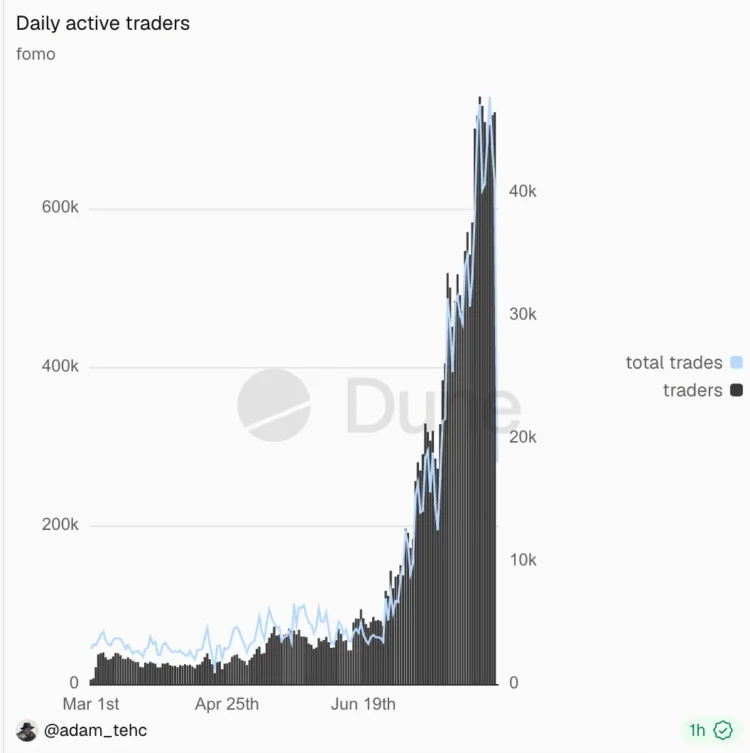
Beyond trading volume, Fomo’s user acquisition has been equally impressive, with the number of weekly traders increasing tenfold over the past few months. Before July of this year, Fomo’s daily active traders hovered in the low thousands, showing relatively slow growth. However, with the launch of the Robinhood Chain mainnet, user activity surged dramatically, with daily active traders quickly climbing into the tens of thousands, peaking at nearly 48,000 on a single day.
This surge in on-chain activity naturally led to a corresponding increase in Fomo’s total transaction fees. Prior to Q2 2026, Fomo’s weekly fees typically ranged from tens of thousands to hundreds of thousands of dollars. As trading volume rapidly expanded in July, fee revenue quickly jumped into the millions, reaching approximately $3.17 million in the latest trading week. Recently, Fomo even broke into the Top 10 protocols by revenue across the entire crypto space, surpassing established names like Hyperliquid, Axiom Pro, and Pump.fun.
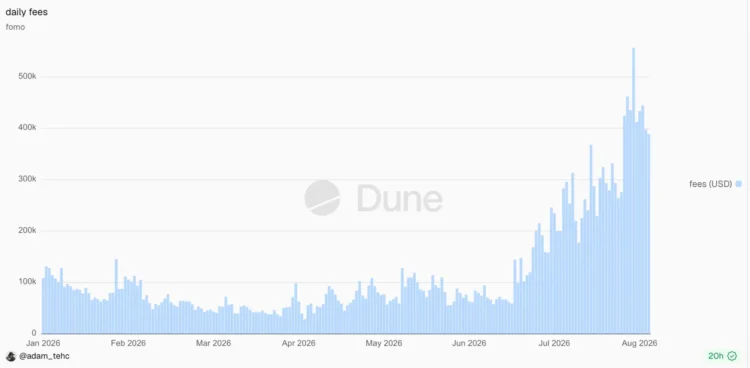
In essence, Fomo’s exponential data growth can be attributed to two key factors: successfully capitalizing on the cold-start traffic from the Robinhood Chain mainnet launch, and effectively addressing the continuous high-frequency trading demands within Solana’s mature meme coin ecosystem.
Bear Market Validation: Fomo’s PMF and Counter-Cyclical Growth Pillars
In the unforgiving landscape of a bear market, robust data serves as the ultimate proof of a company’s genuine product-market fit. Fomo’s meteoric rise within just over a year, amidst a broader crypto downturn, is a testament to this. Not only has it secured significant funding and seen its valuation soar, but it has also charted an impressive growth curve in user acquisition and product expansion.
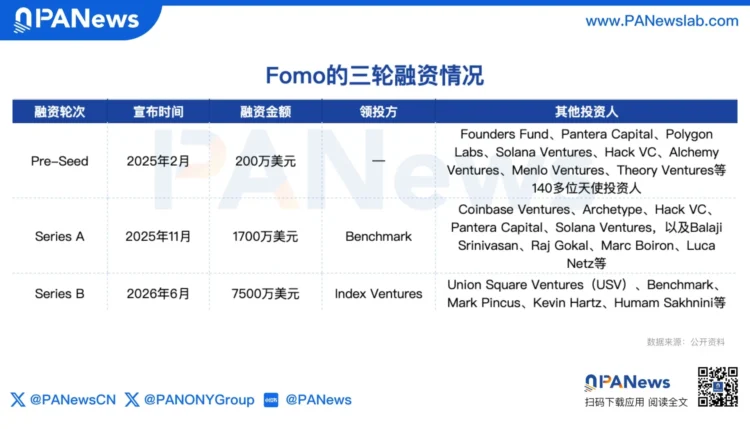
In June of this year, Fomo successfully closed a $75 million Series B funding round led by Index Ventures, with notable participation from Union Square Ventures (USV), Benchmark, Zynga co-founder Mark Pincus, Discord CEO Humam Sakhnini, and Eventbrite co-founder Kevin Hartz. This round propelled the company’s valuation to an impressive $550 million.
For a crypto consumer startup barely a year old, such a funding achievement is remarkable in itself. However, the more critical question is: how did Fomo manage to expand so aggressively during a bear market?
The Pillars of Fomo’s Success: Team, User Experience, and Community
Fomo’s counter-cyclical growth is first and foremost a credit to its highly efficient team, deeply familiar with trading products. The three co-founders — Paul Erlanger, Se Yong Park, and Prashan Dharmasena — all hail from dYdX, a pioneering perpetual DEX. Their collective experience provided them with an intimate understanding of on-chain trading products and prolonged observation of trader behavior, fostering complementary strengths in product development, growth, and engineering. Crucially, the team’s resource efficiency is exemplary; with only about 17 members, core founders initially worked without salaries for the first eight months, offering non-founding engineers a substantial 2% to 3% equity stake—an incentive typically reserved for founding teams. Before full product validation, Fomo avoided relying on massive capital outlays for growth, instead opting for a small, low-cost team and value-aligned incentive mechanisms to rapidly advance its product. This capital efficiency proved a significant advantage during its bear market inception.
Redefining On-Chain Trading: Simplicity and Accessibility
The true value of the dYdX experience for Fomo extends beyond mere pedigree; it lies in the co-founders’ real-world observation that while on-chain assets and trading opportunities were proliferating, the user experience remained stuck in the “crypto-native” era. Historically, engaging in on-chain trading required users to manage wallets, private keys, and seed phrases, navigate cross-chain bridges, contend with gas fees, and grapple with fragmented liquidity across multiple chains. For seasoned crypto users, these were merely tools to learn; for mainstream consumers, they represented insurmountable barriers to entry. Fomo ingeniously pivoted, choosing not to build a tool that forced users to learn more about blockchain. Instead, it deliberately concealed blockchain’s inherent complexities, making the trading experience akin to that of a familiar consumer application.
Users can register directly via Google or Apple ID, eliminating the need for seed phrases or gas fees. The platform also supports deposits via Apple Pay, debit cards, or cryptocurrencies, significantly lowering the entry barrier. Se Yong further explained in an interview that to prevent user unfamiliarity, the platform deliberately avoids using crypto assets like SOL or ETH as account denomination units, opting instead for a direct display of USD cash balances. “If an ordinary person sees $100 turn into $98.52 (due to underlying token price fluctuations), they might immediately assume the platform stole their money,” he remarked. In his view, once users doubt fund security, trust becomes incredibly difficult to rebuild.
This “de-cryptofied” product design has demonstrably attracted non-crypto native users. Data released in June 2026 revealed that over 68,000 users had completed their first crypto purchase via Apple Pay. Julia Andre, a partner at Index Ventures, openly stated that their investment in Fomo wasn’t primarily because it was a crypto company, but because “on-chain trading was simply too hard.” This insight perfectly encapsulates why Fomo has managed to carve out opportunities even in a bear market.
From Transactions to Social Engagement: Building a Viral Loop
While lowering transaction barriers addresses the “how to get in” problem, the real challenge for a consumer-grade product lies in user retention and encouraging active sharing. Fomo’s ingenious solution was to transform trading itself into engaging social content.
The team recognized that trading is fundamentally a social activity, yet existing communities and signal sources suffer from fragmented and inconsistent information quality. Se Yong revealed in a recent interview that Fomo’s core vision is to become the social graph of finance, necessitating a product that is seamless, social, and fun.
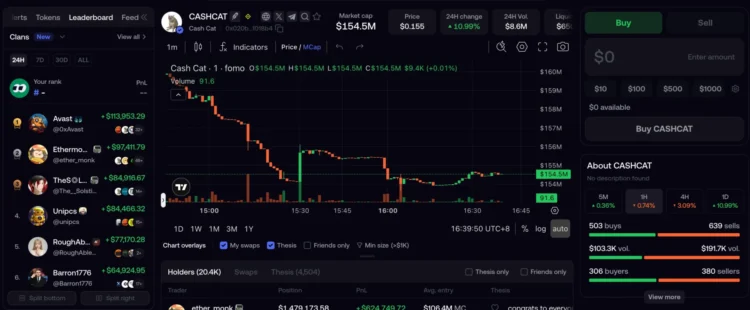
Fomo achieves this by converting the often-dry trading experience into scrollable, followable, and discussable social content. Features include real-time feeds displaying others’ buys, sells, and profit/loss, periodic leaderboards showcasing top traders, support for following users and receiving real-time notifications, transparent personal profiles detailing holdings and history, and chart overlays showing buy/sell points with underlying trade logic. When trading itself becomes viral content, it naturally cultivates FOMO (Fear Of Missing Out) and a desire to share, providing a lower-cost acquisition channel for new users, especially beginners.
Strategic Cold Start: Leveraging Community as a Distribution Network
The most formidable hurdle for consumer products is often the “cold start” problem. Fomo understood that relying solely on advertising or traditional channels for user acquisition could be prohibitively expensive for a product yet to establish network effects. Consequently, it ingeniously integrated community funding into its cold-start strategy. Paul Erlanger explicitly stated the team’s goal: to “solve the cold start problem and create distribution channels” through fundraising.
For its seed round, Fomo curated a “dream investor list” of approximately 200 individuals. Leveraging their dYdX network, they ultimately secured participation from over 140 angel investors, raising $2 million. These investors were more than just capital providers; they included top protocol founders and executives, renowned VCs, professional traders, market makers, and industry operators—effectively a latent user and distribution network for Fomo.
Fomo continued this strategy for its $17 million Series A round, with Benchmark as the sole institutional investor, and the remainder coming from existing and new angel investors. For consumer products requiring rapid network effect establishment, an investor who understands, uses, and actively promotes the product can often be more valuable than simply additional capital.
Furthermore, Fomo’s ability to thrive in a bear market has another pragmatic root: while the collective interest and trading appetite for most crypto assets cooled, meme coins maintained high activity and virality. These assets inherently rely on attention, social consensus, and immediate sentiment, making them a natural fit for Fomo’s social discovery model and opening up an independent growth avenue. However, Fomo’s ambition extends further, with its product already encompassing perpetual futures (Perps) and plans to expand into stocks, derivatives, prediction markets, and other asset classes.
The Road Ahead: Sustaining Momentum
While bull markets can inflate narratives, bear markets truly test a product’s substance. Fomo’s tangible, counter-cyclical growth unequivocally demonstrates that even without broad market tailwinds, genuinely lowering user barriers, enhancing the trading experience, and expanding trading scenarios still present ample opportunities for growth.
Of course, this growth wasn’t instantaneous. Following its initial funding round, Fomo endured several months of stagnation, with its user base struggling to surpass 140 individuals. Se Yong revealed that the turning point came from a dedicated group of early users who engaged with the product daily and provided continuous feedback, enabling the team to iterate relentlessly. This experience underscored the importance of prioritizing a small, dedicated early user base and diligently addressing their genuine needs, rather than prematurely chasing scale.
Nevertheless, whether this rapid growth can be sustained, and whether Fomo can successfully convert short-term traffic into long-term users and stable revenue, remains to be seen and will require ongoing validation over time.
(The above content is an authorized excerpt and reproduction from our partner PANews, original link)
Disclaimer: This article is for market information purposes only. All content and views are for reference only and do not constitute investment advice. They do not represent the views or positions of the author or the publisher. Investors should make their own decisions and trades. The author and the publisher will not be held responsible for any direct or indirect losses incurred by investors’ transactions.