
The Sandbox Rocked by Cross-Chain Bridge Exploit: Billions in Unbacked $SAND Minted
The metaverse and blockchain gaming giant, The Sandbox, recently confronted a critical security incident involving its cross-chain bridge. Attackers exploited a vulnerability in the $SAND cross-chain deployment on the Base and BNB Smart Chain networks, leading to the unauthorized minting of a staggering volume of $SAND tokens without corresponding underlying asset backing.
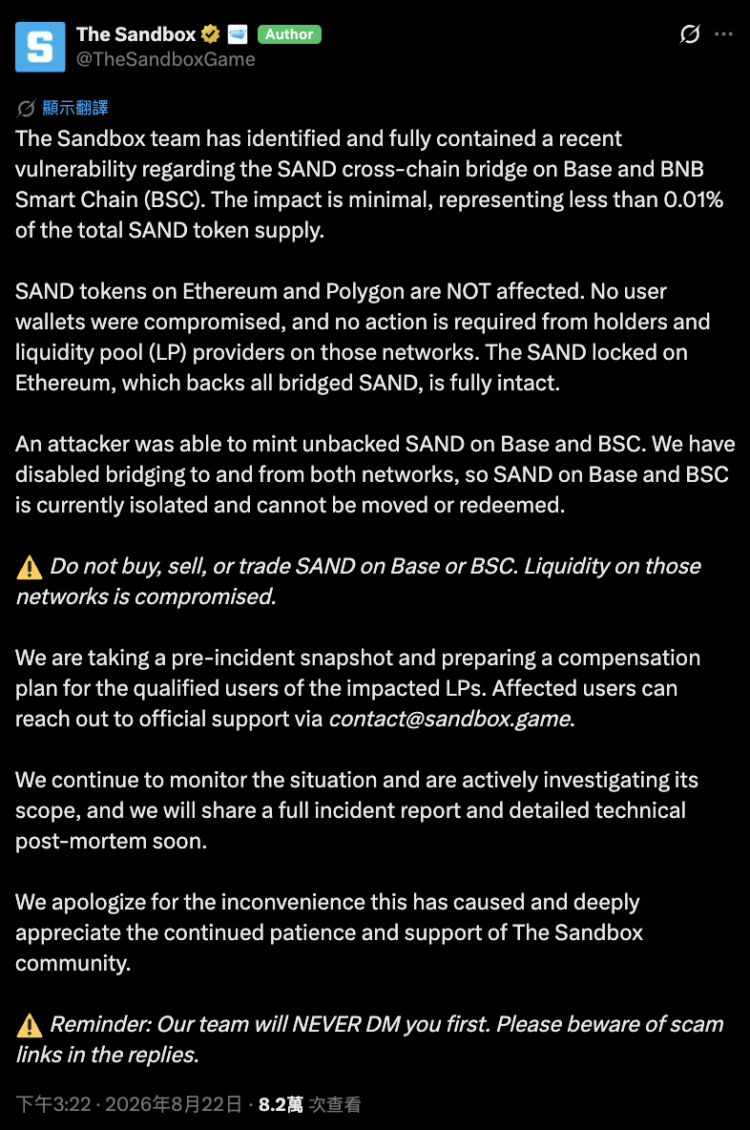
In a swift and decisive response, The Sandbox immediately disabled cross-chain functionalities on both affected networks, effectively isolating the illicitly minted tokens. The platform has reassured its community that $SAND tokens on the Ethereum and Polygon networks remain entirely unaffected by this breach.
Unpacking the Exploit: Hijacked LayerZero Delegate Authority
Blockchain security firm Blockaid shed light on the mechanics of the attack, indicating that the perpetrators likely leveraged the approveAndCall function to hijack LayerZero’s delegate authority. This granted them privileged operational control over the cross-chain contract, enabling them to mint tokens directly on other chains without the prerequisite of locking equivalent Ethereum $SAND.
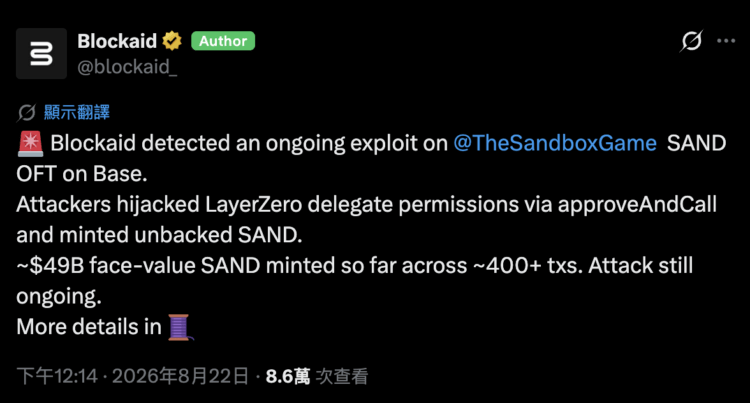
Initial on-chain monitoring quickly revealed over 500 million unbacked $SAND minted on Base. Subsequently, PeckShield identified two addresses holding approximately 14.9 billion $SAND. Blockaid’s real-time assessment during the ongoing attack estimated that the notional value of the unbacked $SAND generated across more than 400 transactions reached an astounding $49 billion based on prevailing market prices.
Distinguishing Notional Value from Actual Loss: A Crucial Clarification
It is imperative to understand that the reported tens of billions of dollars represent a notional value – the market price equivalent of the abnormally minted tokens. This figure does not directly equate to The Sandbox’s actual financial loss. While on-chain systems register the value of these newly created $SAND at market rates, the sheer volume far exceeds available market liquidity. Consequently, these unbacked tokens cannot be fully liquidated at their ‘normal’ price without collapsing the market.
On-chain researchers have traced approximately 14.75 million Ethereum-backed $SAND that flowed out from the cross-chain bridge Adapter during the incident. A portion of these tokens was reportedly sold, yielding around 80 Ethereum ($ETH), valued at approximately $675,000 at the time.
The Sandbox officially confirmed that the direct impact of the incident is minimal, representing less than 0.01% of $SAND’s total supply of 3 billion tokens. The team is currently awaiting a comprehensive technical report to reconcile discrepancies in various on-chain data points.
This clarification refutes earlier, imprecise reports suggesting a “$500 million heist.” The $500 million figure primarily referred to the initial discovery of over 500 million abnormally minted $SAND, not the actual asset loss, which remains subject to the official investigation.
The Sandbox’s Decisive Action: Halting Bridges and Safeguarding Assets
Upon detection of the anomaly, The Sandbox promptly deactivated bidirectional cross-chain functionalities for both Base and BNB Smart Chain. This crucial step prevents the transfer or exchange of the unbacked $SAND on these affected networks through official bridge mechanisms.
The official team has also issued a strong advisory, urging users to temporarily refrain from buying or selling $SAND on Base and BNB Smart Chain, and to avoid providing liquidity to associated pools.
The Sandbox reassured its community that the locked assets on Ethereum, which underpin cross-chain $SAND, remain fully intact. Furthermore, user wallets were not compromised, and $SAND on the Ethereum and Polygon networks were unaffected. The team has taken a snapshot of the blockchain state prior to the attack and is developing a compensation plan for eligible, affected liquidity providers, with a detailed timeline to be announced.
Major South Korean exchanges, Upbit and Bithumb, also reacted swiftly, imposing restrictions on $SAND deposits and withdrawals after detecting potential security concerns. They advised investors to exercise caution due to possible significant price volatility.
Market Reaction and Broader Implications for Cross-Chain Security
Following the disclosure of the incident, $SAND experienced a sharp intraday drop of nearly 10%. However, the price stabilized and recovered some ground after The Sandbox announced that the vulnerability had been contained. The successful isolation of the massive volume of unbacked tokens on the affected networks significantly mitigates the risk of them directly impacting the $SAND supply on the Ethereum mainnet.
This incident serves as a stark reminder of the critical importance of robust permission management within cross-chain bridge architectures. The LayerZero OFT (Omnichain Fungible Token) framework typically operates by locking tokens on the native chain and then minting an equivalent amount on the destination chain. However, as demonstrated, if crucial management permissions, such as delegate authority, fall into the wrong hands, the fundamental asset-backing relationship can be severely compromised.
The Sandbox is yet to release its full incident investigation report. Key details still pending include the definitive root cause of the vulnerability, the precise scale of actual asset losses, and the projected timeline for the restoration of cross-chain services on Base and BNB Smart Chain.
Disclaimer: This article provides market information for reference only. All content and opinions are for informational purposes and do not constitute investment advice. They do not represent the views or positions of the author or BlockCast. Investors should make their own decisions and trades. The author and BlockCast will not bear any responsibility for direct or indirect losses incurred by investors’ transactions.