
Stablecoins Soar: Crypto Card Spending Hits $759M, AI Agents Drive New Payment Frontier
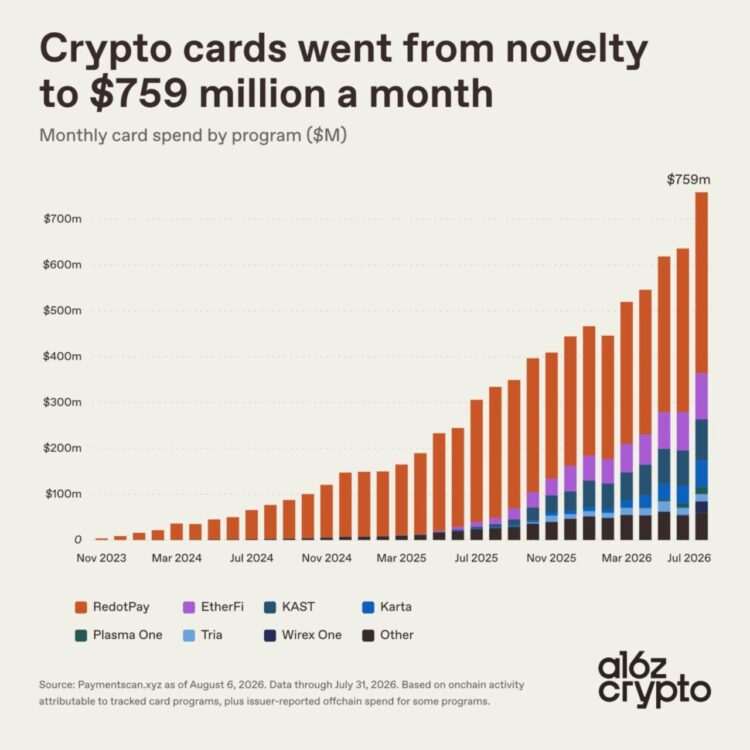
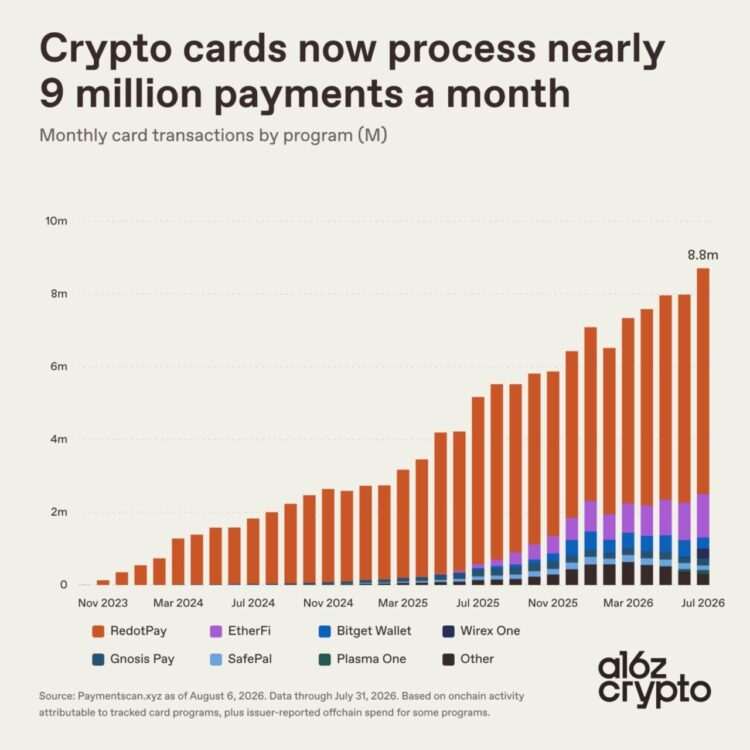
Stablecoins are rapidly evolving beyond mere on-chain transfers and asset storage, embedding themselves into the fabric of everyday consumer payments. Recent data from Paymentscan reveals a monumental shift: tracked crypto payment card spending surged to approximately $759 million in July, marking a more than threefold increase compared to the previous year. This period also saw transaction volumes surpass an impressive 10 million instances.
The Dominance of Stablecoins in Consumer Spending
Within this burgeoning market, US dollar-pegged stablecoins have emerged as the primary payment source. USDC accounted for approximately 50.8% of July’s spending, while USDT made up 20.3%, collectively representing over 70% of the total volume. This signifies a substantial increase from a year prior, when USDC and USDT held roughly 48% and 7% shares, respectively, underscoring their expanding dominance in the crypto card ecosystem.
The nature of these transactions is also evolving. What once primarily facilitated crypto asset liquidation is now increasingly catering to routine expenditures. Market insights from Brazil, for instance, show Oobit active users conducting an average of 20 transactions monthly, spending around $400, with groceries constituting about 35% of regional transaction activity. In Argentina, 72% of Oobit payments utilize USDT, and food-related purchases account for approximately 41% of transaction volume. Similarly, Binance’s crypto card in Brazil has seen a continuous rise in users, with ride-hailing, food delivery, groceries, restaurants, and online subscriptions becoming key usage scenarios.
Global Expansion: Visa’s Vision and Emerging Market Growth
The rapid expansion of stablecoin payments in daily life heavily relies on the existing infrastructure of credit and debit card networks. Crypto cards typically convert stablecoins or other digital assets into local fiat currency at the point of sale, allowing merchants to receive payments through their established networks without requiring new infrastructure.
In June, Visa announced that over 160 stablecoin-linked card programs are either operational or under development globally. StraitsX, a key partner assisting crypto companies in issuing payment cards, projects an astounding 40-fold growth in its related infrastructure transaction value from Q4 2024 to Q4 2025.
Emerging markets are at the forefront of this growth. StraitsX data indicates that from March 2025 to February 2026 (projected), the total crypto card transaction value in low-GDP markets is expected to surge by approximately 600%, significantly outpacing the 150% increase anticipated in high-GDP markets during the same period. Food and retail remain the most prominent spending categories in these regions.
Despite this growth, the market remains highly concentrated. Paymentscan’s July statistics show RedotPay with approximately $395 million in transaction volume, EtherFi at around $100 million, and KAST at $89.6 million. Combined, these three platforms account for approximately 77% of the tracked transaction volume. It’s worth noting that some data is self-reported, and a comprehensive understanding of the overall market size would benefit from broader payment platform data.
Beyond Human Wallets: AI Agents Embrace Stablecoin Payments
A new and exciting payment market for stablecoins is rapidly forming within the realm of AI Agents. These autonomous entities can perform tasks such as data retrieval, API calls, utilizing computing power, and purchasing digital services. Such operations often necessitate a high volume of extremely small, frequent machine-to-machine (M2M) payments.
Coinbase’s x402 protocol exemplifies this innovation. By leveraging the “402 Payment Required” standard in web protocols, x402 enables AI Agents to directly pay for services upon receiving a quote. Once payment is verified, the agent gains immediate access to data or services. This entire process is automated by software, eliminating the need for traditional account setups or manual credit card entries.
- Related News: What is the x402 protocol? Behind the x402 meme coin hype, you should understand the future payment revolution.
Coinbase reports that x402 has cumulatively processed over 165 million payments, totaling approximately $50 million.
Lincoln Murr, Coinbase’s Head of AI Products, estimates that roughly 99% of these payments utilize USDC. Based on available data, the average transaction value is approximately $0.3, with most uses concentrated on APIs, data, AI inference, computing resources, and online tools.
While x402’s current scale pales in comparison to traditional payment networks (e.g., x402 processed ~$24 million in 30 days in July, equivalent to Visa’s transaction volume in just one minute), this niche of machine-to-machine payments represents a significant new market where stablecoins offer a distinct advantage over traditional credit cards.
The Future of Digital Commerce: Stablecoins vs. Traditional Networks
The burgeoning demand for AI Agent payments has spurred both crypto and traditional financial players to strategically position themselves. Stablecoins, with their 24/7 operability, global transfer capabilities, and suitability for low-value payments, are particularly well-suited for micro-transactions like API calls and data purchases that may cost only a few cents. Traditional card payments typically involve a 2% to 4% merchant acquisition cost, coupled with fixed processing fees, making it challenging to establish a viable business model for transactions under $1.
- Circle is actively testing $USDC Nanopayments, a system designed to batch multiple small payments before on-chain settlement.
- Cloudflare has introduced Wallets and cloudflare.pay, empowering users to set budgets, approve merchants, and define single-transaction limits for their AI Agents.
- MoonPay’s PayBox further bridges the gap by connecting credit cards with crypto wallets, allowing AI Agents to flexibly use either the x402 or Visa network based on specific scenarios.
Traditional payment giants are also developing their own Agent payment architectures:
- Mastercard has launched Agent Pay for Machines, enabling users to pre-configure the types of goods, spending limits, and transaction scopes their Agents can engage in.
- Visa is collaborating with financial institutions to test AI Agents using existing credit and debit card networks for shopping and travel transactions.
Currently, these two payment models are carving out distinct application scenarios. Stablecoins are proving ideal for high-frequency, small-value transactions such as API calls, data acquisition, computing power, and AI inference. Conversely, credit card networks maintain an established advantage in larger consumer purchases, refunds, dispute resolution, and providing credit lines.
From humans using crypto cards for groceries, ride-hailing, and subscription services to AI Agents autonomously purchasing digital resources with USDC, the payment scope of stablecoins is continuously expanding, reaching deeper into both everyday consumer spending and the exciting new realm of machine commerce.
(The above content is an excerpt and reproduction authorized by our partner “Crypto City”.)
Disclaimer: This article provides market information only. All content and opinions are for reference only, do not constitute investment advice, and do not represent the views and positions of BlockTempo. Investors should make their own decisions and trades. The author and BlockTempo will not be liable for any direct or indirect losses incurred by investors’ transactions.