
Authored by: Kurumi, CryptoCity
Cleveland Fed Study Reveals Investor Expectations Outweigh Demographics in Crypto Adoption
A groundbreaking study by the Federal Reserve Bank of Cleveland sheds new light on the driving forces behind cryptocurrency investment. The research indicates that an investor’s subjective expectations about future returns and risks play a far more significant role in their crypto holding behavior than traditional demographic factors like age, income, or gender. This finding offers a compelling explanation for the crypto market’s inherent volatility, suggesting that vast differences in investor outlook and the self-reinforcing cycle of price surges fueling optimism contribute to its dynamic nature.
The comprehensive study, titled “Do You Even Crypto, Bro? Cryptocurrencies in Household Finance,” was co-authored by Michael Weber, Bernardo Candia, Olivier Coibion, and Yuriy Gorodnichenko. The research team meticulously analyzed cryptocurrency investment patterns among U.S. households through multiple large-scale surveys, each encompassing up to approximately 25,000 families.
While demographic disparities persist – individuals under 40 are approximately 13 percentage points more likely to hold crypto than those over 60, and men show a 4 percentage point higher likelihood than women, with wealthier households also exhibiting greater participation – these factors are ultimately overshadowed by the power of belief.
A Chasm of Belief: Crypto Holders Expect 22% Returns, Non-Holders Just 7%
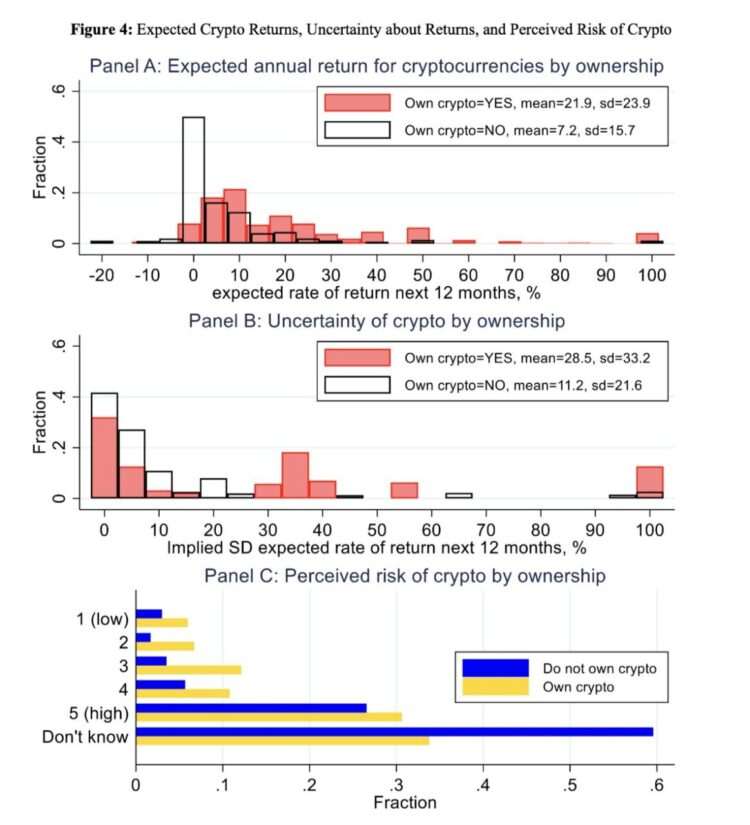
Far more influential than demographics are investors’ subjective “beliefs” regarding future crypto performance. The study revealed a striking 15-percentage-point disparity: among respondents willing to predict future returns, crypto holders anticipated an average annual return of 22%, whereas non-holders expected a mere 7%.
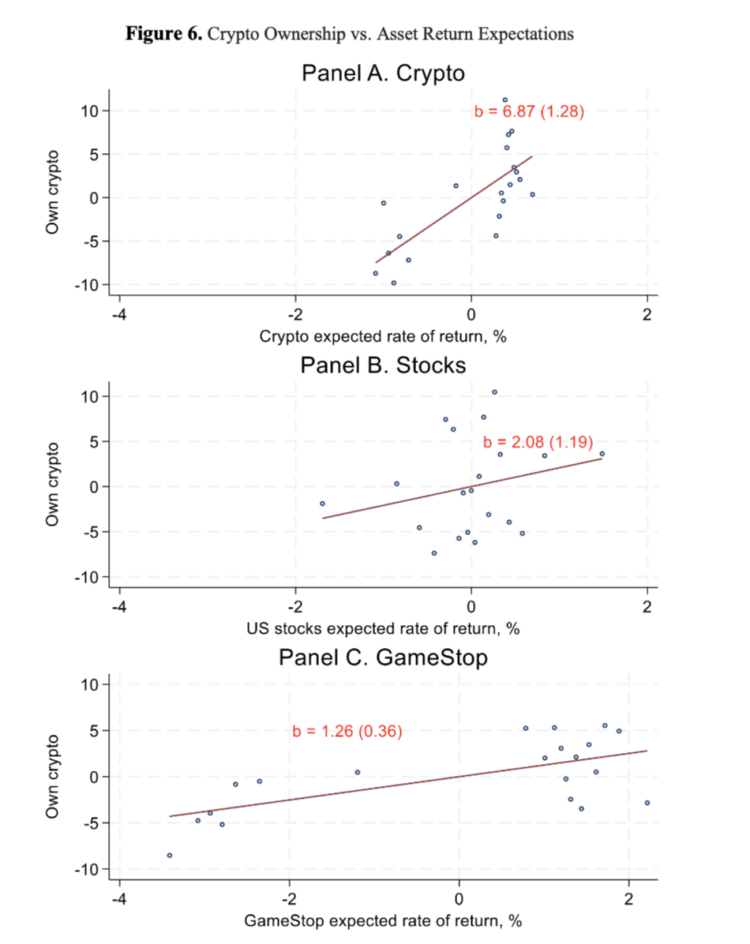
Quantifying this impact, the research found that each one-percentage-point increase in an individual’s expected crypto return correlated with an approximate 0.8 percentage point rise in their likelihood of holding these assets. Collectively, investors’ subjective assessments of returns and risks provided a far superior explanation for holding disparities than any combination of age, income, or gender.
This divergence from traditional financial assets like stocks, bonds, and gold is crucial. Investment in conventional assets typically finds greater explanatory power in wealth, income, and demographics, whereas the crypto market appears uniquely susceptible to investors’ subjective price expectations.
Compounding this, a significant information gap exists. In a 2021 survey, a staggering 87% of non-crypto holders admitted they couldn’t estimate future returns, and even among current holders, 54% were unable to provide an expectation.
The Power of the Past: How Bitcoin’s Historical Performance Ignites Investment Intent
In a compelling 2025 randomized information experiment, the research team segmented households, exposing them to various data points, including Bitcoin ($BTC)‘s past performance, stock market trends, GameStop’s trajectory, or inflation data. Crucially, those presented with Bitcoin’s prior 12-month returns exhibited a marked increase in their propensity to invest in cryptocurrencies.
The results were clear: exposure to Bitcoin’s historical returns prompted respondents to increase their desired cryptocurrency portfolio allocation by an average of 2 percentage points. This represented a substantial 47% boost in investment intent compared to the control group’s baseline allocation of approximately 4.3%.
This influence extended beyond intent to actual trading behavior, with those exposed to recent Bitcoin performance showing a 2.5 percentage point higher probability of subsequently purchasing cryptocurrencies. This effect was most pronounced among individuals who previously cited “insufficient information” as a barrier, while those already holding negative views on crypto remained largely unaffected.
Researchers posit that this mechanism creates a powerful, self-reinforcing price feedback loop unique to the crypto market. As prices surge and generate impressive historical returns, prospective investors, upon seeing this data, elevate their return expectations, leading to increased buying. This influx of new capital can then further drive up prices, drawing even more participants into the market.
Crypto Gains: A ‘Lottery Win’ Mentality and Persistent Volatility
The study also examined the impact of increased crypto wealth on household consumption. A doubling of Bitcoin’s price, for instance, correlated with an approximate 1.4 percentage point (or 7% relative) increase in the likelihood of a crypto-heavy household purchasing durable goods.
However, this wealth effect did not significantly translate into everyday spending. Researchers drew a parallel between crypto gains and “gambling income” or lottery winnings, suggesting investors tend to perceive sudden asset value increases as a one-off windfall rather than a stable, permanent augmentation of household wealth.
In conclusion, the Cleveland Fed’s research underscores the cryptocurrency market’s unique dynamics: a pervasive lack of consistent information, widely divergent investor beliefs about future returns and risks, and the potent influence of historical price performance on buying behavior. These factors coalesce to create a market prone to self-reinforcing cycles of price and sentiment, ensuring that high volatility remains a defining characteristic of the crypto landscape.
(The above content is an authorized excerpt and reproduction from our partner “CryptoCity,” original link)
Disclaimer: This article is for market information purposes only. All content and views are for reference only and do not constitute investment advice. They do not represent the views and positions of BlockTempo. Investors should make their own decisions and trades. The author and BlockTempo will not bear any responsibility for direct or indirect losses resulting from investor transactions.