
Bitcoin’s Rally Stalls: Macro Headwinds Push BTC Below Key Support as Treasury Yields Soar
Bitcoin (BTC) saw its impressive ascent to an eight-month high abruptly halted this week, facing significant resistance as macroeconomic pressures intensified. After nearing the $87,000 mark during Wednesday’s Asian trading session, BTC experienced a sharp pullback, dipping below $84,000. This reversal coincided with a fierce sell-off in US Treasuries, which propelled the 10-year US Treasury yield to an alarming 5.127% – a level not seen since 2007.
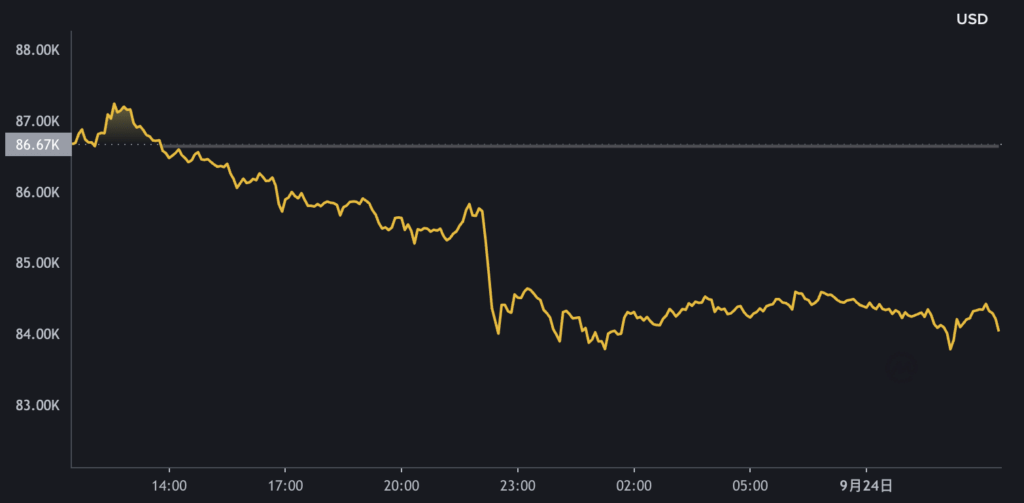
As of September 24th, Bitcoin was trading around $84,300, reflecting a 24-hour decline of approximately 2.3%. This marks a notable cooling from its recent high of approximately $86,600 recorded on September 21st. The primary catalyst for this downturn? A resurgence in US Treasury yields.
US 10-Year Treasury Yield Surges Past 5.1%: A Looming Threat to Risk Assets
The most significant external pressure on Bitcoin’s recent rally has undeniably stemmed from the US Treasury market. On September 23rd, the 10-year US Treasury yield surged by roughly 18.5 basis points in a single day, hitting 5.127% – a near two-decade high. The 2-year yield also climbed to approximately 4.93%. This dramatic shift was accompanied by a rapid increase in market expectations for another interest rate hike in October, jumping from about 50% the previous day to roughly 73%.
The triggers for this yield spike included stronger-than-expected US economic data. Preliminary September Manufacturing PMI rose from 53.9 to 57.0, while Services PMI increased from 56.5 to 58.7. Both figures surpassed market forecasts, reinforcing the “higher for longer” interest rate narrative that has gripped financial markets. During this period of soaring yields, the US dollar simultaneously strengthened, the Nasdaq index briefly dropped over 1%, and Bitcoin quickly retreated from above $86,000 towards $84,000.
Why 5%+ Treasury Yields Create Pressure for Bitcoin
For Bitcoin, the 10-year US Treasury yield breaching the 5% threshold presents a critical challenge: risk-free returns suddenly become far more appealing. When investors can secure a nominal yield of over 5% by simply holding US Treasuries, high-volatility assets like Bitcoin and technology stocks – which lack fixed cash flows – must offer a substantially higher expected return to attract new capital.
This dynamic was clearly evident this week. On September 21st, when the 10-year yield fell below 5%, BTC surged over 6% in a single day. Conversely, on September 23rd, as yields sharply rebounded above 5.1%, Bitcoin, Nasdaq, and major altcoins all experienced simultaneous pullbacks.
Bitcoin’s price remains highly sensitive to global liquidity conditions and real interest rates.
$87,000 Proves Elusive, $84,000 Becomes the First Line of Defense
Analyzing Bitcoin’s price structure reveals two failed attempts this week to establish a foothold above $87,000. Following the second rejection at this level, BTC broke below $84,000 around the Wall Street open, triggering approximately $280 million in long liquidations within a mere four hours. This starkly contrasts the market structure just two days prior, when Bitcoin’s breach of $84,000 on September 21st was primarily driven by short liquidations, with over $260 million wiped out in a single hour.
The current price retreat indicates a shift from a “short squeeze-driven” rally to a more typical tug-of-war between bulls and bears, where over-leveraged long positions are now being unwound.
In the short term, the $84,000 to $85,000 range represents a crucial support zone. Should this level fail, the next significant support for the market is anticipated around $82,000.
$18 Billion in Options Expiry Adds to Weekend Volatility
Compounding the macroeconomic pressures is a major derivatives settlement scheduled for this Friday. According to the latest CoinDesk statistics, approximately $18 billion worth of quarterly Bitcoin options are set to expire, marking one of the largest market events of the quarter. A significant concentration of call options currently sits above $85,000. Consequently, Bitcoin’s retreat back to the $84,000 vicinity before expiry could compel some market makers to readjust their Delta hedging strategies, potentially amplifying price swings.
Over the next two days, Bitcoin’s volatility may be influenced not only by spot buying and selling but also by options Gamma and position rollovers.
Bitcoin’s recent rapid rebound from approximately $76,000 to nearly $87,000 was supported by several factors, including ETF-related capital flows, policy narratives, and short liquidations. Crucially, it also benefited from a prior decline in US Treasury yields and falling oil prices, which improved overall market risk appetite. This favorable condition has now abruptly reversed.
The 10-year Treasury yield surged from roughly 4.93% on September 22nd to a peak of 5.127% on September 23rd, an increase of nearly 20 basis points in less than two days.
Whether Bitcoin can once again break above $87,000 will likely depend on more than just internal crypto market buying pressure. If US Treasury yields remain above 5% and the US dollar continues to strengthen, BTC will face persistent valuation headwinds, even if it manages to hold the $84,000 support. Conversely, a renewed decline in yields below 5% would create more favorable conditions for another test of the $87,000 resistance.
While $84,000 serves as Bitcoin’s immediate short-term support and $87,000 as its overhead breakout level, the true determinant of whether risk assets can sustain their upward momentum is shifting. The focus is moving away from internal crypto short squeezes and back towards US Treasury yields and the Federal Reserve’s interest rate expectations.
Disclaimer: This article is for market information purposes only. All content and views are for reference only and do not constitute investment advice. They do not represent the views and positions of the author or BlockTempo. Investors should make their own decisions and trades, and the author and BlockTempo will not be held responsible for any direct or indirect losses incurred by investors’ transactions.