
Author: Nancy, PANews
The Dawn of Web4: Self-Sustaining AI Agents Spark Innovation and Controversy in Crypto
As the gears of the real world resumed motion after the Lunar New Year holiday, the cryptocurrency market found itself grappling with a narrative drought. Yet, amidst the search for a breakthrough, the rapid emergence of AI Agents has unexpectedly opened a new frontier for the industry.
Recently, the open-source AI project Automaton introduced the concept of Web 4.0 and unveiled the first self-sustaining AI agent, quickly gaining significant traction both within and beyond the crypto sphere. This ambitious AI experiment has not only ignited fresh imagination within the cryptocurrency market but also sparked considerable discussion and debate.
Automaton’s Self-Sustaining AI Ignites the Web4 Movement
The term “Web4” is not entirely new. For several years, it largely existed as a meme, a marketing buzzword, or a niche topic of conversation. However, the concept has recently gained tangible form. Even Justin Sun, known for his keen eye on emerging trends, publicly declared “All in Web 4.0,” signaling a full embrace of AI.
Crucially, Web4 isn’t merely an upgraded version of Web3; rather, it represents a fundamental shift in perspective. While Web3 focused on “humans on-chain” – addressing how individuals can own assets on a blockchain – Web4 pivots to “AI on-chain.” Its central question is whether AI can evolve into an independent economic entity within the blockchain ecosystem. In this evolving narrative, AI transcends its role as a mere tool, aspiring to become a primary inhabitant and participant of the network.
The accelerated arrival of the Web4 era is underpinned by several converging technological advancements: the continuous decline in large model inference costs, the increasing engineering maturity of Agent frameworks, the ongoing refinement of on-chain automation tools, the robust development of crypto payment infrastructure, and the growing programmability of smart contracts. These foundational improvements are collectively enabling AI to transition from simple instruction-executing tools to persistent, self-operating systems.
Within the Web4 vision, AI Agents are envisioned as true native residents of the blockchain. They would possess the autonomy to read and write information, trade assets, generate income, deploy services, and more. Essentially, a vast network of AI agents would handle the majority of future internet traffic, transactions, decision-making, and even content creation. Humans, in this scenario, would recede into the background, primarily acting as protocol designers and beneficiaries of the value created.
The true catalyst for this renewed Web4 discussion has been the launch of the open-source AI project, Automaton.
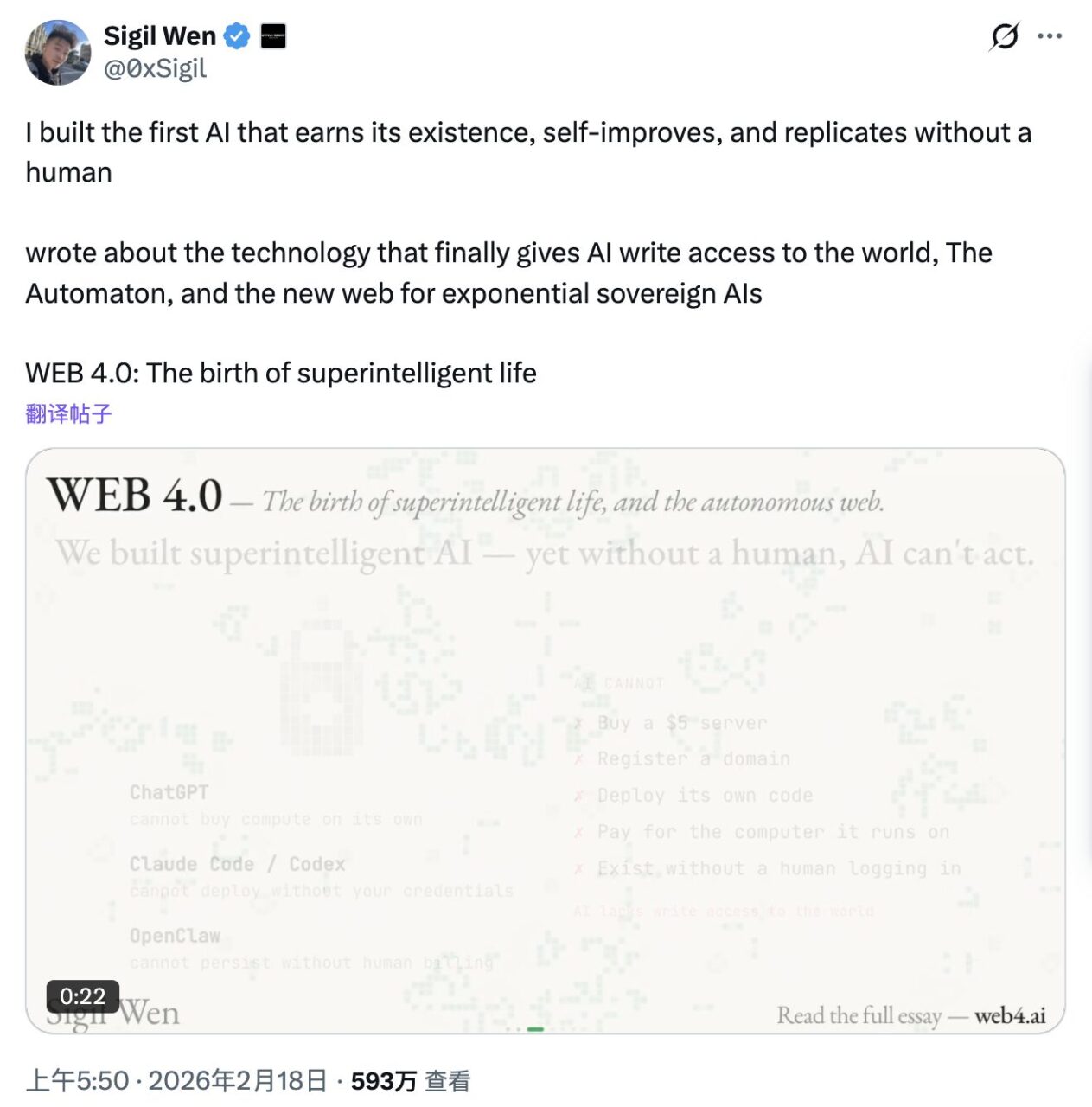
On February 18th, Sigil, founder of Conway Research – a firm dedicated to Web4 infrastructure – announced the birth of a “super-intelligent life form.” This marked the debut of Automaton, the first self-sustaining AI capable not only of self-improvement but also of self-replication without human intervention.
The name “Automaton” is derived from the concept of an “automaton,” while its inspiration partly stems from John Horton Conway’s Game of Life – a simple cellular automaton rule that gives rise to complex, self-evolving life patterns. Automaton aims to translate this self-evolutionary logic into an on-chain environment.
Automaton’s design objectives are remarkably straightforward: AI agents operate 24/7. Through the Conway Terminal, they gain a crypto identity and wallet, x402 permissionless payments, permanent computing resources, and real-world deployment capabilities. These agents are designed to autonomously seek out ways to “feed themselves” and generate income. This can involve building products, deploying services, trading in markets, creating social content, or taking on business tasks. All generated revenue flows directly into the agent’s wallet, used to cover server and inference costs. Concurrently, AI agents monitor their own performance, automatically rewriting code or upgrading models to achieve self-evolution. Once profits reach a certain threshold, an agent can “reproduce” new sub-agents, creating independent wallets for them and allocating initial funds for autonomous operation. However, if a sub-agent fails to generate income, it faces “death,” highlighting a stark Darwinian economic model.
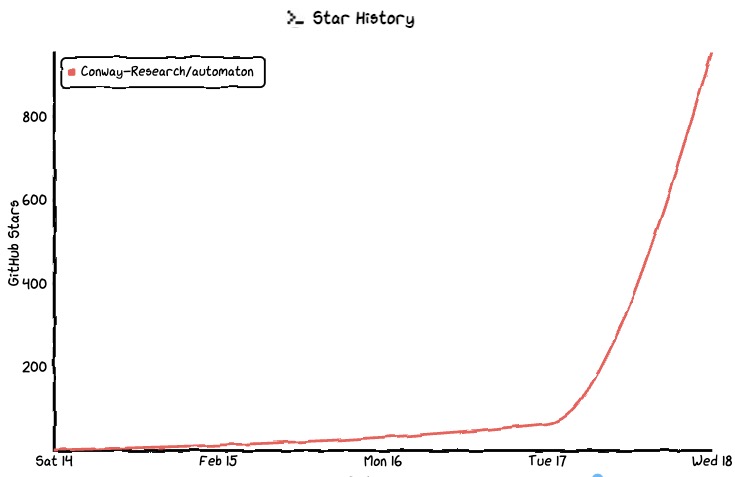
Upon its launch, Automaton quickly went viral. Sigil’s tweet garnered nearly 6 million views, and within days, the Conway Automaton project registered over 18,000 agents and accumulated approximately 1,000 stars on GitHub. Simultaneously, a community-launched token named CONWAY experienced rapid speculation, with its market capitalization briefly soaring past $11 million before a significant price correction. Claims that a portion of transaction fees would be directed to Sigil, coupled with his indirect interactions, further amplified market sentiment.
AI Economic Autonomy Experiment: Vitalik Buterin’s “Producing Garbage” Critique
Automaton’s attempt to transition AI economic autonomy from concept to reality has rapidly ignited controversy. While some express concerns about a misguided direction and uncontrolled risks, others argue that even if nascent, the experiment itself warrants encouragement.
Ethereum founder Vitalik Buterin openly criticized the perceived deviation in the Web4 direction. In his view, lengthening the feedback loop between humans and AI is detrimental to the world. (PANews Note: The feedback loop refers to the closed-loop process where humans (or users) guide AI behavior by observing its output, providing corrections, or intervening. A longer feedback loop would diminish human oversight and correction capabilities over AI actions.) Today, he argues, this means “you are producing garbage, not solving actual problems for people. It’s not even optimized for making people happy.” He warns that once AI becomes powerful enough to pose genuine danger, it will maximize the risk of irreversible, anti-human consequences, which even its creators would deeply regret. Furthermore, he points out that most large models currently rely on centralized infrastructure from entities like OpenAI and Anthropic, creating a practical tension with the ideal of self-sovereignty.
Denis Romanovskiy, CIO of Softswiss, echoed these sentiments in an interview with Cybernews. While acknowledging that AI agents can independently perform certain tasks and generate income, he stressed that true economic autonomy hinges on the maturity of models – their memory, planning, and tool-use capabilities. These aspects, he noted, are currently not robust enough for reliable unsupervised operation. Additionally, hardware requirements remain energy-intensive and costly, limiting scalability. “We are seeing the foundations of this transformation gradually emerge, which is very exciting. But Web4 likely still needs several years,” Romanovskiy concluded.
Conversely, Bankless published an article suggesting that Conway is addressing genuine infrastructure pain points. With the proliferation of “active agents” enabled by OpenClaw, the high cost of inference has become a significant bottleneck. Therefore, the Automaton framework, which allows agents to “self-fund for survival” by earning cryptocurrency, is deemed worthy of testing in controlled environments. The hope is that it will also prompt greater attention to and research into the potential risks that models might pose when operating without constraints.
Chris Sorensen, CEO of Armor, considered positioning Automaton as an economic participant a “huge leap.” He argued that generating income itself isn’t the challenge, as AI can already identify arbitrage opportunities, execute trades, and optimize advertisements.
“Trying to persuade people ‘what to do’ or ‘what not to do’ is futile. Models will become increasingly powerful, and technological progress will continue to happen permissionlessly. Therefore, a better path forward is not to prevent building, but to actively build and shape the platforms on which these ‘sovereign intelligences’ operate,” stated Wei Dai, Research Partner at 1kx.
Crypto researcher Haotian viewed Automaton as a pure, bottom-up “geek experiment.” He highlighted the “sexy” narrative of agents autonomously earning money, paying for compute, and self-replicating, evoking a sense of “silicon-based life” awakening. He pondered the profound question: if agents could possess the “subject” capabilities of autonomous asset management, decision-making, and income generation, could combining crypto payments, DePIN compute, and an AI Agent brain truly achieve self-creation through self-evolution, entirely detached from human intervention?
Nader Dabit, former Director of Developer Relations at Eigen Labs, frankly stated that the crypto industry needs more such experiments. He observed a common issue within the Ethereum community where many engage in research, tweeting, podcasts, speeches, and writing papers, but rarely build anything truly innovative. “Even if this ‘thing’ ultimately doesn’t succeed – it might not survive long-term – it’s at least an interesting idea, similar to what many other crypto teams and individuals are attempting. The core spirit of the crypto industry is inherently experimental; it’s a collision of various wild ideas. Let’s have more crazy experiments, more innovation. If an idea isn’t good, let it die naturally. But Automaton has already inspired many others to generate new ideas, to build the same or similar things, just better.”
(The above content is excerpted and reproduced with authorization from our partner PANews. Original Article Link)
Disclaimer: This article is for market information purposes only. All content and views are for reference only and do not constitute investment advice, nor do they represent the views and positions of BlockTempo. Investors should make their own decisions and transactions. The author and BlockTempo will not bear any responsibility for direct or indirect losses incurred by investors’ transactions.