Author: Ariel, CryptoCity
Prediction Markets Under Fire: Kalshi and Polymarket Face Scrutiny Over Geopolitical Contracts
Kalshi’s Controversial Settlement of ‘Khamenei Stepping Down’ Contract
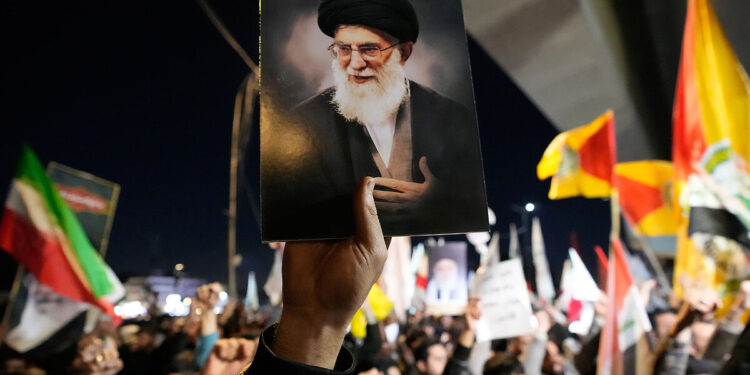
Following a joint U.S.-Israeli airstrike that resulted in the death of Iran’s Supreme Leader, Ali Khamenei, prediction market Kalshi found itself at the center of a storm. Tarek Mansour, CEO of Kalshi, addressed the controversy surrounding a contract with over $50 million in trading volume on their platform, asserting that their primary intention was to prevent investors from profiting from a death event.
The prediction contract, titled “Will Khamenei Step Down as Iran’s Supreme Leader?”, explicitly stipulated that in the event of Khamenei’s death, it would settle at the last trading price before his demise. However, upon the news of Khamenei’s death, a massive influx of capital flooded the contract, leading Kalshi to suspend trading amidst chaotic settlement procedures.
Kalshi subsequently acknowledged a “grammatical ambiguity” in its settlement terms and ultimately opted to refund users’ net losses. Sources familiar with the matter informed Bloomberg that this decision cost the platform an estimated $2.2 million.
Kalshi’s Promotional Tactics and Inconsistent Standards Draw Widespread Criticism
The refund decision did little to quell the mounting criticism, which primarily stemmed from Kalshi’s active promotion of the controversial contract during the unfolding events. On the Saturday morning when news of Khamenei’s death began to circulate, Kalshi posted on X (formerly Twitter) stating: “BREAKING: Chance of Khamenei no longer being Supreme Leader of Iran surges to 68%.” CEO Tarek Mansour himself retweeted this message.
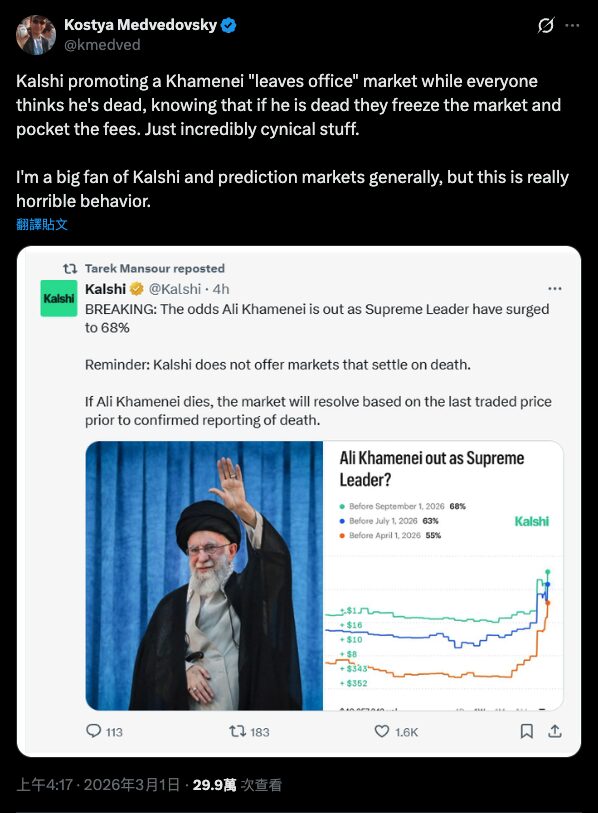
Amanda Fischer, former Chief of Staff at the U.S. Securities and Exchange Commission (SEC), sharply criticized Kalshi’s actions, equating them to operating a proxy market for assassination.
Users further lambasted Kalshi for perceived inconsistencies in its settlement standards. They cited instances where, in a comparative scenario involving Jimmy Carter’s passing, the platform had directly settled a contract regarding his inauguration attendance as “No,” accusing Kalshi of invoking special clauses only when facing potential financial losses.
Dennis Kelleher, CEO of Better Markets, articulated that Kalshi’s conduct underscores the inherent dilemma for prediction markets: attempting to simultaneously boost trading volume while sidestepping laws explicitly prohibiting markets related to assassination.
Prediction Markets Cross a Red Line: U.S. Lawmakers Demand Strict Oversight
While prediction markets are often touted as platforms where “anything can be traded,” recent events have starkly illuminated their ethical and regulatory limits. Even prior to the U.S.-Israeli airstrike in Iran, California Democratic Senator Adam Schiff had already penned a letter to Michael Selig, Chairman of the U.S. Commodity Futures Trading Commission (CFTC), demanding rigorous enforcement against prediction contracts associated with war and assassination, setting a response deadline of March 9.
Adding to the legislative pressure, Connecticut Democratic Senator Chris Murphy announced he is drafting legislation to outright ban such market contracts. His aim is to prevent insider trading and manipulation by individuals with foreknowledge of outcomes, asserting that Kalshi’s settlement controversy serves as irrefutable proof that these speculative market contracts should not exist.
Polymarket’s “Wordplay” and Insider Trading Allegations Spark Parallel Controversy
Beyond Kalshi, Polymarket also hosts a significant number of Iran-related markets, with 187 currently active. One particular contract predicted whether the U.S. would “forcibly remove” Khamenei by March 31. Polymarket ultimately settled the outcome as “No,” justifying its decision by stating the U.S. merely “contributed to or assisted” in the elimination operation. This interpretation, characterized by some as “wordplay,” drew fierce backlash from commentators who called for a dispute.
Given Polymarket’s reliance on decentralized settlement mechanisms built on the blockchain, the fairness and impartiality of contract adjudication remain a persistent challenge.
Crucially, on-chain data revealed a highly suspicious pattern: hours before the airstrike, six enigmatic wallets collectively wagered on “U.S. to attack Iran by February 28,” ultimately accumulating approximately $1.2 million in profits. These wallets were almost all newly established in February, with funds transferred within 24 hours preceding the military action. This abnormal trading activity has intensified suspicions of military intelligence leaks being exploited for illicit on-chain insider trading.
(The above content is excerpted and reproduced with authorization from our partner ‘CryptoCity’. Original Link)
Disclaimer: This article is provided for market information purposes only. All content and views are for reference only and do not constitute investment advice. They do not represent the views and positions of BlockTempo. Investors should make their own decisions and transactions. The author and BlockTempo will not be liable for any direct or indirect losses incurred by investors’ transactions.