Author: Jae, PANews
On March 19, the stablecoin supply on the Solana blockchain officially surpassed the historic threshold of $17 billion.
This figure not only marks a new high for the Solana network but also reflects the remarkable resilience of its ecosystem, which has expanded against the backdrop of a bear market, progressing steadily towards its vision of becoming an “Internet Capital Market.”
The $17 billion milestone is no longer solely driven by a speculative meme coin frenzy; rather, it is the culmination of favorable policy, profound integration by Wall Street institutions, and powerful ecosystem synergies.
From Stripe to PayPal, from Visa to BlackRock, giants from Wall Street and Silicon Valley are actively shaping Solana’s development with significant capital and unwavering commitment.
From $1.5 Billion to $17 Billion: A Steep Recovery Curve
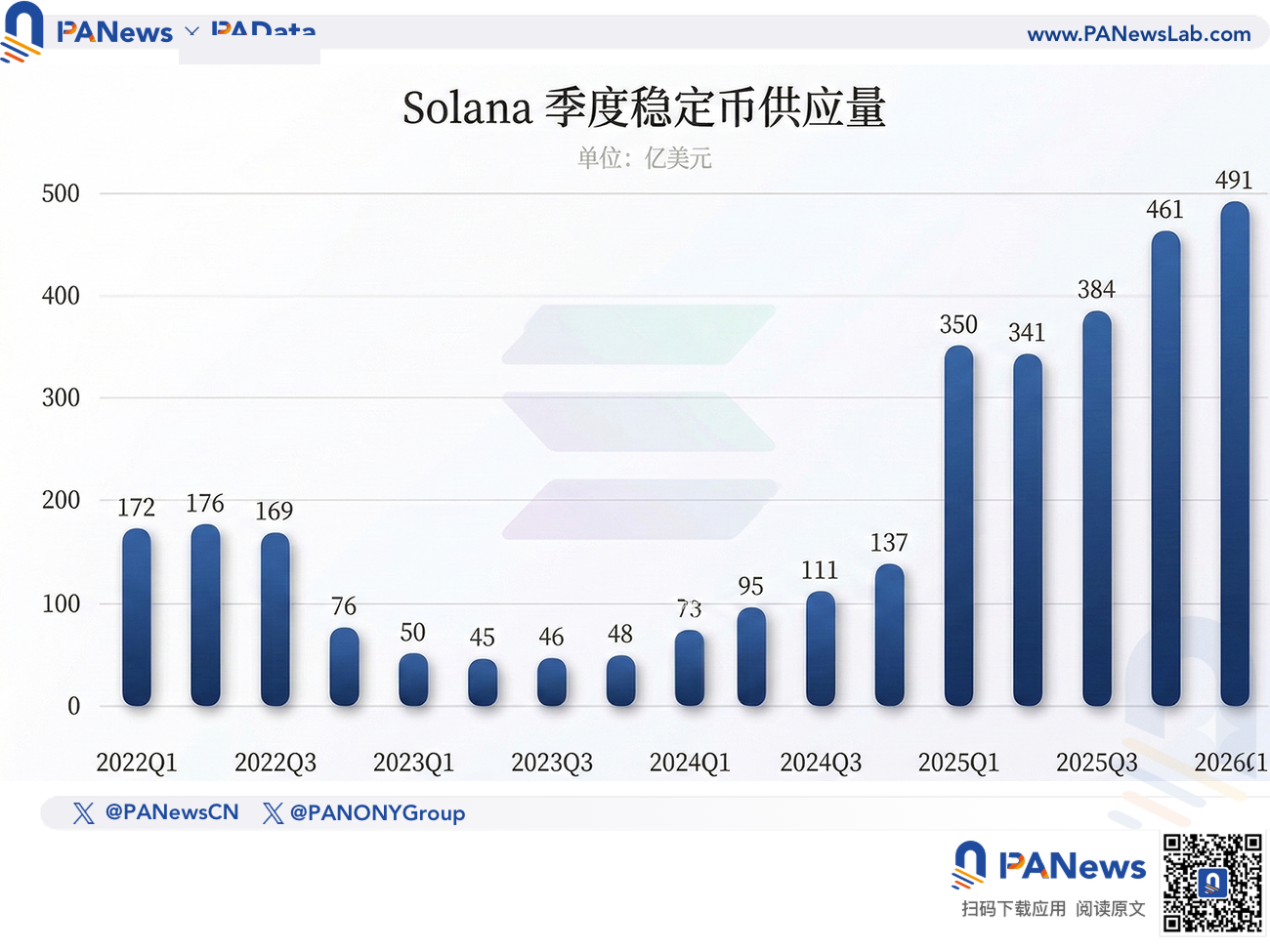
Solana’s stablecoin supply growth trajectory illustrates a remarkable four-year journey from its nadir to its current peak.
In November 2022, severely impacted by the FTX collapse, Solana’s on-chain stablecoin total supply dwindled to $2 billion, lingering around a challenging low of $1.5 billion for nearly half a year.
At that time, market skepticism about Solana reached its zenith, with many questioning whether the once-hailed “Ethereum killer” had become a relic of the past.
However, the subsequent recovery trajectory has surprised even the most seasoned observers.
Phase One: Organic Ecosystem Recovery (Q1-Q4 2024)
Solana’s stablecoin supply steadily recovered from $2.2 billion at the beginning of the year to approximately $5.3 billion. During this period, decentralized exchange (DEX) protocols like Jupiter and Raydium fueled a significant wealth effect on Solana, attracting a large influx of retail investors due to their remarkably low transaction costs. Stablecoins, serving as the essential “fuel” for on-chain transactions, began to accumulate once more.
Phase Two: Meme Coin & Liquidity Resonance (Q1-Q2 2025)
In early 2025, the explosion of political meme coins, such as TRUMP, triggered a rapid inflow of global liquidity into Solana. The stablecoin supply surged from $5.3 billion to $12.8 billion within just four months, representing an astonishing increase of over 2.4 times.
DEXs like Meteora effectively locked in substantial liquidity through USDC trading pairs, elevating stablecoins from mere asset anchors to sophisticated “liquidity amplifiers” for on-chain transactions.
Phase Three: Compliance & Institutional Dividends (Q3 2025 to Present)
The signing of the “GENIUS Act” in July 2025 provided crucial legal certainty for the large-scale circulation of compliant assets like USDC and PYUSD. The breakthrough to $17 billion is fundamentally a direct manifestation of traditional financial capital beginning to strategically allocate assets through Solana’s “high-performance rail.”
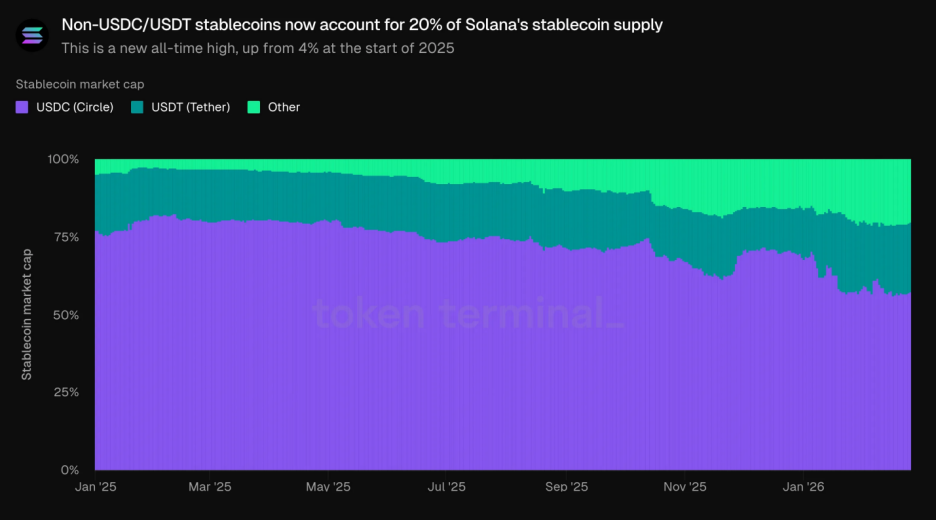
Notably, the supply of non-USDC/USDT stablecoins has grown by approximately 15 times over the past 12 months, now accounting for over 20% of the total supply. This “dual-dominant, multi-strong” landscape significantly reduces Solana’s reliance on any single issuer, thereby enhancing the overall resilience and decentralization of the ecosystem.
However, risks persist. On March 18, higher-than-expected Producer Price Index (PPI) inflation data pushed back expectations for a Federal Reserve rate cut until September, indicating a tightening of macroeconomic liquidity. If this trend continues, the stablecoin turnover rate on Solana, which heavily relies on high-frequency trading, could experience a sharp decline.
Policy Tailwinds and Deep Integration by Giants
The “GENIUS Act,” effective July 2025, established clear “rules of the game” for payment-oriented stablecoins, paving the way for broader adoption.
For Solana, while the act’s interest-prohibition policy curbed the expansion of certain yield-bearing stablecoins, it simultaneously bolstered the confidence of compliant capital providers like Circle and PayPal, encouraging their deeper engagement.
Solana’s achievement of the $17 billion stablecoin supply milestone is inextricably linked to the profound integration by payment giants that has unfolded since the previous year.
In October 2025, Stripe added Solana support to its crypto products. Through this advanced suite, Stripe can automatically convert stablecoins to fiat currency, with funds settled directly in USD to merchant Stripe balances, effectively eliminating price volatility risks for businesses.
In December 2025, Visa announced that U.S. banks could utilize USDC on Solana for transaction clearing, marking the first comprehensive deployment of its stablecoin settlement service within the American banking system.
In March 2026, cross-border payment giant Western Union partnered with infrastructure provider Crossmint to support the issuance of USDPT stablecoins on Solana and seamlessly connect to global payment networks, expanding digital remittance capabilities.
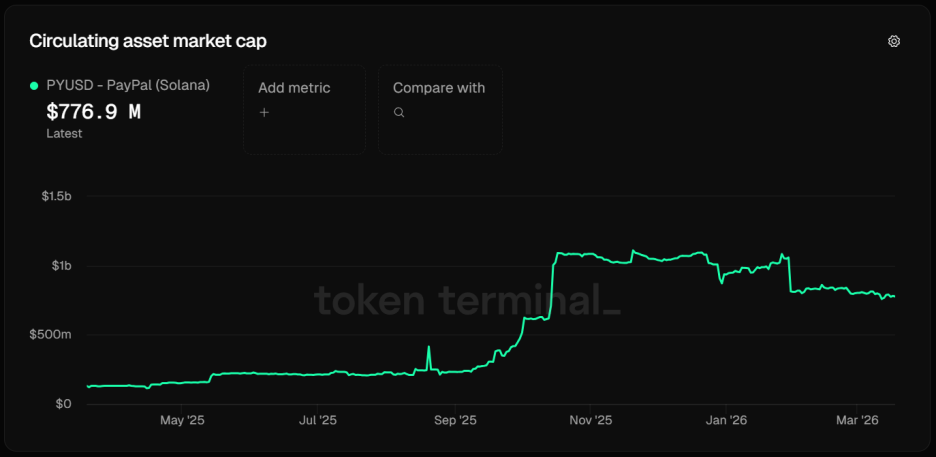
To date, PYUSD’s market capitalization on Solana has surged to approximately $777 million, representing an impressive annual growth of about 600%. This exponential growth is primarily attributable to the launch of the “Pay with Crypto” feature, which allows millions of merchants to accept over a hundred cryptocurrencies, instantly converting them to PYUSD for a competitive 0.99% transaction fee. Leveraging PYUSD, Solana’s robust infrastructure has been extended to users in 70 countries and regions worldwide.
The continuous and strategic adoption by these payment giants signifies that the $17 billion figure is no longer merely an aggregation of speculative funds but a true reflection of payment channel migration and the increasing utility of blockchain technology in real-world finance.
Crucially, the act clarified stablecoin holders’ priority claim rights in the event of an issuer’s bankruptcy. This provides on-chain assets with a level of consumer protection equivalent to that found in traditional financial markets, fostering greater trust and stability.
DeFi, RWA, and AI Agent Payments: A Tripartite Ecosystem Synergy
The unprecedented surge in stablecoin volume has created a powerful positive feedback loop, driving an explosion of application-layer innovations within the Solana ecosystem.
A significant portion of the $17 billion in stablecoins is strategically locked within various decentralized finance (DeFi) protocols, fueling their growth and utility.
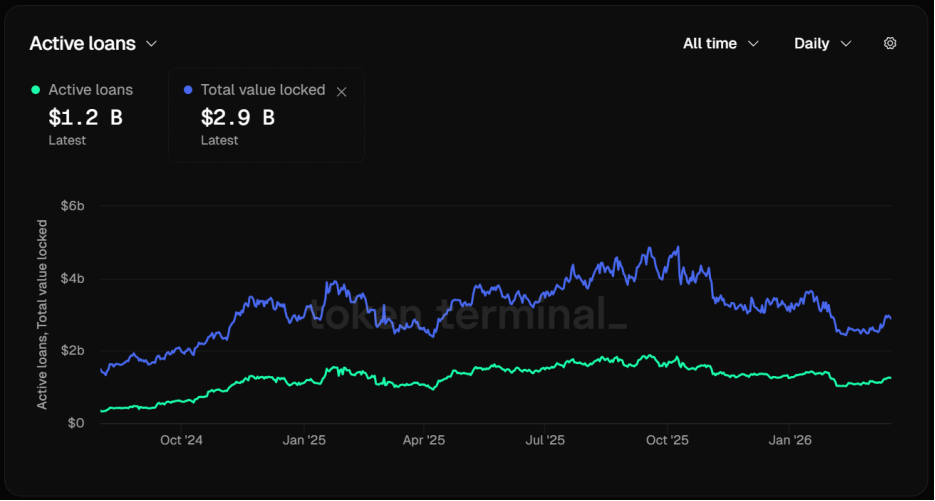
Kamino, as Solana’s largest lending platform, has seen its Total Value Locked (TVL) reach an impressive $2.9 billion, with active loans amounting to $1.2 billion. Kamino’s innovative introduction of yield-bearing liquidity tokens, kTokens, allows users to earn fees while simultaneously using these tokens as collateral to borrow stablecoins again, significantly boosting overall capital efficiency within the ecosystem.
Jupiter, serving as a primary traffic and liquidity gateway for Solana, processes over 70% of the entire chain’s transaction volume through its advanced aggregator. Jupiter’s strategic collaboration with BlackRock to launch JupUSD, which invests stablecoin reserves into tokenized U.S. Treasuries, provides robust underlying liquidity to the ecosystem, with a circulation of nearly $74 million.
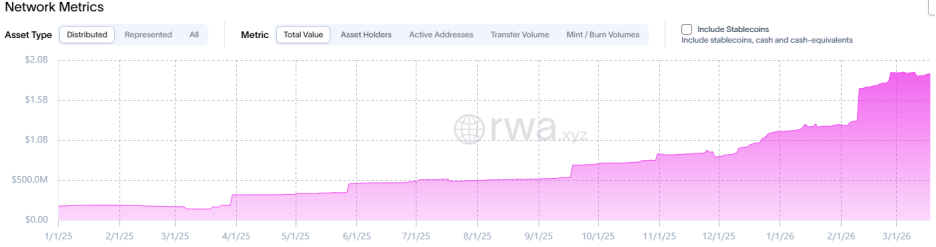
In March 2026, the market capitalization of Real World Assets (RWA) on Solana surpassed $1.8 billion, representing a more than tenfold increase year-over-year. Ondo has successfully deployed tokenized short-term U.S. Treasuries and money market funds on Solana, enabling users to bypass traditional brokers for efficient, 24/7 trading. BlackRock’s BUIDL fund on Solana now exceeds $500 million, demonstrating unequivocally that top asset management institutions are beginning to view Solana as a primary battleground for their tokenization transformation initiatives.
Another significant and transformative trend is also rapidly emerging: the explosion of economic output by AI Agents on Solana.
Leveraging Solana’s microsecond-level confirmation times and extremely low transaction costs, AI Agents are uniquely positioned to perform high-frequency micropayment operations, such as settling thousands of API calls per second. In stark contrast, traditional banks or slower Layer 1 (L1) networks simply cannot support this type of high-frequency, small-value capital circulation.
Consequently, stablecoins are proving to be the ideal and most efficient payment medium for this burgeoning “digital workforce.”
However, every silver lining has a cloud. Beneath the surface of surging liquidity, potential risks and challenges within the Solana ecosystem cannot be overlooked.
As liquidity increases, the activities of MEV (Maximal Extractable Value) attackers become more rampant. While mechanisms like Jito return a portion of the profits to holders, high priority fees during peak periods could potentially erode Solana’s fundamental low-fee advantage, hindering the widespread adoption of micro-payments for everyday use.
Nevertheless, it is clear that the on-chain stablecoin supply breaking the $17 billion mark is merely a significant waypoint for Solana, not the final destination.
From Stripe to Visa, and from PayPal to BlackRock, the collective adoption by these global giants is helping Solana construct a sophisticated financial empire that transcends the traditional crypto sphere, reshaping the future of digital finance.
The key to Solana’s continued ability to define “Internet Capital Markets” will be its capacity to effectively navigate macroeconomic headwinds and internal network challenges while steadfastly maintaining its high-performance and low-cost advantages.
(The above content is an authorized excerpt and reprint from our partner PANews. Original Link )
Disclaimer: This article provides market information only. All content and views are for reference only, do not constitute investment advice, and do not represent the views or positions of BlockBeats. Investors should make their own decisions and trades. The author and BlockBeats will not bear any responsibility for direct or indirect losses incurred by investors’ transactions.