Author: Nancy, PANews
In less than a year, HYPE has not only shattered its all-time high but continues to set new records, catapulting its market capitalization past that of the long-established meme coin Dogecoin. This remarkable ascent has officially placed HYPE among the top 10 cryptocurrencies globally by market cap.
The potent combination of strong fundamentals and robust funding has fueled HYPE’s impressive rally. However, as the United States officially opens its doors to a compliant cryptocurrency perpetual contracts market, the next significant challenge for Hyperliquid is securing its ticket to mainstream financial integration.
HYPE Defies Market Trends, Over 90% of Revenue Fuels Buybacks
While the broader crypto market has experienced a period of softness, HYPE has surged against the tide, demonstrating exceptional resilience and growth.
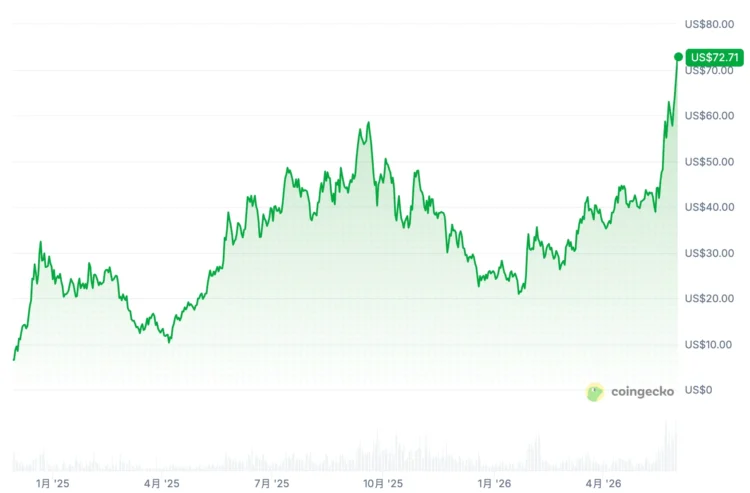
According to CoinGecko data, HYPE’s price has soared past $72, pushing its market capitalization beyond $16.1 billion and establishing a new all-time high. Over the past 30 days, HYPE has delivered a cumulative gain of 75.4%. Extending the timeline to the past year reveals an astounding increase of 122.7%, significantly outperforming most major crypto assets.
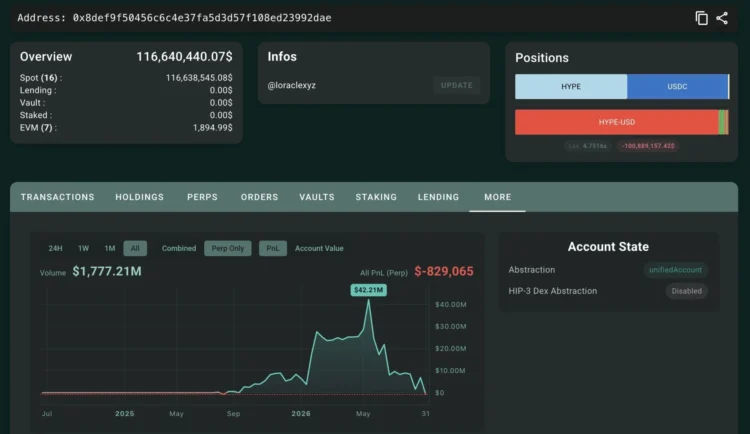
HYPE’s relentless upward trajectory has inflicted heavy losses on short-sellers. Onchain Lens monitoring indicates that Loracle, identified as the largest HYPE short-seller, has steadily reduced their short positions. Their 5x leveraged short, initially valued at $102 million, has shrunk to approximately $60.94 million. Currently, this whale still holds 843,232 HYPE short positions (worth roughly $60.7 million), facing an unrealized loss exceeding $22 million. This particular investor began shorting HYPE above $40 in April, attempting to average down their cost basis through multiple additions. However, HYPE’s continuous climb has only exacerbated their losses. This single short trade has not only eradicated their previous 10 months of profits (approximately $40 million) on the Hyperliquid platform but has also incurred an additional loss of over $5 million.
Conversely, long-position holders have reaped substantial rewards. On-chain data reveals one trader generated over $1.4 million in profit within just two days using a 10x leveraged HYPE long position. Meanwhile, a whale address starting with 0x082, holding a 5x leveraged long position since December 2024, has accumulated an unrealized profit exceeding $46 million.
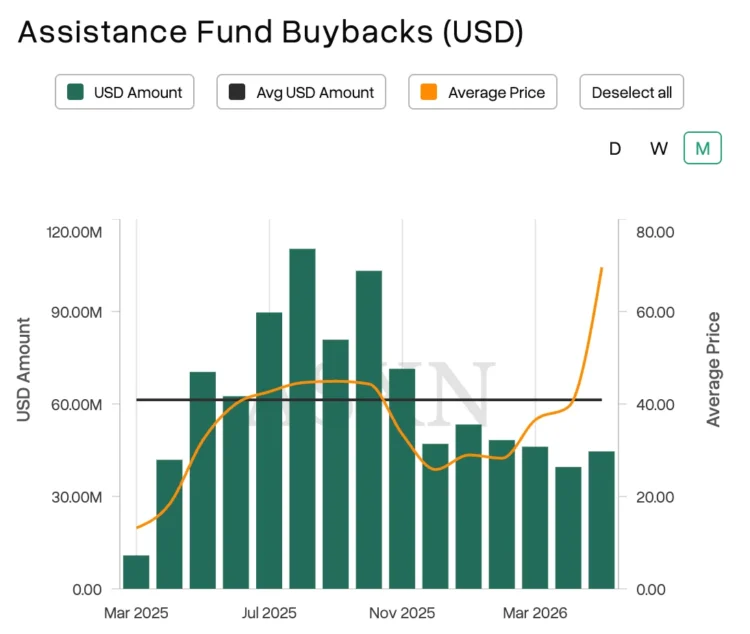
The primary engine driving HYPE’s appreciation is the consistent token buybacks executed by Hyperliquid’s dedicated Assistance Fund. Hyperscreener data shows that Hyperliquid’s cumulative protocol revenue has reached nearly $950 million to date. An impressive $920 million of this revenue, representing over 96%, has been channeled directly into HYPE token buybacks. In the current month alone, Hyperliquid repurchased HYPE tokens worth $44.6 million at an average price of approximately $69.6.
Looking ahead, as Hyperliquid continues to expand its trading volumes and revenue streams across sectors like Pre-IPO and prediction markets, the protocol is expected to consistently convert its cash flow into market demand, providing long-term price support for HYPE.
ETFs Attract Capital, Wall Street Accelerates Entry
Beyond protocol buybacks, the familiar “DAT” (Direct Allocation Trust) mechanism within the crypto space has also served as a significant catalyst for HYPE’s recent surge.
Hyperliquid Strategies Inc. (PURR), Hyperliquid’s affiliated DAT company, was recently included in the prestigious Russell Microcap Index. Since its inception, PURR has invested approximately $216 million to acquire 7.3 million HYPE tokens, bringing its total holdings to roughly 20 million HYPE.

Market observers widely anticipate that PURR’s inclusion in the Russell Index will attract passive index funds and benchmark-tracking capital, thereby introducing new sources of liquidity and further elevating market attention on the Hyperliquid ecosystem.
ETFs are another crucial pillar supporting HYPE’s demand. SoSoValue data indicates that two HYPE spot ETFs, Bitwise BHYP and 21Shares THYP, have maintained continuous net inflows since their launch, accumulating nearly $110 million in historical net inflows. This contrasts sharply with Bitcoin and Ethereum spot ETFs, which experienced net outflows during the same period. Notably, Bitwise allocates 10% of its BHYP ETF management fees directly to purchasing and holding HYPE, meaning the expansion of the ETF’s size directly translates into additional market buying pressure.
Grayscale is also accelerating its product development, having recently filed an S-1 amendment for a HYPE staking ETF, with plans to seed it with 2 million HYPE tokens (valued at approximately $115 million). In its latest report, Grayscale posited that Hyperliquid is rapidly evolving from a mere crypto perpetuals exchange into a foundational blockchain financial infrastructure platform, with the potential to challenge traditional derivatives trading systems and grow into a financial services behemoth.
This “Wall Street playbook” is reminiscent of previous developments observed with Ethereum (ETH) and Solana (SOL).
It is important to note that approximately 9.92 million HYPE tokens are scheduled for unlocking on June 6, 2026. At the current price of around $72, this represents an unlocked value of approximately $713.8 million, accounting for about 2.54% of the circulating supply.
US Approves First Perpetual Contracts, Hyperliquid Faces a Pivotal Moment
The recent approval of crypto perpetual contracts in the United States has injected fresh momentum into the entire sector.
On May 29, the U.S. Commodity Futures Trading Commission (CFTC) announced its approval for KalshiEX LLC to list BTCPERP perpetual contracts. This marks the first truly compliant Bitcoin perpetual contract in US history, signaling the official opening of a regulated crypto perpetuals market. Concurrently, the CFTC issued an interpretive letter and no-action letter to Coinbase, permitting it to offer crypto options and perpetual contracts to US users via its affiliated offshore exchange, Deribit FZE.
These historic actions are widely interpreted by the market as a significant shift in the stance of US regulators towards crypto derivatives. As the regulatory framework gradually solidifies, it is expected to provide a compliant entry point for more institutional capital, potentially ushering in a new growth cycle for the perpetuals market.
However, for Hyperliquid, a leading decentralized perpetuals platform, regulatory openness does not automatically equate to having cleared the compliance hurdle. Recent debates within the crypto community have centered on Hyperliquid’s compliance and transparency.
Kyle Samani, co-founder of former Multicoin, publicly stated on X that Hyperliquid is merely “Binance 2.0,” leveraging temporary regulatory arbitrage to gain prominence, and predicted that no legitimate US company would partner with it. He even issued a challenge, betting that Hyperliquid would be unable to launch a US-compliant frontend in the short term.
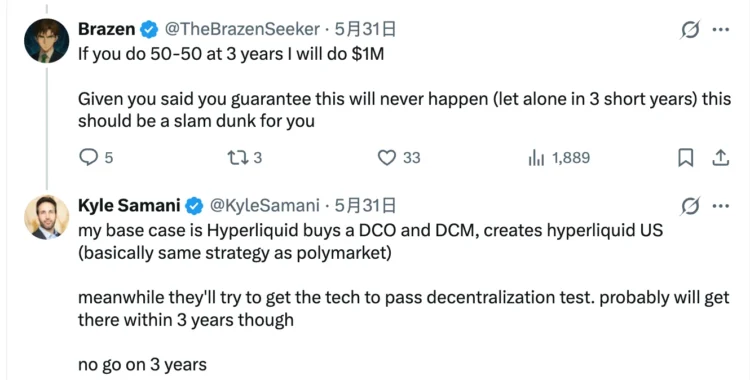
In response, a community member expressed willingness to wager $1 million, predicting Hyperliquid could launch a US-compliant frontend within three years. Kyle subsequently declined the three-year timeframe, suggesting Hyperliquid might pursue a strategy similar to Polymarket, acquiring a DCO (Derivatives Clearing Organization) and DCM (Designated Contract Market) to establish “Hyperliquid US.” Interestingly, despite Kyle’s public skepticism, Multicoin Capital had already made substantial purchases and staked HYPE several months prior.
Mike Dudas, an investor at 6MV, countered Kyle’s assertions, arguing that comparing Hyperliquid to Binance is unfounded. Dudas highlighted that Hyperliquid does not directly invest in its listed assets, nor does it engage in asset dumping through perpetual contracts or Launchpad mechanisms. Furthermore, it does not extract multiple percentage points from the supply of listed assets, nor does it manipulate platform asset costs or relationships through marketing programs, distinguishing its tokenized approach.
Beyond the community discourse, the market has been particularly attentive to a noticeable shift in the stance of Intercontinental Exchange (ICE).
Just days ago, at a recent industry conference hosted by Bernstein, Jeffrey Sprecher, founder and CEO of ICE, unexpectedly singled out Hyperliquid for high praise. He remarked, “It’s even bigger than Nasdaq, and it’s only 11 people, it’s a very smart team.”
Jeffrey Sprecher specifically mentioned that Hyperliquid has already listed SpaceX-related derivatives, which will be put to the market test on June 11, when SpaceX is officially expected to go public. He found it intriguing whether Hyperliquid’s market price would influence the IPO. Sprecher believes that Hyperliquid, with its blockchain settlement, stablecoin collateral, and up to 100x leverage mechanism, is attracting an increasing number of market makers and professional trading institutions.
He explicitly stated that Hyperliquid’s perpetual contracts are essentially “Swap” products under the traditional financial framework. Sprecher further revealed that ICE has engaged in multiple rounds of communication with the Hyperliquid team, discussing areas of business overlap and potential collaboration opportunities.
Such public and positive endorsement of a crypto-native protocol by an industry giant deeply rooted in traditional financial infrastructure is highly unusual. This is especially true given that only weeks prior, ICE had reportedly pressured the CFTC and the US Congress to increase regulatory scrutiny on Hyperliquid. Now, with its top executive publicly signaling a positive outlook and even discussing potential collaboration, it adds considerable speculative room for Hyperliquid’s future progress towards compliance.
In summary, while the CFTC has indeed opened the door for compliant crypto perpetual contracts, and Hyperliquid has proven its product competitiveness, the core challenge for truly breaking into the mainstream US financial market extends far beyond mere technological innovation.
Hyperliquid’s strategic choice—whether to fully embrace compliance or steadfastly maintain its independent, decentralized ethos—will undoubtedly influence the broader evolution and landscape of the cryptocurrency market.
(The above content is an authorized excerpt and reprint from our partner PANews. Original Link)
Disclaimer: This article provides market information only. All content and views are for reference only and do not constitute investment advice. They do not represent the views and positions of BlockTempo. Investors should make their own decisions and trades. The author and BlockTempo will not be liable for any direct or indirect losses incurred by investors’ transactions.