Avalanche Forges a Bridgehead in Real-World Assets Amidst Crypto Winter
While the broader crypto market navigates a persistent chill in July 2026, with AVAX token prices under pressure and market sentiment at a low ebb, Avalanche’s on-chain data paints a strikingly different picture. According to RWA.xyz, the value of tokenized assets on Avalanche has surged to an impressive $2.1 billion, marking a monthly increase of over 60% and solidifying its position among the top five public chains in the burgeoning Real-World Assets (RWA) sector.
This remarkable counter-trend growth is a testament to Avalanche’s strategic cultivation of the tokenization landscape and the decisive adoption by global industry giants. The on-chain migration of assets is accelerating rapidly on Avalanche, driven by a confluence of technological prowess and institutional trust.
Avalanche’s Compliance Edge: BUIDL Ignites Capital Efficiency
Success in the RWA domain hinges on a delicate balance of capital efficiency, composability, and deep regulatory compliance. Avalanche has swiftly secured a leading position in this regard, propelled by the explosive growth of BlackRock’s BUIDL U.S. Treasury fund and the on-chain native issuance of U.S. equities by tokenization infrastructure provider Securitize.
In March 2024, BlackRock, the world’s largest asset manager, collaborated with Securitize to launch BUIDL, a tokenized money market fund. Investing primarily in U.S. Treasuries, cash, and repurchase agreements, BUIDL was designed to offer qualified investors an on-chain, interest-bearing USD tool, quickly becoming an industry benchmark. What was initially perceived as a symbolic “test of waters” two years ago has now evolved into a powerful torrent.
Today, BUIDL’s scale on the Avalanche chain has witnessed exponential growth. Latest statistics from RWA.xyz reveal a 105% surge in its asset size within a single week, skyrocketing from $464 million to over $900 million, with a net inflow of $436 million in just seven days. This robust performance by BUIDL has been instrumental in pushing Avalanche’s on-chain tokenized RWA Total Value Locked (TVL) to $2.1 billion, a 60% increase month-over-month, underscoring a tight strategic synergy.
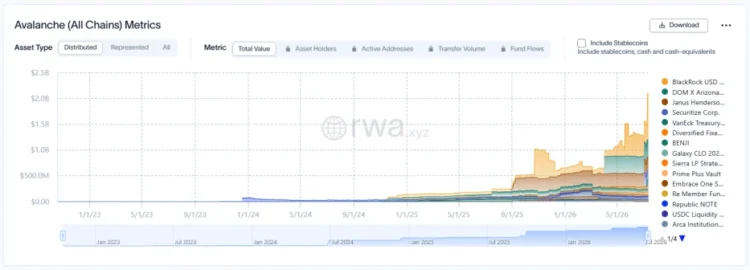
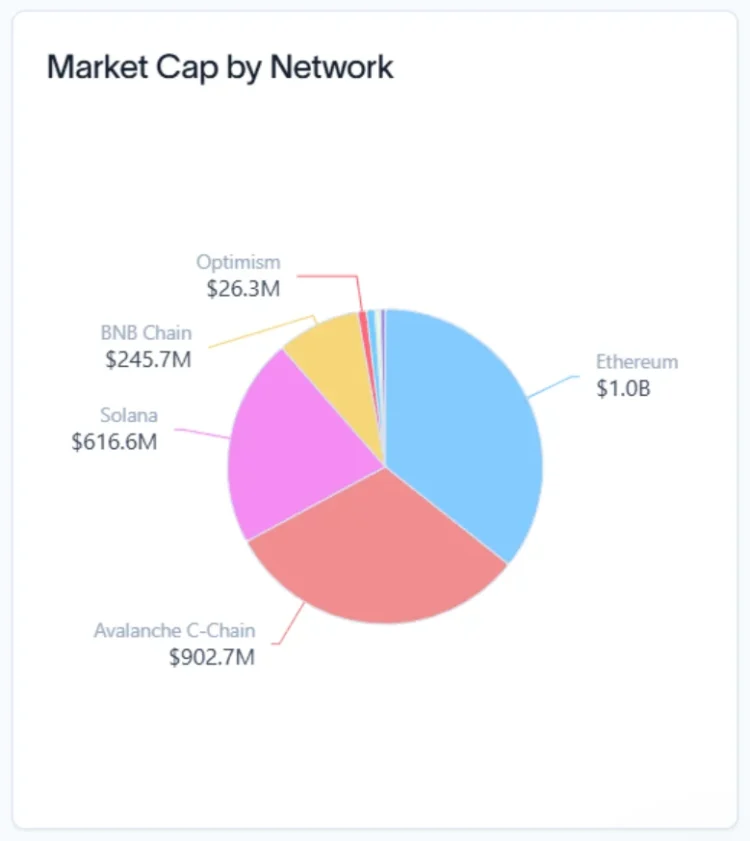
Currently, BUIDL’s total assets under management (AUM) across all networks are nearing $2.87 billion. Notably, the BUIDL share hosted on Avalanche accounts for over one-third of the fund’s total assets, establishing it as the second-largest distribution network after Ethereum. Within Avalanche’s RWA ecosystem, BUIDL alone comprises a significant 43% of its single-asset portfolio.
Adding another layer of innovation, sBUIDL, a derivative asset 1:1 pegged to BUIDL fund shares, has been approved as qualified collateral for Euler, a non-custodial lending protocol. This groundbreaking integration allows compliant users to stake sBUIDL and borrow on-chain liquidity such as USDC or AUSD. For the first time, traditional asset management products are truly connecting with the composable DeFi ecosystem, unlocking a powerful multiplier effect on capital while preserving the inherent interest-bearing properties of U.S. Treasuries.
Furthermore, Securitize has successfully executed an “Issuer-Sponsored Tokenization” of its common stock, SECZ (listed on the NYSE), on both Avalanche and Solana. This on-chain native issuance of a publicly traded stock, distinct from offshore-packaged synthetic assets, validates the feasibility of tokenized equities within existing securities law frameworks. It effectively extends Avalanche’s identity as a “crypto public chain” into the compliant architecture of mainstream securities settlement.
Asian Giants Embrace Avalanche: A New Era of Tokenization in Japan and Korea
While Western markets often prioritize top-tier compliance for securities and asset management, Asia’s tokenization initiatives are deeply rooted in micro-level industrial applications: retail payments, enterprise settlements, and cross-border fund transfers. Real-world business scenarios are rapidly migrating onto the blockchain.
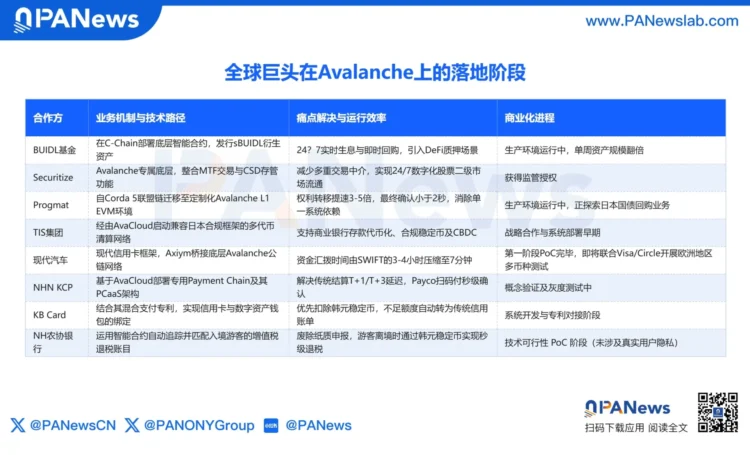
On July 13, Progmat, a platform backed by Japanese titans like Mitsubishi UFJ Trust, Mizuho, the Tokyo Stock Exchange, and SBI, completed a significant upgrade of its underlying architecture. This involved migrating over JPY 452 billion (approximately $2.7 billion) in tokenized assets from a Corda 5-based private permissioned chain entirely to Avalanche.
Progmat commands a dominant 53% market share in Japan’s security token market, with its issued tokenized assets representing 64.6% of all assets issued nationwide, covering diverse categories such as real estate and corporate bonds. The primary motivation for this migration was the inherent limitation of consortium chains as closed liquidity silos, preventing assets from connecting to the broader DeFi ecosystem and restricting value circulation. By transitioning to Avalanche, asset transfer speeds are expected to increase 3-5 fold, and final transaction confirmation times will be compressed to under 2 seconds. Crucially, Progmat gains seamless interoperability with the global blockchain ecosystem, paving the way for 24/7 real-time settlement of future services like Japanese government bonds and on-chain repurchase agreements.
Japan’s payment sector is also witnessing rapid advancements. TIS, a Japanese payment giant processing $2 trillion annually in credit card and payment transactions, has launched a multi-token payment and settlement platform via AvaCloud. This platform not only supports stablecoins and tokenized deposits issued by banks and enterprises but will also be compatible with real-time settlement of Central Bank Digital Currencies (CBDCs) in the future.
In South Korea, Avalanche’s adoption is even more deeply integrated into daily consumption and corporate operations, showcasing a multi-pronged approach:
- Cross-border Fund Transfers: On July 10, Hyundai Motor Group’s credit card division launched an internal cross-border remittance system on Avalanche, becoming the first major Korean enterprise to publicly leverage stablecoins for cross-border treasury settlement. In its initial pilot, a $20,000 test transfer between Hyundai Motor’s U.S. and Mexican subsidiaries averaged just 7 minutes, a remarkable 97% reduction in time compared to SWIFT’s 3-4 hours.
- Payment Infrastructure: In mid-April, NHN KCP, South Korea’s largest e-commerce payment company, utilized AvaCloud to build the country’s first payment-dedicated mainnet. This innovation compresses traditional T+1 to T+3 settlement delays to sub-second speeds. A pilot with the mobile payment application Payco demonstrated scan-to-payment confirmation in just 2 seconds, validating Avalanche’s commercial readiness for high-concurrency retail scenarios.
- Retail Consumption: By the end of March, major Korean credit card company KB Kookmin Card partnered with Avalanche to develop a hybrid stablecoin credit card payment system. This system prioritizes deducting Korean Won stablecoin balances during transactions, automatically utilizing traditional credit limits for any deficit, thereby optimizing the stablecoin user experience. Last November, NongHyup Bank of Korea, in collaboration with Mastercard and other institutions, also piloted a stability-based system on Avalanche.
Subnet Power: Avalanche’s Technical Edge and Its Double-Edged Sword Effect
The collective shift of industry giants from Wall Street to the Japanese and Korean markets, spanning from securities to payments, towards Avalanche is underpinned by a profound technological imperative. Enterprises grappling with blockchain adoption face a core dilemma: they seek the security, efficiency, and immutability of distributed ledgers, yet also demand data sovereignty, access control, and regulatory isolation. Avalanche’s customizable Layer 1 (Subnet) mechanism offers an elegant solution that balances both requirements.
Leveraging low-code tools like AvaCloud, enterprises can freely customize their dedicated Layer 1 networks according to their specific business needs:
- Geographical Restrictions: Enterprises can specify validator nodes to be located within particular countries, ensuring compliance with data sovereignty and outbound regulatory requirements.
- Access Control: KYC/AML (Know Your Customer/Anti-Money Laundering) rules can be embedded at the protocol layer, preventing unverified wallets from interacting with assets on the chain and fostering a compliant operating environment.
- Performance Isolation: Dedicated L1s possess independent computing resources and Gas pricing mechanisms, safeguarding them from congestion on the public network and guaranteeing the stability required for enterprise-grade services.
In essence, enterprises gain “autonomous and controllable blockchains” while simultaneously benefiting from the public network’s security consensus and ecological interoperability. This ingenious compromise of “sovereign isolation + public security” perfectly aligns with the fundamental demands of industry leaders.
However, despite Avalanche’s burgeoning prominence in the RWA sector, value capture has emerged as the most challenging structural dilemma within its tokenization strategy. While the total RWA on the Avalanche chain has surpassed $2.1 billion and industry giants are actively participating, the price of its native token, AVAX, has remained largely disconnected from this ecosystem prosperity, experiencing a year-to-date decline of over 50%.
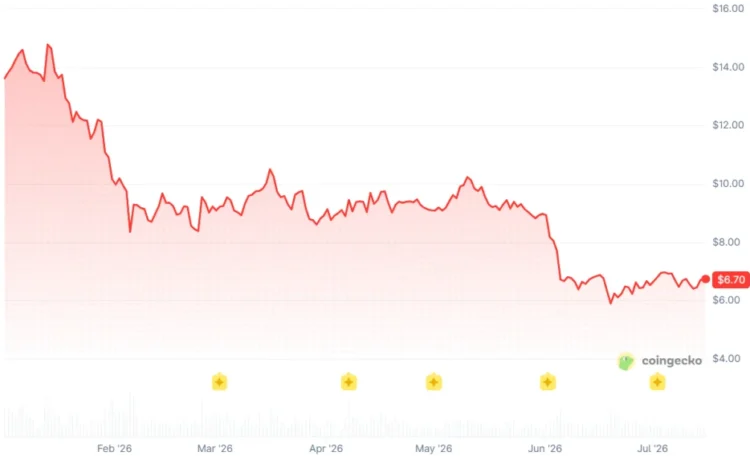
The root of this disconnect lies within the Subnet mechanism itself. To mitigate the financial risks associated with token volatility, enterprises on their dedicated L1s rarely use AVAX as a transaction medium. Instead, they prioritize stablecoins or tokenized deposits for Gas fees. Enterprises essentially leverage the Avalanche mainnet as an affordable final settlement ledger and security guarantor. Consequently, the immense value generated by these high-volume transactions struggles to be effectively transmitted to AVAX token holders through mechanisms like Gas burning.
AVAX token holders bear the risks of price volatility and lock-up without adequately sharing in the dividends of the tokenization ecosystem’s development. This “strong ecosystem, weak token” dynamic poses a significant challenge to the foundation of community consensus.
The crypto winter may linger, but spring inevitably follows. Will Avalanche’s bold bet on RWA ultimately define a new paradigm for public chain value capture, or will it be remembered as an infrastructural tragedy where it “built a wedding dress for others”? Only time will reveal the answer.