Author: Kurumi, CryptoCity
Satoshi Nakamoto’s Prescient Warning: Market Manipulation Debate Resurfaces Amidst Bitcoin’s 2026 Volatility
As Bitcoin navigated a significant market pullback in 2026, the crypto community rediscovered a profound statement made by its enigmatic creator, Satoshi Nakamoto, 16 years prior on the BitcoinTalk forum. On July 9, 2010, a user posed a critical question: could a well-funded attacker potentially dismantle the Bitcoin system by acquiring all available Bitcoins?
Satoshi Nakamoto’s response was remarkably insightful. He explained that such an act, known as “cornering the market” in traditional finance, would yield an inverse effect for a truly scarce asset. The more aggressively a buyer attempts to absorb the supply, the faster the price would escalate, leading to increasingly prohibitive acquisition costs for subsequent purchases.
To illustrate this principle, Satoshi referenced the infamous attempt by the Hunt brothers to monopolize the silver market between 1979 and 1980. Silver prices skyrocketed from approximately $11 per ounce to nearly $50, only to plummet rapidly after exchanges adjusted margin requirements, resulting in colossal financial losses for the brothers. This historical precedent served to demonstrate Satoshi’s point: when market participants endeavor to hoard vast quantities of a scarce asset, the resulting price surge benefits existing holders, encourages further retention, and ultimately risks backfiring on the very entity attempting the monopoly.

Corporate Accumulation Defies Downturn, Tightening Bitcoin’s Supply Structure
The resurgence of this historic post is particularly relevant given the evolving market dynamics of 2026. After reaching an all-time high of $126,210 on October 6, 2025, Bitcoin experienced a nearly 50% correction, settling into the $62,000 to $63,000 range by July 9, 2026. This market pressure was attributed to various factors, including ETF outflows, geopolitical instability, energy supply fluctuations, and a discernible shift of capital towards AI-themed equities.
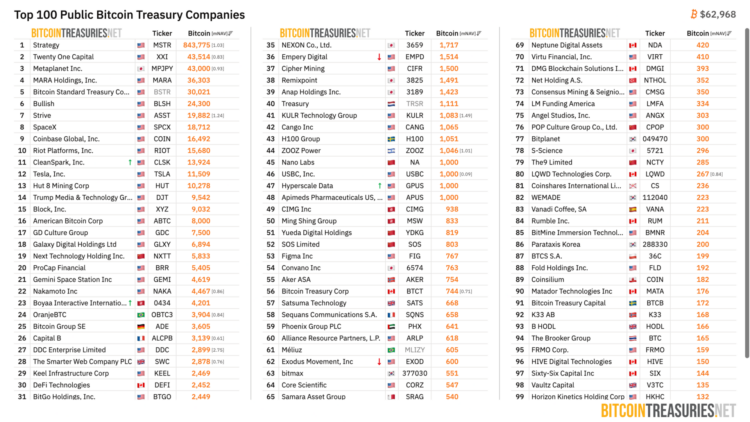
Yet, amidst this price weakness, corporate balance sheet allocations to Bitcoin continued their upward trajectory. Data reveals that as of early July 2026, publicly listed companies collectively held approximately 1.27 million Bitcoins, representing over 6% of the total supply, with nearly 200 enterprises now part of this growing trend.
Strategy Inc. (formerly MicroStrategy) cemented its position as the preeminent corporate holder, boasting 843,775 Bitcoins as of July 5, acquired at an average cost of approximately $75,476, totaling an investment of roughly $63.69 billion. Other notable corporate players include Twenty One Capital, holding around 43,514 Bitcoins, Japan’s Metaplanet with approximately 43,000 Bitcoins, and significant positions held by SpaceX and Tesla.
Supply Concentration in Long-Term Hands, New Issuance Struggles to Meet Demand
Beyond direct corporate purchases, the institutional landscape further solidifies Bitcoin’s supply constraints. Spot ETFs and cryptocurrency exchanges collectively hold an estimated 1.6 million Bitcoins, accounting for approximately 7.7% of the total supply. BlackRock’s iShares Bitcoin Trust alone commands about 3.9% of the circulating Bitcoin. When factoring in holdings by governments, private companies, DeFi protocols, miners, and other traceable entities, the aggregated holdings approach 18% to 19% of Bitcoin’s immutable 21 million supply cap.
Crucially, the phenomenon of long-term illiquid supply continues to expand. Research from Fidelity Digital Assets classifies Bitcoins unmoved for over seven years, alongside publicly listed company holdings exceeding 1,000 BTC, as highly illiquid supply. This segment is estimated to surpass 6 million Bitcoins, representing over 28% of the final supply.
Satoshi Nakamoto himself is believed to hold over 1.1 million dormant Bitcoins, a quantity that exceeds the remaining supply yet to be mined. With the current block reward at 3.125 Bitcoins, miners introduce approximately 450 new Bitcoins into circulation daily. However, Bitwise data for Q1 2026 revealed that publicly listed companies increased their holdings by 50,351 Bitcoins in that single quarter, indicating that corporate absorption rates are approximately 2.8 times higher than the rate of new issuance.
Major Pullback Tests Conviction, Scarcity Narrative Endures
Satoshi Nakamoto’s original logic is manifesting in a tangible and compelling manner within the 2026 market. Strategy Inc.’s holdings, exceeding 4% of the total Bitcoin supply, represent the largest single corporate position globally. However, their continuous accumulation has also elevated their average cost basis, necessitating strategic flexibility for cash flow management.
Between June 29 and July 5, 2026, Strategy Inc. executed a sale of 3,588 Bitcoins, generating approximately $216 million. This capital was utilized to fund dividends for Digital Credit securities, marking the company’s first significant public sale after years of consistent accumulation.
Despite the parallels, key distinctions exist between Bitcoin and the 1980 silver market. Bitcoin’s supply cap is hard-coded into its protocol, its on-chain ledger offers unparalleled transparency, making large-scale, clandestine accumulation virtually impossible, and its global distribution of holders is far wider. Furthermore, multiple market corrections exceeding 50% have demonstrated a high degree of resilience and tolerance for volatility among long-term Bitcoin holders.
While Bitcoin remains susceptible to short-term influences such as ETF flows, macroeconomic shifts, and prevailing market risk appetite, the overarching trends of corporate hoarding, expanding illiquid supply, and the reduced issuance following halving events underscore Satoshi Nakamoto’s 16-year-old description of supply and demand as the fundamental driving force behind Bitcoin’s market structure.