

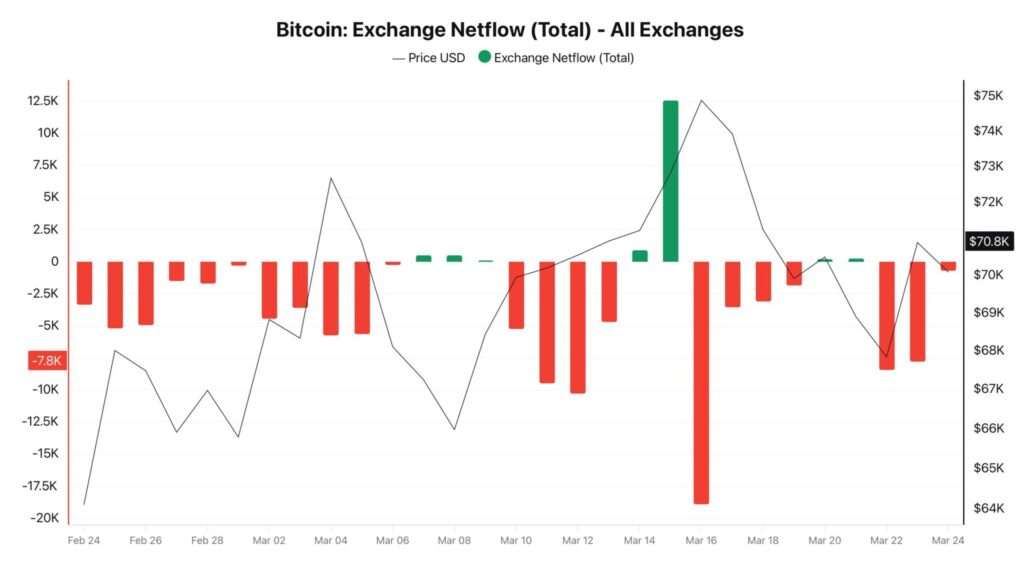
A recent in-depth analysis by CryptoQuant analyst Darkfost sheds light on a compelling trend in the cryptocurrency market: Bitcoin (BTC) has experienced a sustained period of net outflows from exchanges over the past month. This critical on-chain indicator suggests a significant shift in investor behavior, with participants increasingly moving their BTC holdings off trading platforms, signaling a preference for long-term accumulation rather than preparing for short-term sales.
Sustained Bitcoin Exchange Outflows Signal Genuine Accumulation
Darkfost’s observations underscore that Bitcoin’s market dynamics have been predominantly shaped by net outflows from exchanges for the better part of the last month. This consistent negative net flow is a strong signal that investors are actively acquiring BTC and withdrawing it, rather than depositing it onto exchanges with the intent to sell. In the realm of on-chain analytics, such persistent behavior is widely interpreted as a mid-to-long-term accumulation signal, diverging from typical short-term bearish indicators.
Darkfost: “This sustained outflow indicates that investors are indeed accumulating, continuously buying Bitcoin and withdrawing it from exchange platforms. While this demand isn’t yet sufficient to restart a trend, it clearly shows ongoing accumulation and is likely one of the reasons Bitcoin prices have been range-bound for several months.”
Further bolstering this narrative, the trading volume structure on leading exchanges like Binance and Coinbase has gradually transitioned from being seller-dominated to exhibiting a buyer-led resurgence. This shift implies that after a period of multi-month adjustments, fresh capital is beginning to re-engage with the Bitcoin market.
From a price perspective, Bitcoin is currently trading around $71,111, according to Binance data at the time of writing. Its 24-hour range has seen fluctuations between $68,923 and $71,400, demonstrating that BTC maintains a volatile yet robust stance above the critical $70,000 threshold. Should the net outflows from exchanges persist, coupled with the price sustainably holding above $70,000, market conviction regarding “smart money accumulating at lower levels” is poised to strengthen considerably.
Ethereum Recovers to $2,150, But Rally Faces Scrutiny
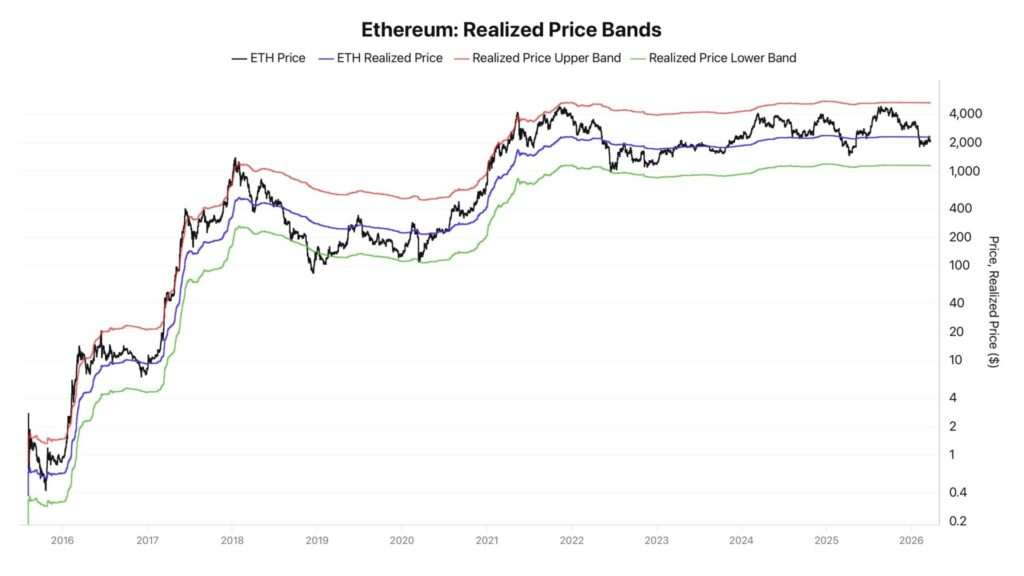
Darkfost’s recent assessment of the Ethereum (ETH) market structure reveals that ETH trading remains heavily influenced by futures and other derivative products, while spot market momentum appears notably subdued. This indicates that although capital has not entirely withdrawn from Ethereum, new buying interest is proceeding with relative caution.
Darkfost highlights, “Ethereum also continues to trade within a short-term range, currently priced around $2,150. This price point is in close proximity to the average transaction price of $2,300. Utilizing standard deviation, the projected upper bound for Ethereum’s average transaction price is approximately $5,300, with a lower bound around $1,150.”
Darkfost advises that given ETH’s current position in the middle of this transaction price range, “waiting” represents the optimal strategy for investors considering mid-to-long-term allocations. He stresses that this advice is particularly pertinent in the prevailing market environment, where the realized price acts as a significant resistance level and could serve as a breakeven exit point for some investors.
The market’s immediate attention will be fixed on whether ETH can decisively break and sustain above the $2,200 level. Relevant data from Coinglass suggests that a breach above approximately $2,222 could trigger liquidations of over $1.3 billion in short positions. This implies that this level is not merely a technical resistance point but potentially a powerful catalyst for a short-term market expansion. Conversely, a fall below the $2,021 vicinity could pressure long positions into forced liquidation.
While Ethereum is indeed experiencing a rebound, its current market structure, ETF fund flows, and recent trading and price performance collectively suggest that this upward movement is more akin to a “rebound within a weak recovery” rather than a confirmed entry into a new, robust uptrend. For investors, a sustained breakout from the current consolidation phase for ETH would necessitate not only prices stabilizing above $2,200 but also a simultaneous and significant improvement in spot demand and ETF capital inflows to unlock substantial further upside potential.
Altcoin Trading Volume Freezes: A Closing Liquidity Window?
In a separate, equally critical observation, Darkfost previously highlighted a stark contraction in altcoin spot trading volumes across Binance and other major exchanges. This trend signifies a noticeable decline in investor engagement with higher-risk crypto assets, indicating not only weakening market sentiment but also that altcoins may remain entrenched in a phase characterized by Bitcoin dominance and conservative capital allocation.
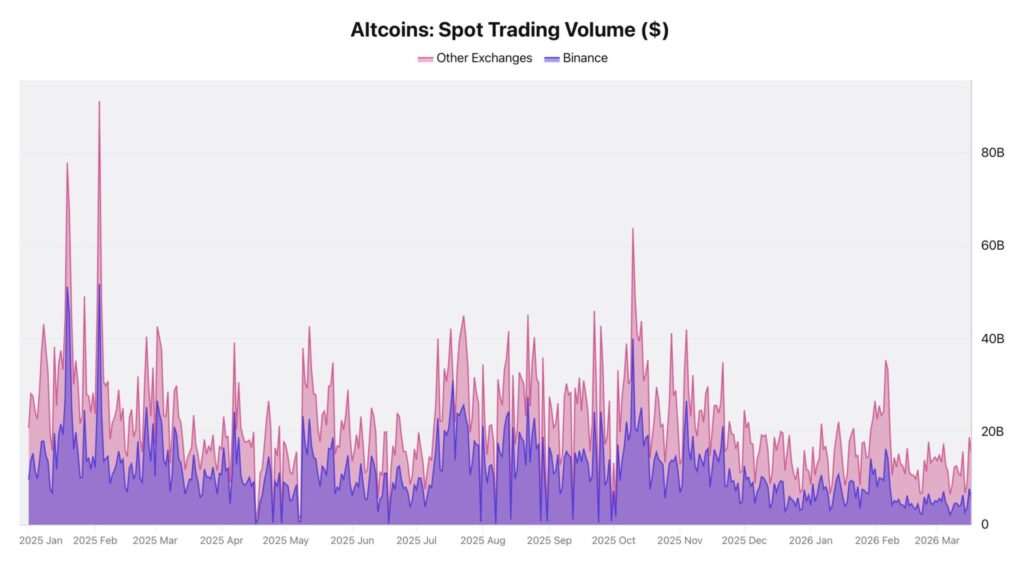
In his May 20 post, Darkfost underscored that current altcoin spot trading volumes have plummeted to multi-month lows. Data illustrates Binance’s daily altcoin volume at approximately $7.7 billion, with other major exchanges collectively reaching around $18.8 billion. These figures represent a dramatic decrease compared to the peaks observed during active periods in October 2025 and February 2026, when Binance alone commanded volumes of $40 billion to $50 billion, and other platforms ranged from $63 billion to $91 billion. Darkfost explicitly states that this stark difference reflects a clear and concerning loss of investor interest in altcoins.
Within the dynamic crypto market, altcoin trading volume is frequently regarded as a crucial “thermometer” for overall market risk appetite. When capital eagerly flows into more volatile and fundamentally less stable tokens, it typically signals an optimistic and speculative market sentiment. Conversely, a rapid and pronounced contraction in altcoin volume often suggests that traders are adopting a more cautious stance, preferring to allocate capital to Bitcoin, stablecoins, or even exiting the market entirely.
Darkfost’s data precisely illustrates this phenomenon: current altcoin volumes are not only significantly below previous highs, but Binance alone now accounts for roughly 40% of altcoin trading. This concentration indicates that overall liquidity is increasingly centralizing on a few large platforms, and market breadth is simultaneously narrowing, signifying a less robust and diversified market.
The current decline in trading volume unmistakably signals a widespread lack of investor interest, which remains a negative indicator in the short term. Without a tangible improvement in the macroeconomic environment or Bitcoin’s ability to sustainably hold higher price ranges, altcoins are highly likely to remain under persistent pressure and maintain a market structure that is notably “weaker than Bitcoin.”
Disclaimer: This article is provided for market information purposes only. All content and views expressed are for reference and do not constitute investment advice. They do not represent the views or positions of BlockBeats. Investors should conduct their own due diligence and make independent trading decisions. The author and BlockBeats will not assume any responsibility for direct or indirect losses incurred by investors’ transactions.




