
Binance vs. The Wall Street Journal: Unpacking the $1.7 Billion Iran Sanctions Allegations and the Future of Crypto Compliance
A bombshell report from The Wall Street Journal alleging $1.7 billion in funds flowed to sanctioned Iranian entities via Binance, coupled with claims of compliance officers being dismissed for “knowing too much,” has ignited a fierce legal battle. This escalating dispute raises critical questions: Is this a failure of an exchange’s compliance framework, or a misinterpretation of on-chain data by the media? As Binance launches a defamation lawsuit, this geopolitical, financial sanctions, and on-chain forensics ‘Rashomon’ is exposing the most intense struggles of the cryptocurrency industry’s transformation.
Before delving into the deeper implications of this controversy, let’s trace the events along a timeline and highlight the key points of contention to understand the full scope of the dispute.
Timeline of the Dispute
- February 13: Fortune breaks the story, accusing Binance of dismissing internal investigators who were pursuing potential violations involving Iranian financial flows.
- February 23: The Wall Street Journal and The New York Times follow up. The WSJ specifically alleges Binance facilitated up to $1.7 billion in funds to sanctioned Iranian entities and claims senior management “forcibly halted investigations” and “suppressed compliance reports.”
- February 23: Binance issues a statement, publicly detailing its internal investigation processes and refuting media reports as based on “incomplete and materially mischaracterized narratives.” The statement emphasizes that funds did not flow directly to sanctioned entities.
- March 11: Binance officially files a defamation lawsuit against The Wall Street Journal. On the same day, the WSJ publishes another article, stating the U.S. Department of Justice is investigating the matter, to which Binance responds, “unaware of any such investigation.”
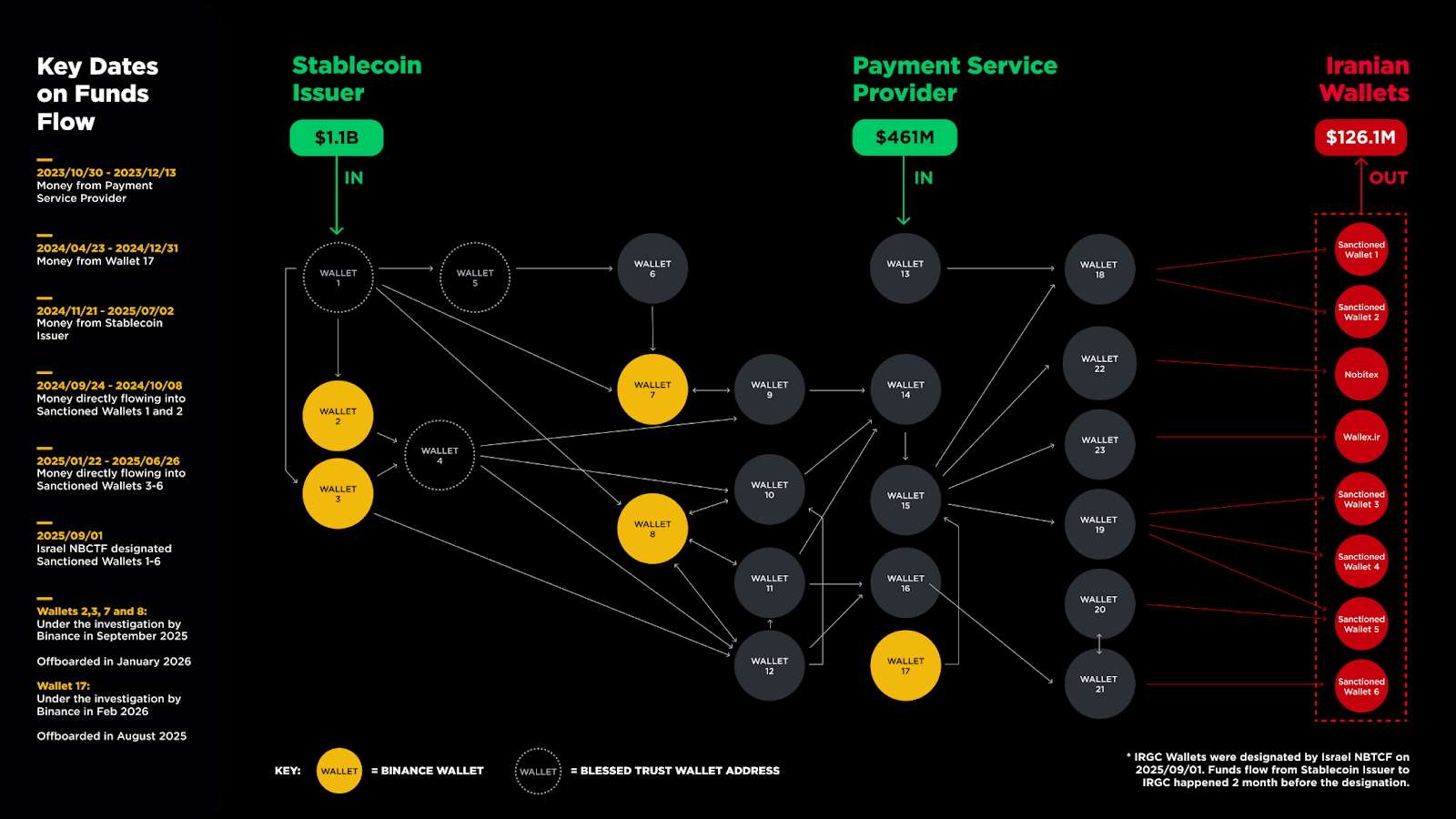
- March 11: Binance releases a statement, directly labeling the foreign media’s four major accusations as “false” and revealing a detailed on-chain fund flow diagram showing the $1.7 billion went through “at least 3 layers away” from Binance.
The Media’s Thriller Narrative: “The Disappearing Investigation”
According to reports from The Wall Street Journal and The New York Times in February, Binance’s compliance investigation team discovered last year that two companies, “Blessed Trust” and “Hexa Whale Trading,” allegedly transferred hundreds of millions of dollars in cryptocurrency through the Binance platform for Iran-linked organizations, including the Islamic Revolutionary Guard Corps (IRGC).
The most explosive revelation centered on personnel changes. The reports claimed that after investigators escalated their concerns to senior management, they were successively suspended, and the entire investigation team was disbanded shortly after founder Changpeng Zhao (CZ) received a pardon.
This narrative perfectly aligns with public perceptions of “large corporations covering up the truth”: internal whistleblowers expose a shocking scandal, only to face retaliatory purges, with massive financial flows linked to terrorist organizations. The plot is tight, full of dramatic tension. For a time, Binance appeared to be an uncontrolled financial behemoth, willing to cross sanction red lines for profit.
The Genesis of the Storm: Binance’s Counter-Narrative
The incident garnered widespread attention not merely due to the “large scale of funds” but, more critically, because it touched upon two highly sensitive issues: “alleged assistance to Iran in evading sanctions” and “the integrity of cryptocurrency exchange compliance.”
However, as Binance released more details of its internal investigation, a different version of the story began to emerge.
To uncover the true genesis of the storm, how exactly did this investigation begin? According to Binance’s statement, the investigation commenced in mid-2025, initially as a “request for assistance from law enforcement agencies.” It was through this collaboration that they discovered suspicious connections within a complex chain of funds, leading to certain wallets.
Binance immediately launched an internal investigation, which led to the identification of the two implicated accounts: “Blessed Trust” and “Hexa Whale.” The statement emphasizes that Binance promptly blocked these accounts and proactively reported the relevant intelligence to law enforcement. This, Binance argues, is the full factual picture intentionally omitted from the sensational headlines.
The $1.7 Billion Enigma: Direct Pipeline to Tehran or On-Chain Labyrinth?
How did the “alleged $1.7 billion in funds” reported by the media flow on the blockchain? After months of investigation, the Binance team gradually reconstructed a financial activity model spanning Asia, the Middle East, and other regions. This involved multiple actors and primarily included three key stages:
- Fund Origin: The funds originated from a regulated large stablecoin issuer and a Singapore-regulated digital payment and banking services provider.
- Intermediate Transfers: After leaving Binance, the funds were disbursed to multiple wallet addresses. Further investigation revealed that many of these wallets were likely controlled by the same owner and belonged to a larger criminal group.
- Final Recipients: After multiple “multi-hop” transfers on the blockchain (meaning funds moved between several addresses), approximately $126.1 million eventually reached Iran-related wallet addresses, with the actual amount flowing to “Islamic Revolutionary Guard Corps (IRGC)” related wallets being $24.1 million.
Binance pointed out that the users involved were not listed on any international sanctions lists at the time, and their transactions on the Binance platform did not trigger any industry-standard on-chain monitoring tool alerts. The transactions and wallets related to the IRGC were, in fact, only unearthed by Binance through proactive cooperation with law enforcement after initiating its own investigation.
Media’s Four Key Accusations and Binance’s Rebuttal
To clarify the truth, we have contrasted the media’s “four major accusations” with the “objective facts” presented by Binance:
-
Accusation 1: “Binance transferred $1.7 billion to sanctioned Iranian entities.”
- Binance’s Response: The origin and destination of these disputed funds were not on Binance. Funds flowed through multiple third-party intermediary wallets before reaching Iran-related addresses, and the vast majority of funds were unrelated to Iran. Binance has deactivated accounts suspected of illicit activity and reported suspicious activities to law enforcement. Binance’s actions comply with applicable sanctions laws and are a testament to an effective compliance program.
-
Accusation 2: “Binance compliance personnel were fired for investigating this case.”
- Binance’s Response: No employee was dismissed for reporting compliance concerns. The departure of some compliance employees was due to their being found in an internal review to have severely violated the company’s information protection and confidentiality policies. In the financial and compliance sectors, leaking user privacy and internal investigation secrets constitutes a major breach warranting dismissal.
-
Accusation 3: “The investigation was forcibly stopped or suppressed by senior management.”
- Binance’s Response: The investigation was never interrupted, even after the departure of relevant employees. The ultimate outcome was that Binance, upon concluding the investigation, immediately closed all accounts involved in suspicious activities and reported all these activities to law enforcement agencies.
-
Accusation 4: “Binance investigators were denied access to the Blessed Trust account.”
- Binance’s Response: System logs show that investigators were granted access to the account from the outset, and this access was extended multiple times, never being restricted or obstructed.
The Deeper Question: Where Does Compliance Responsibility End?
In this battle over the $1.7 billion fund flow, the most critical point of contention is: How far should the boundaries of compliance extend?
From the perspective of traditional banking, Binance’s role here is akin to a “relay bank.” Firstly, before entering Binance, the funds originated from regulated digital payment service providers and large stablecoin issuers. This implies that the funds underwent initial screening at the front end. However, after leaving Binance, the funds entered what Binance describes as a “dark labyrinth,” undergoing multiple transfers. Ultimately, only $24.1 million flowed into sanctioned entities (like the IRGC), representing merely about 1.4% of the total amount alleged by the media.
We must consider: If a financial institution has already conducted Know Your Customer (KYC) verification and the funds’ origin is legitimate, does it still possess the legal obligation and technical capability to “predict” the ultimate destination of these funds after five, ten, or more transfers?
Binance’s decision to sue The Wall Street Journal is less a battle for reputation and more a direct challenge to the concept of “unlimited compliance liability.” In traditional banking, there has rarely been such an exacting demand for financial institutions to bear joint responsibility for “infinite downstream” activities. However, in the face of the transparent blockchain ledger, traditional media has seemingly leveraged this transparency to unilaterally expand the “boundaries” of compliance, placing Binance under the public’s magnifying glass for arbitrary condemnation.
As Binance stated in its announcement: “No exchange, whether in crypto or traditional finance, can guarantee that risk will never touch its platform. What distinguishes a responsible institution is what it does when risk occurs: can it detect the risk, investigate, take measures to mitigate it, and report it in a timely manner? In every case recently reported, Binance has done all four.”
How the Judiciary Views Similar Allegations: Precedent-Setting Rulings
While media narratives can carry bias, U.S. federal court rulings offer a calm and objective legal perspective. To understand Binance’s position regarding the “$1.7 billion Iran fund flow,” we must refer to two significant precedents:
Firstly, in early March this year (as the WSJ reports were gaining traction), U.S. District Court Judge Jeannette A. Vargas of the Southern District of New York issued a significant ruling: She fully dismissed a class-action lawsuit filed by 535 victims of terrorist attacks against Binance under the Anti-Terrorism Act.
The plaintiffs alleged that Binance knew since 2019 that terrorist organizations like Hamas were using its platform (claiming $56 million in Hamas-related funds flowed through Binance), and thus Binance should be held responsible for these attacks.
However, the judge, in a 62-page ruling, stated that while Binance had a “general awareness” of potential terror financing risks on its platform, this was insufficient to establish legal liability. Plaintiffs had to prove that Binance “knowingly” and “deliberately assisted” terrorists, and that this assistance had a direct link to the attacks themselves.
The court rejected the plaintiffs’ “fungibility of funds” theory, which posits that “as long as funds flow through a platform, the platform is funding terrorism,” ruling that this logic is legally unsound.
Within two weeks, a U.S. federal court in Alabama also dismissed another Anti-Terrorism Act lawsuit against Binance.
In this case, the court not only found significant legal and pleading deficiencies on the part of the plaintiffs but also described the complaint as a “shotgun pleading,” failing to clearly define claims and improperly lumping all defendants together without distinguishing individual actions and responsibilities.
Binance’s “Compliance Moat”: A $200 Million Annual Investment
Beyond the legal boundaries established by judicial rulings, Binance’s recent investments and achievements in compliance offer another perspective:
- Between January 2024 and July 2025, the proportion of “sanctions-related exposure” in Binance’s total transaction volume was dramatically reduced by 96.8%.
- Between January 2024 and January 2026, Binance’s “direct exposure amount” to the four major Iranian cryptocurrency exchanges plummeted from $4.19 million to $0.11 million, a reduction of 97.3%.
- In 2025 alone, Binance’s compliance team processed over 71,000 requests for assistance from law enforcement agencies worldwide.
- With Binance’s assistance, over $131 million in illicit funds were seized and handed over to law enforcement agencies in 2025.
- Binance invests over $200 million annually in its compliance programs, with nearly 25% of its employees dedicated solely to compliance work.
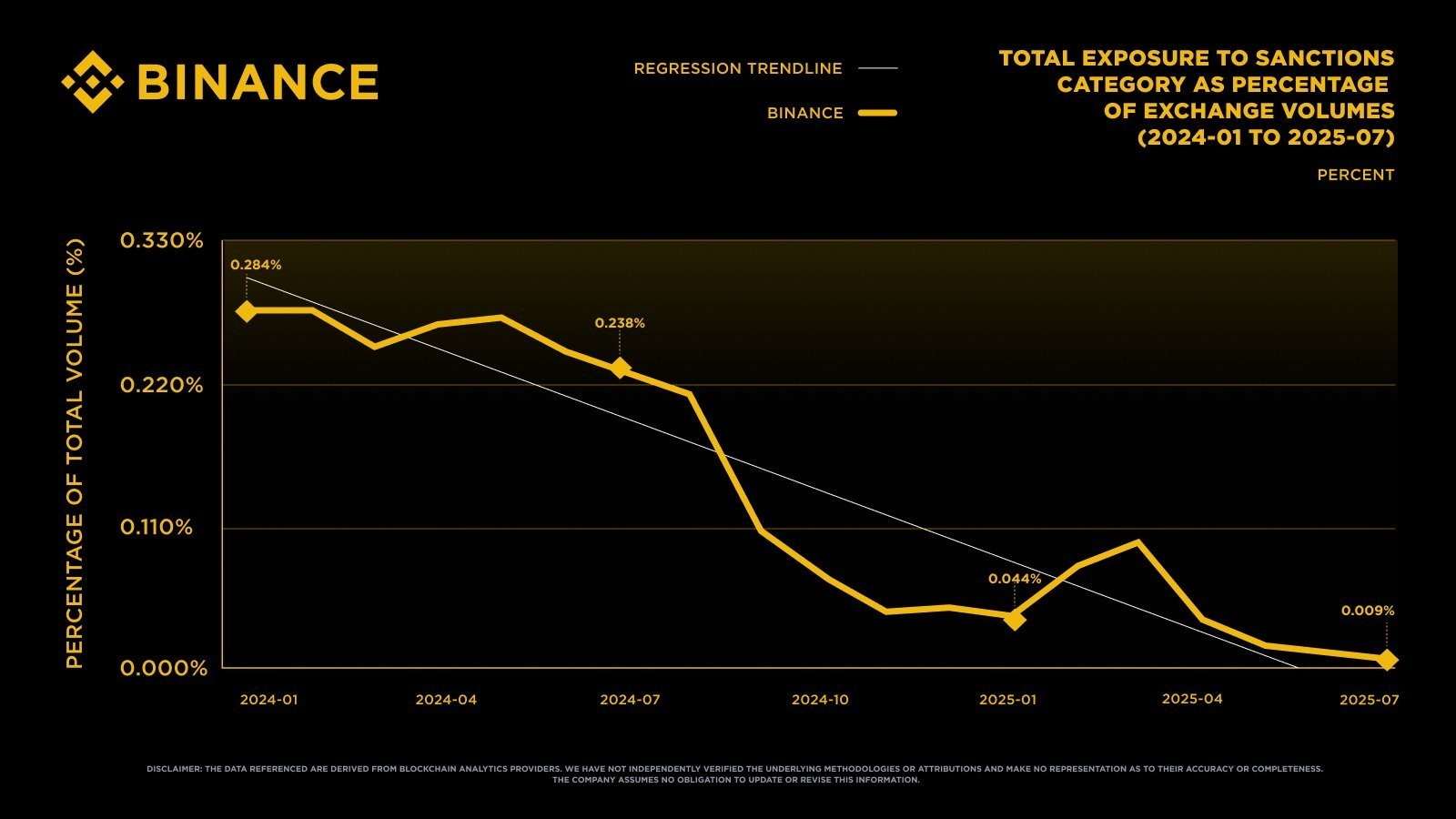
Evidently, in the fight against money laundering and for international sanctions compliance, Binance’s performance has been notably strong, even surpassing many mainstream exchanges. When focusing on controlling exposure to Iranian exchanges, Binance not only leads in effectiveness but also officially emphasizes that the platform has further strengthened its sanctions-related risk control mechanisms, pushing its already industry-low risk levels even lower.
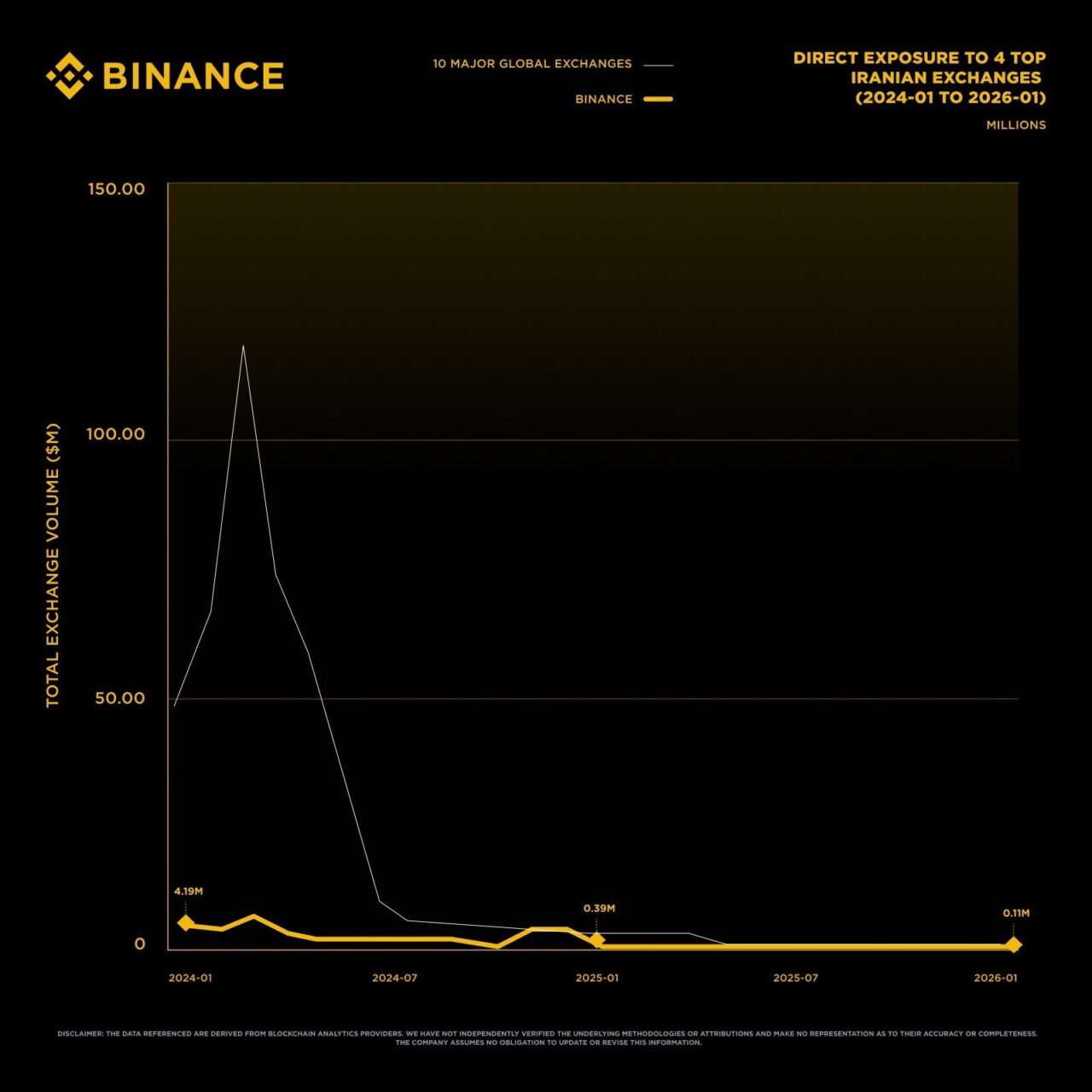
Undeniably, the cryptocurrency industry, in its early, unregulated growth phase, accumulated numerous historical challenges due to a lack of compliance awareness. As an industry leader, Binance’s role necessitates enduring the most rigorous scrutiny, a seemingly inevitable cost.
However, when an enterprise invests $200 million annually, dedicates 25% of its workforce, and slashes sanctions exposure by 96.8%, yet traditional media still chooses to disregard objective facts and sell anxiety through selective reporting, it undoubtedly strikes an unfair blow to a cryptocurrency industry striving for robust compliance.
Disclaimer: This article is for market information purposes only. All content and opinions are for reference only and do not constitute investment advice. They do not represent the views and positions of the author or BlockTaker. Investors should make their own decisions and trades. The author and BlockTaker will not bear any responsibility for direct or indirect losses incurred by investors’ transactions.




