
For years, the “new token launch” arena within the cryptocurrency primary market has largely operated in a regulatory gray zone. This environment, especially since 2018, has effectively excluded U.S. users from participating in initial token offerings. However, a significant shift is underway, spearheaded by crypto giant Coinbase.
Less than a month after its strategic $375 million acquisition of on-chain fundraising platform Echo, Coinbase has taken another monumental step: launching its dedicated token sales platform. This initiative is set to redefine access, reopening the door for U.S. retail investors to compliantly engage in initial token sales.
Coinbase’s Game-Changing Approach: A Structural Transformation in Token Launches
Coinbase’s new platform isn’t just another launchpad; it represents a fundamental re-evaluation of how new tokens are brought to market. Its design principles aim to address long-standing issues of fairness, transparency, and market stability.
1. From Lottery to Algorithm: Democratizing Access for Retail Investors
Traditional launch platforms, like Binance Launchpad and OKX Jumpstart, often rely on lottery systems or first-come, first-served (FCFS) mechanisms. These methods frequently favor large capital holders, leaving general users reliant on luck for allocation.
Coinbase’s platform introduces an innovative “algorithmic allocation” mechanism. This system prioritizes smaller subscription amounts, gradually scaling up to larger allocations. This design significantly lowers the financial barrier for entry, effectively curbing high-frequency arbitrage and providing genuine participation opportunities for retail investors.
2. Fostering Long-Term Commitment: Lock-ups and Anti-Arbitrage Measures
To combat the “pump and dump” phenomenon common in early token listings, Coinbase has implemented robust stability measures:
- Mandatory Project Lock-ups: Project teams and associated entities are prohibited from conducting over-the-counter (OTC) sales or selling tokens for six months post-issuance.
- User Incentive System: If a user sells their allocated tokens within 30 days of listing, they will face automatic reductions in future allocations, encouraging a long-term investment mindset.
3. Empowering Informed Decisions: Standardized Disclosure
Coinbase sets a new benchmark for transparency. Projects launching on the platform are mandated to disclose comprehensive details, including:
- Detailed tokenomics
- Purpose of funds
- Team background
- Development roadmap
- Potential risks
This disclosure standard significantly surpasses the information depth typically found on most existing exchange launchpads. While other platforms require some data, Coinbase’s standardized approach aims to mirror the prospectus-level disclosures seen in traditional IPO markets. This empowers investors to make truly informed decisions, rather than relying solely on “community hype” or “FOMO.”
4. Beyond Platform Tokens: A Return to Project Value
A common practice in many token launches is the requirement to hold or stake an exchange’s native token (e.g., BNB, OKB) to qualify for participation. This often forces users to acquire platform ecosystem assets, which can exacerbate price volatility and amplify risks for both the platform token and the new asset.
Coinbase breaks this “platform token dependency.” Users are not required to lock up any platform-specific tokens; participation solely requires USDC, and the process is entirely fee-free for users. The platform generates revenue from a fixed percentage service fee paid by the project teams. This mechanism refocuses the “new token launch” experience on its core essence: evaluating and investing in promising projects, rather than speculating on platform tokens.
Monad: Coinbase’s Inaugural Launch – A Deeper Dive
The first project to launch on Coinbase’s new token sales platform is Monad ($MON), a high-performance Layer 1 public blockchain currently under development. Monad emphasizes parallel execution, exceptionally high transaction throughput, and full compatibility with the Ethereum Virtual Machine (EVM). It boasts backing from prominent institutional investors, including Jump Trading, Placeholder, Lattice, and Dragonfly.
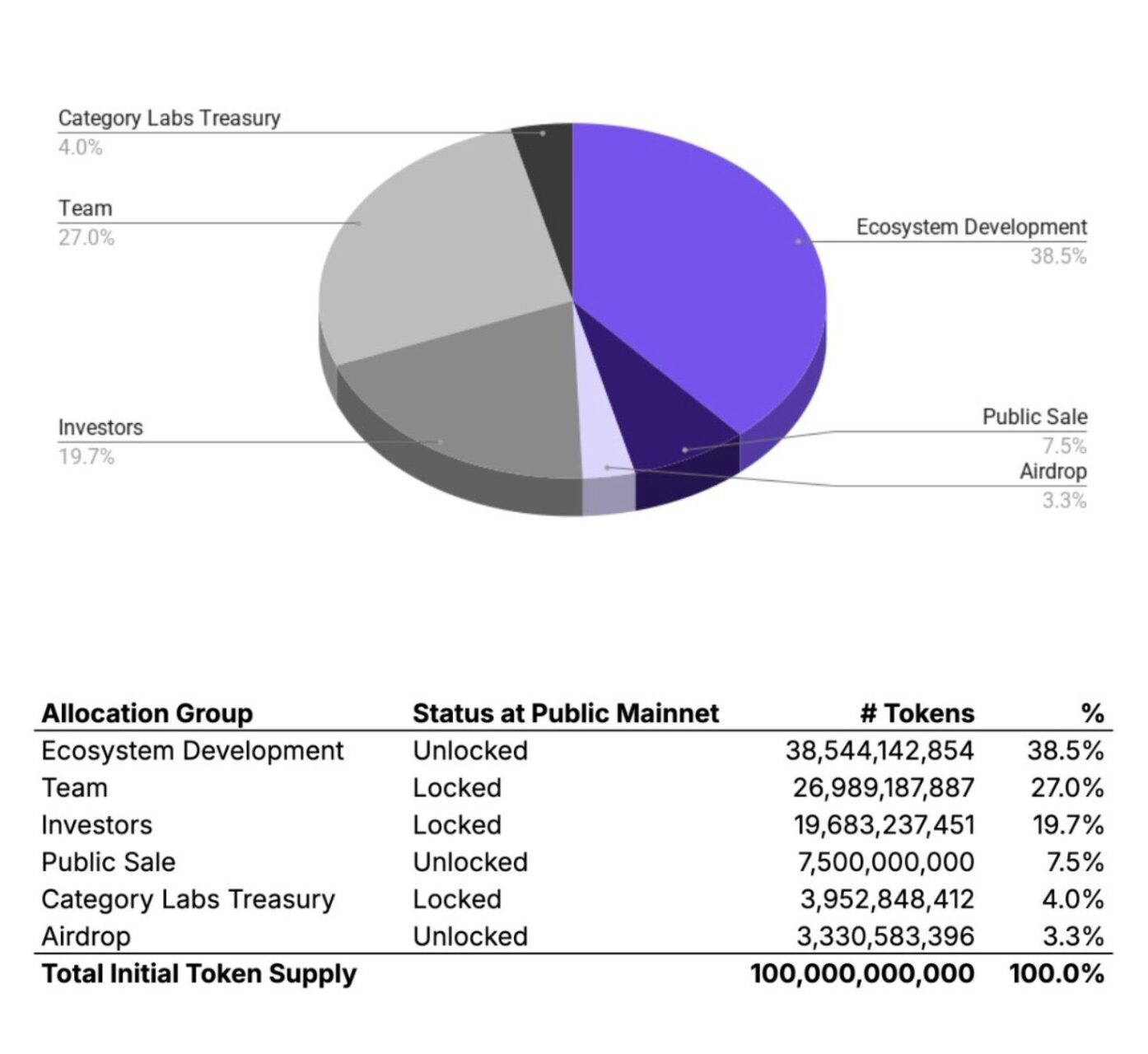
The public sale price for Monad is set at $0.025, a substantial discount compared to its previous pre-market trading price of approximately $0.06. This significant price difference has fueled market expectations of a 2–3x short-term upside, especially given the prestige of a Coinbase launch.
However, prospective investors should exercise caution. Monad is releasing only 7.5% of its total supply, valuing the project at roughly $2.5 billion. This valuation is notably high for an L1 project that has yet to launch its mainnet. Furthermore, its ecosystem is still nascent, and development is in its early stages, leaving future performance uncertain.
Additionally, due to Coinbase’s algorithmic allocation mechanism prioritizing smaller applications, individual users are likely to receive relatively small allocations, limiting the overall investment opportunity for single participants.
Therefore, while Monad presents a compelling opportunity, it is not a “guaranteed win” for the average investor. If participating, it’s advisable to control the subscription amount, adopt a mid-to-long-term perspective on the project’s development, and closely monitor its ecosystem build-out post-mainnet launch.
The Intensifying Competition Among Centralized Exchanges
Coinbase’s latest move is not an isolated incident. In recent years, most major centralized exchanges (CEXs) have been aggressively expanding their “token launch” offerings. From project screening and fundraising design to listing and ecosystem support, they are increasingly building comprehensive “launch ecosystems.” Platforms like Binance Launchpad, OKX Jumpstart, and Bybit IDO are prime examples of this trend.
This evolution from being mere “exchange platforms” to “full-chain primary market service providers” reflects both the exchanges’ business expansion strategies and the broader crypto industry’s maturation towards a more structured and standardized era.
Here’s a comparison of several top exchanges:
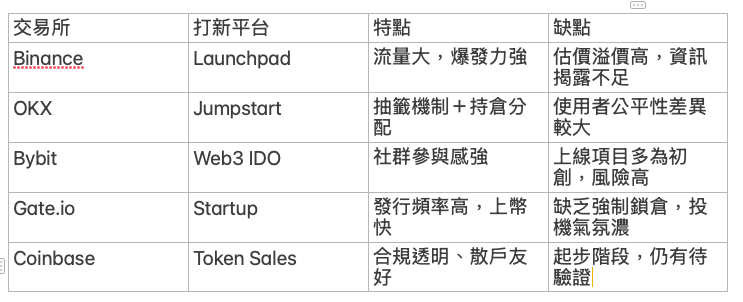
What sets Coinbase apart is its design philosophy, which more closely aligns with traditional financial market processes such as IPOs, private placements, and lock-up periods. Coinbase is consciously attempting to guide the entire token issuance ecosystem away from a “speculative frenzy” and towards institutionalized, rule-based development.
Rather than simply replicating Binance’s success, Coinbase is charting a distinct course, establishing a new token issuance pathway better suited for compliant users and long-term investors. The essence of this model lies in infusing stability and predictability into digital assets through standardized procedures and robust risk control systems.
For the broader crypto industry, Coinbase’s launch platform has the potential to not only restore retail investor confidence but also become a legitimate “main gate” for high-quality projects entering the market. By reducing reliance on regulatory gray areas, it could establish a new foundation of trust for the primary market.
Can Coinbase Usher in an Institutionalized Crypto Primary Market?
The current industry is in dire need of both breakthrough projects and a fair, compliant issuance system accessible to everyone. Coinbase may well be forging this new path.
More than just a “launch innovation,” Coinbase is posing a critical question: Can early-stage Web3 fundraising mechanisms be more orderly, fairer, and more rational than mere speculation, lottery systems, or blind investments? Through its acquisition of Echo, Coinbase is actively pursuing the vision of an integrated “fundraising to listing” pipeline. If Echo’s issuance tools seamlessly integrate with Coinbase’s distribution and compliance framework, it could establish standardized primary market infrastructure within the U.S., significantly enhancing the efficiency from capital raising to liquidity.
While immediate success is not guaranteed, this initiative undoubtedly opens a crucial doorway. Whether this gateway will become the primary entry point for mainstream compliant users and premium projects in the future remains to be seen.
However, before celebrating a new era, a dose of realism is warranted: Can a market already saturated with new tokens truly be revitalized by yet another launch platform? Coinbase has restructured the rules of issuance, but perhaps its greatest challenge lies in identifying genuinely valuable new assets for an increasingly crowded market.
(This content is an authorized excerpt and reproduction from our partner PANews. Original Link | Source: Bitpush)
Disclaimer: This article is for market information purposes only. All content and opinions are for reference only and do not constitute investment advice. They do not represent the views and positions of BlockTempo. Investors should make their own decisions and transactions. The author and BlockTempo will not bear any responsibility for direct or indirect losses resulting from investor transactions.




