
Bitcoin Mining Difficulty Hits 2021 High with 15% Spike, Challenging Miner Profitability
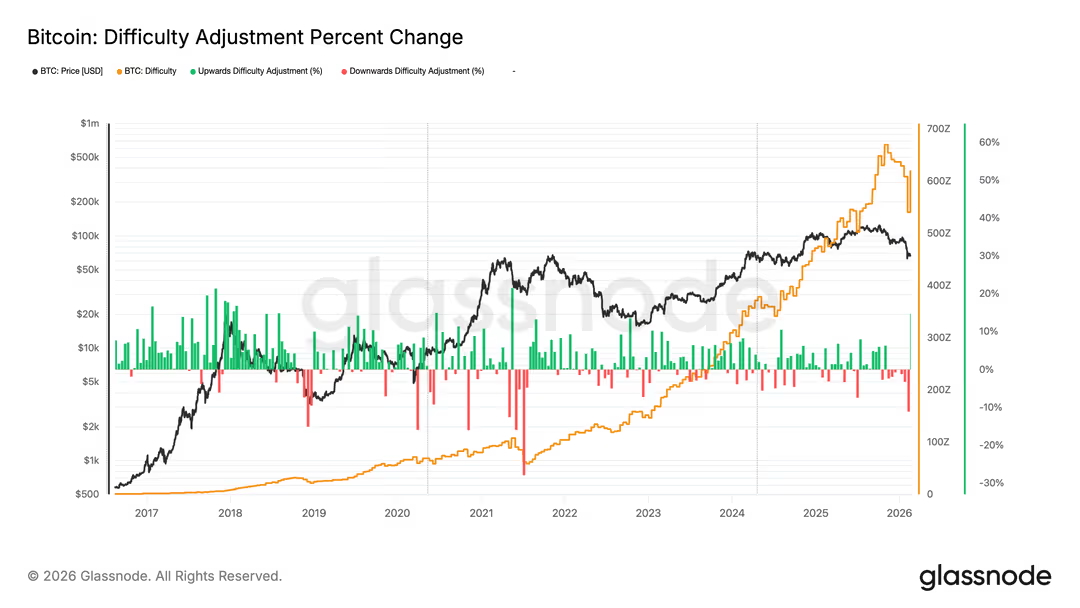
Despite recent fluctuations in Bitcoin’s price, the competitive landscape for cryptocurrency miners has intensified dramatically. Latest data reveals a significant surge in Bitcoin mining difficulty, climbing to an unprecedented 144.4 T. This marks a substantial 15% increase in a single adjustment, representing the largest such jump recorded since 2021.
A Historic Surge: Echoes of 2021
The last time Bitcoin’s mining difficulty experienced such a sharp upward revision was in 2021. That period coincided with China’s sweeping ban on Bitcoin mining, which triggered a massive relocation of hash rate globally. Following the network’s stabilization post-migration, a remarkable 22% upward correction in mining difficulty was observed.
Understanding Bitcoin’s Difficulty Adjustment Mechanism
The Bitcoin blockchain is designed with an ingenious self-regulating mechanism: its mining difficulty adjusts approximately every two weeks, or every 2,016 blocks. This adjustment is crucial for maintaining a consistent block production rate of roughly one block every 10 minutes, regardless of the number of miners actively participating in the network.
Essentially, mining difficulty serves as a barometer for competition among miners. A higher difficulty level indicates more intense competition. If the network’s aggregate hash rate (total computational power) increases over the two-week period, the difficulty rises, making it harder to mine new blocks. Conversely, a decline in hash rate leads to a decrease in difficulty, simplifying the mining process.
Recent Volatility and Hash Rate Recovery
The previous difficulty adjustment saw a 12% downward revision, primarily due to a sharp decline in hash rate. This downturn was largely attributed to extreme winter storms across the United States, which compelled several major mining operations to temporarily scale back or halt activities, marking the most significant setback for mining since late 2021.
Historical data illustrates a close correlation between Bitcoin’s price and network hash rate. Last October, as BTC prices were reported to have surged to an approximate historical high of $126,500, the total network hash rate also simultaneously peaked at 1.1 ZH/s. However, when the coin’s price retreated to around $60,000 in February of this year, the hash rate subsequently dropped to 826 EH/s.
More recently, with Bitcoin’s price rebounding to approximately $67,000, the network’s hash rate has shown a robust recovery, now standing at the 1 ZH/s level. This strong resurgence in computational power has laid the groundwork for the latest dramatic increase in mining difficulty.
The Profitability Squeeze for Miners
Despite the formidable return of hash rate, Bitcoin miners are currently grappling with significant challenges to their profitability. The “Hashprice” — a key metric estimating the daily expected revenue per unit of hash rate — remains stubbornly low, hovering around multi-year lows of approximately $23.9 per PH/s. This persistently low hashprice is severely compressing profit margins for mining operators, even as network competition reaches new heights.
Disclaimer: This article is provided for market information purposes only. All content and views are for reference only and do not constitute investment advice, nor do they represent the views and positions of BlockTempo. Investors should make their own decisions and trades. The author and BlockTempo will not bear any responsibility for direct or indirect losses resulting from investors’ transactions.