
Author: Fenrir, Crypto City
Morgan Stanley’s MSBT ETF Shatters Records, Dominating Bitcoin Market Entry with Ultra-Low Fees
Morgan Stanley (MS) has made a formidable entry into the cryptocurrency market, with its newly launched Bitcoin Exchange-Traded Fund (ETF), ticker MSBT, demonstrating extraordinary growth momentum in its inaugural week of trading.
According to the latest data from Farside Investors, this pioneering fund, which commenced trading on April 8th, achieved a cumulative net inflow exceeding $100 million—specifically, $103 million—within just six trading days. As of the time of writing, the fund’s total net inflows over seven days have reached an impressive $116 million.
This remarkable performance marks MSBT as the most successful ETF launch in Morgan Stanley’s history, quickly outperforming numerous competitors that entered the market earlier. On a single Wednesday, MSBT attracted $19.3 million in inflows, catapulting its total assets past the WisdomTree Bitcoin Fund (WBTC), which debuted in January 2024. MSBT’s rapid ascent is largely attributed to its highly competitive fee structure.
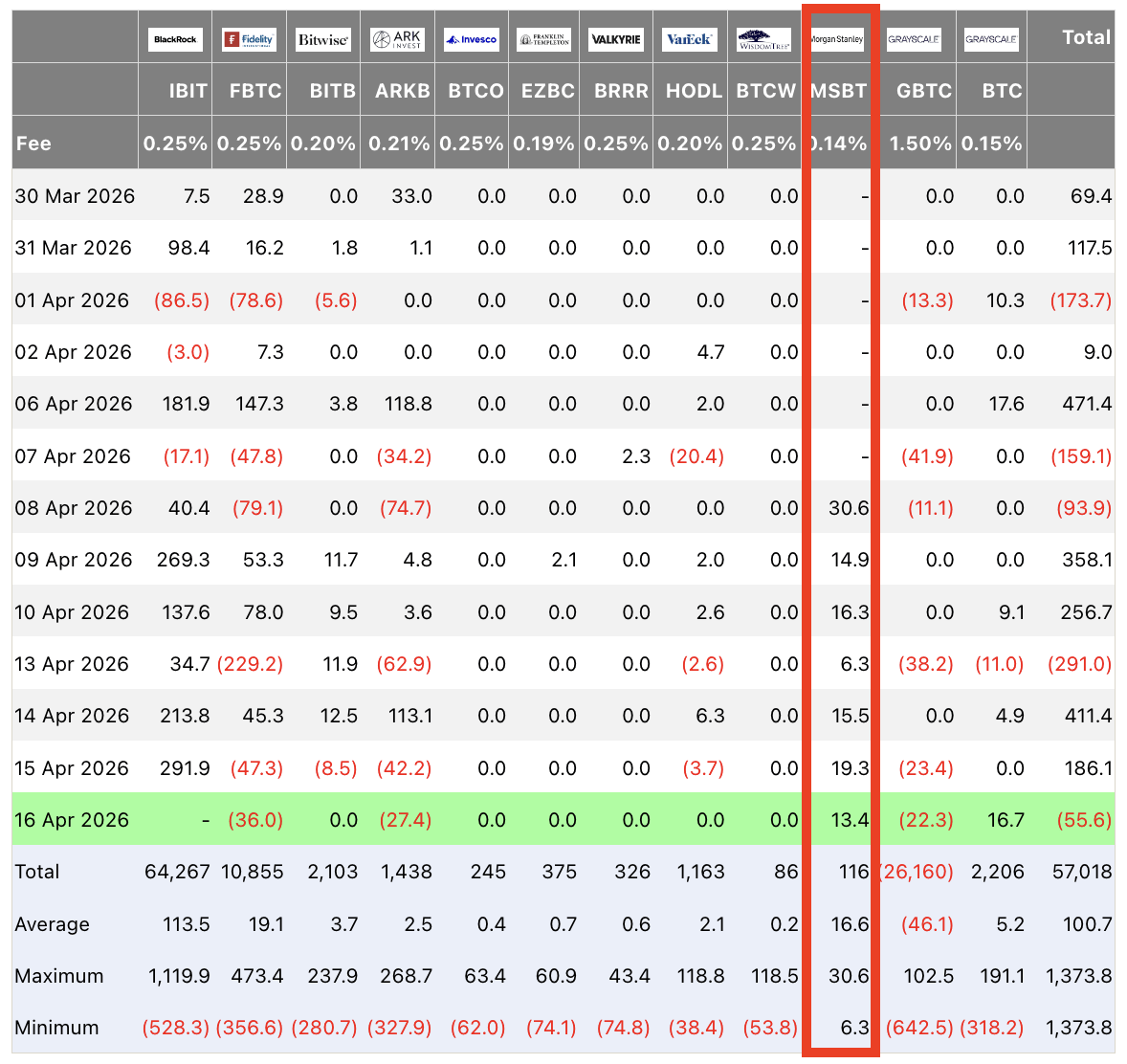
The fund currently boasts an expense ratio of 0.14%, positioning it as the lowest-cost spot Bitcoin ETF available in the U.S. market. This is one basis point lower than the Grayscale Bitcoin Mini Trust’s 0.15%. Such aggressive pricing is a common strategy in the asset management sector, and Morgan Stanley has skillfully leveraged its immense brand influence and cost efficiency to capture the attention of price-sensitive investors.
- Related News: Morgan Stanley’s Bitcoin ETF Attracts $34 Million on Launch Day with “Lowest Fees” Strategy!
Digital Assets as a Core Strategy: Morgan Stanley’s Comprehensive Financial Infrastructure Overhaul
Digital assets are rapidly becoming an integral component of Morgan Stanley’s operational framework. Amy Oldenburg, the firm’s Head of Digital Asset Strategy, emphasized that the industry is at a pivotal inflection point, with cryptocurrency now firmly integrated into the company’s core business. Oldenburg, who assumed her current role in February, oversees digital asset development across both institutional wealth management and asset management divisions, underscoring the bank’s commitment to deeply embedding crypto into its primary financial services.
To facilitate this profound integration, Morgan Stanley is actively engaged in a comprehensive overhaul of its financial infrastructure. This initiative spans critical areas such as wallet systems, custody solutions, data transmission, and compliance monitoring. The team is meticulously analyzing existing workflows to gain a deeper understanding of fund flows, transaction mechanisms, and the inherent challenges of integrating blockchain technology. While the regulatory landscape for tokenized assets and stablecoins is still evolving, Morgan Stanley views tokenization as a crucial step towards building high-value-added services. The bank’s technological innovation focus for the coming years will center on achieving scalability for transactions ranging from $50 million to $100 million.
Explore more on Morgan Stanley’s strategic moves in the crypto industry:
- Morgan Stanley Eyes Crypto Opportunities: Applies for Bank License to Offer “Staking and Custody” Services
- Accelerating Crypto Adoption! Morgan Stanley Plans Digital Wallet Launch by H2 2026
Wall Street Giants Accelerate Crypto Push, Structured Investment Products Emerge as Next Frontier
Leading Wall Street financial institutions are swiftly responding to Morgan Stanley’s aggressive market entry. Goldman Sachs recently filed an application with the U.S. Securities and Exchange Commission (SEC) for a Bitcoin Premium Income ETF, formally joining the burgeoning crypto investment landscape. This new generation of products leverages options strategies to generate additional yield, signaling a market shift towards structured products that offer stable cash flow. BlackRock is also reportedly preparing similar income-generating ETFs, intensifying the competitive dynamics among institutions.
- Related News: Goldman Sachs Files for Bitcoin ETF: No Spot Holdings, Relies on “Options” for Premium Income
Morgan Stanley’s vast wealth management network provides a significant strategic advantage. With trillions of dollars in client assets under management and thousands of financial advisors, the firm possesses a direct conduit for introducing Bitcoin to traditional investors. Many investors prefer the security and familiarity of regulated accounts over trading on native cryptocurrency platforms, and MSBT offers a seamless entry point. Established financial institutions now recognize that ignoring Bitcoin ($BTC) is no longer an option. Giants like JPMorgan are expected to follow suit, further accelerating Bitcoin’s mainstream adoption within the traditional financial system.
Global Bitcoin ETF Market Overview: Institutional Inflows Bolster Price Momentum
The market influence of the 13 U.S. spot Bitcoin ETFs continues to expand significantly. As of April 16th, the combined net assets of these funds reached $97.6 billion, representing approximately 6.5% of Bitcoin’s total market capitalization. On April 15th alone, the entire market recorded $186 million in net inflows. While MSBT’s asset scale is still distant from BlackRock IBIT’s $64.3 billion, its explosive growth rate poses a clear challenge to mid-tier players like Franklin Templeton, Valkyrie, and Invesco, whose cumulative inflows range between $200 million and $400 million.
The ETF industry is characterized by fierce competition, with the average lifespan of ETFs shrinking from 4.66 years in 2024 to an anticipated 3.5 years in 2025. Over 40 ETFs have already been liquidated in the first two months of 2026. Fortunately, major cryptocurrency ETFs have thus far remained unaffected by this liquidation trend. Bitcoin’s price is currently consolidating around the $74,600 to $75,000 range. While still below its all-time high of $126,000 set in October 2025, the consistent influx of institutional capital provides robust fundamental support for Bitcoin’s price. As traditional financial infrastructure continues to evolve and integrate, the convergence of Bitcoin and Wall Street is an undeniable and established trend.
(The above content is an authorized excerpt and reprint from our partner “Crypto City”, original link)
Disclaimer: This article is for market information purposes only. All content and views are for reference only and do not constitute investment advice. They do not represent the views and positions of Blockcast. Investors should make their own decisions and trades. The author and Blockcast will not bear any responsibility for direct or indirect losses resulting from investor transactions.