Author: Kurumi, CryptoCity
AscendEX Ceases Operations: A Deep Dive into the Exchange’s Shutdown and User Concerns
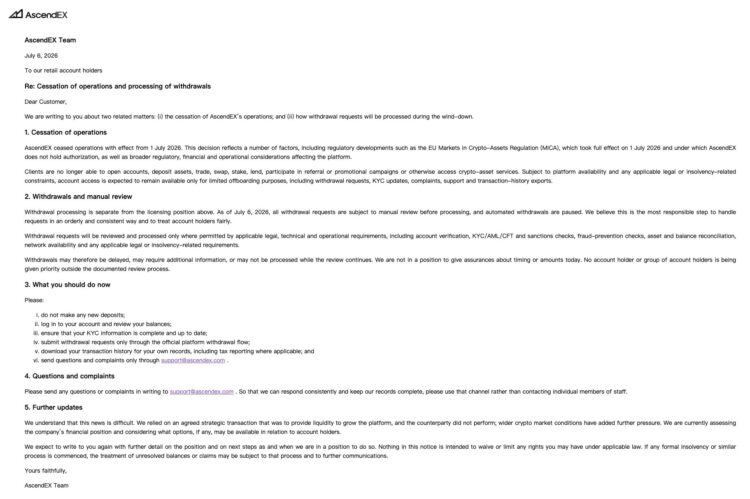
Cryptocurrency exchange AscendEX has officially announced the complete cessation of its platform operations starting July. This pivotal decision means the exchange will no longer offer a range of services including account opening, deposits, spot trading, derivatives, staking, lending, and other digital asset functionalities. The platform’s official statement indicates that limited account access will be maintained to facilitate essential user actions such as asset withdrawals, transaction history downloads, KYC data updates, and customer support requests, as it gradually winds down its operational procedures.
Why AscendEX is Shutting Down: Regulatory Hurdles and Market Pressures
AscendEX attributes its decision to cease operations to a confluence of challenging factors. A primary driver is the official enactment of the European Union’s Markets in Crypto-Assets (MiCA) regulation, under which the platform failed to secure the necessary operating licenses. This regulatory hurdle, combined with an evolving market landscape, escalating operational costs, and significant liquidity pressures, rendered it unsustainable for the company to continue providing its services.
Further compounding these issues, the exchange disclosed that a previously planned strategic transaction ultimately fell through. This failure significantly impacted the company’s financial planning, emerging as a critical factor in the decision to halt operations.
Withdrawal Crisis Looms: Manual Review and Unsettling Disclaimers
The official announcement confirms that, as of July 6th, all withdrawal requests will be subject to manual review, with the automated withdrawal system being entirely decommissioned. AscendEX clarifies that each withdrawal will now undergo a rigorous manual verification process, encompassing KYC, AML, sanctions list checks, and asset balance confirmations. This new protocol is expected to significantly slow down withdrawal speeds, with some cases potentially requiring additional documentation for processing.
Crucially, AscendEX has stated that it cannot guarantee the completion time for all withdrawal applications, nor can it assure the final amount that users will be able to withdraw. This alarming disclaimer has ignited widespread market concern, prompting many users to fear a potential capital shortfall within the platform. Reports have surfaced across social media platforms from users whose withdrawals remain in a “processing” status for extended periods, with some waiting days without receiving their assets, rapidly intensifying market anxieties regarding the exchange’s liquidity.
ZachXBT Raises Alarm: On-Chain Data Points to Hot Wallet Liquidity Issues
Even before AscendEX’s official announcement, renowned on-chain investigator ZachXBT had publicly highlighted receiving multiple reports from users experiencing abnormal withdrawal delays. His analysis of on-chain data revealed that the balances of key assets in AscendEX’s publicly observable hot wallets—including Ethereum ($ETH), Tether ($USDT), $USDC, and $SOL—were remarkably limited. This indicated a significant disparity between available hot wallet liquidity and the known withdrawal demands from users.
- Related News: AscendEX Exchange Reportedly Facing Weeks-Long Withdrawal Delays! On-Chain Detective: May Be Headed for a Liquidity Crisis
ZachXBT further elaborated that the cumulative value of confirmed withdrawal applications amounted to several million dollars, yet the publicly visible hot wallet assets were insufficient to fully meet these demands.
He advised users to refrain from depositing further assets into AscendEX until all pending withdrawals are processed. The subsequent announcement of the platform’s shutdown and the shift to manual withdrawal reviews has amplified market speculation regarding whether AscendEX will need to transfer assets from cold wallets or implement other strategies to address the escalating withdrawal requests.
It is important to note that while insufficient hot wallet balances are a concern, they do not directly prove insolvency, as the majority of exchange assets are typically held in secure cold wallets. Nevertheless, in the absence of a comprehensive disclosure from AscendEX regarding its full asset allocation and withdrawal progress, the market remains acutely focused on the platform’s ability to fulfill all user withdrawal obligations.
The Road Ahead: AscendEX’s Post-Operations Plan and Asset Recovery
Founded in 2018 as BitMax before rebranding to AscendEX in 2021, the exchange has a history marked by a significant hack in 2021, which resulted in a loss of approximately $78 million from its hot wallets, yet it continued operations. The recent decision to cease operations positions AscendEX as another mid-to-large-sized cryptocurrency exchange to exit the market amidst a rapidly evolving global regulatory landscape and intensifying competition.
AscendEX has confirmed that it will continue to process withdrawal applications, though all will be subject to manual review. However, the exchange has not yet provided a complete processing timeline or clarified when all users can expect to complete their withdrawals. The future progress of these withdrawals, the platform’s overall liquidity status, and the potential disclosure of additional asset information will remain critical points of market observation. These factors will undoubtedly influence external assessments of AscendEX’s subsequent liquidation and asset return procedures.
(The above content is an authorized excerpt and reprint from our partner “CryptoCity”, original link)
Disclaimer: This article provides market information only. All content and views are for reference purposes only and do not constitute investment advice, nor do they represent the views and positions of BlockTempo. Investors should make their own decisions and trades. The author and BlockTempo will not bear any responsibility for direct or indirect losses resulting from investor transactions.