
Author: Jae, PANews
The first week of August brought a renewed sense of optimism to the US stock market’s AI sector, with leading companies in the AI supply chain experiencing impressive gains of over 10%. Nvidia’s stock surged for five consecutive days, while Marvell Technology soared by nearly 20%. This robust performance marked a significant recovery for AI concept stocks, which had faced a challenging “Waterloo” in July, reclaiming substantial lost ground.
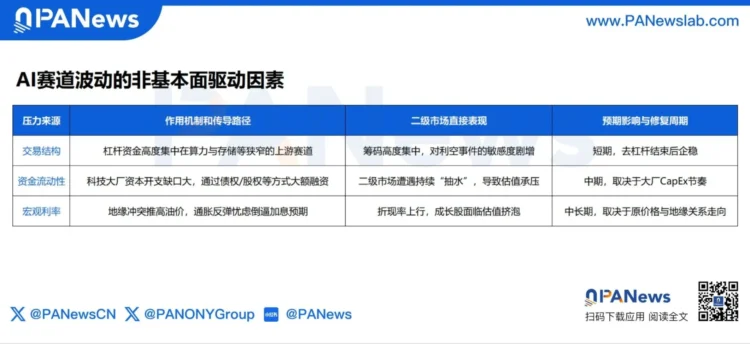
However, this vigorous rebound was not a standalone event; it followed a period of intense deleveraging in late July. During that time, upstream semiconductor and computing power assets saw considerable valuation corrections, leading to widespread market anxiety about a potential “bubble burst.” Morgan Stanley’s Chief China Economist, Xing Ziqiang, offered a crucial perspective, asserting that the recent volatility in the AI sector was not due to deteriorating fundamentals. Instead, it represented a temporary “half-time rest” triggered by a convergence of overcrowded trades, significant capital withdrawals by major tech firms, and escalating oil prices fueling interest rate hike expectations. This analysis has since garnered consensus among top Wall Street investment banks.
While AI supply chain stocks in the US continue to demonstrate strong performance, the initial fervor surrounding the AI sector is undeniably moderating. The global capital market’s most potent engine is subtly shifting gears. The initial phase of AI investment saw capital overwhelmingly concentrated on computing power chips, championing the predictable narrative of “shovel sellers.” However, Morgan Stanley’s research team now projects a pivotal shift in investment focus for the next phase, moving along two distinct trajectories: a deeper dive into application-centric solutions, emphasizing tangible cost reduction, efficiency gains, and concrete cash flow generation; and an expansion into the physical world, re-evaluating AI-critical energy and heavy assets.
The “Three Mountains” Pressuring AI’s “Shovel Sellers”
A confluence of three powerful forces collectively pressed the “pause button” on the AI sector’s meteoric rise.
1. Crowded Trades: A Fragile Equilibrium Built on High-Leverage Positions
The AI market’s trajectory in the first half of the year served as a textbook example of “crowded trades.”
A torrent of leveraged capital and momentum-driven funds flooded into upstream segments such as computing power chips, semiconductors, and storage. This influx rapidly propelled the concentration of market positions to historic highs. Such a dense and uniform capital structure inherently magnified the market’s vulnerability, ultimately precipitating a stampede-like deleveraging sell-off.
In late July, these overly consistent trading expectations met a concentrated unwinding of positions. Goldman Sachs data revealed a dramatic decline in the Asset Under Management (AUM) of leveraged semiconductor ETFs, plummeting from a June peak of approximately $163 billion to $100 billion – a nearly 40% drop and the largest since April 2025. Notably, semiconductor ETFs accounted for roughly 63% of all leveraged ETF outflows in the US during this period.
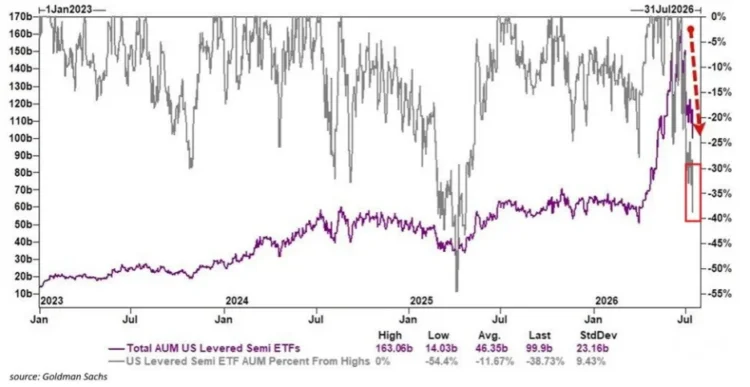
Despite the initial pain, this deleveraging process effectively purged purely speculative bubbles, allowing the market’s overheated sentiment in the AI sector to cool down to a more sustainable level.
2. Capital Drain: The Liquidity Backlash of Trillions in CAPEX
The relentless AI arms race carries a significant hidden cost: the continuous siphoning of liquidity from the secondary market.
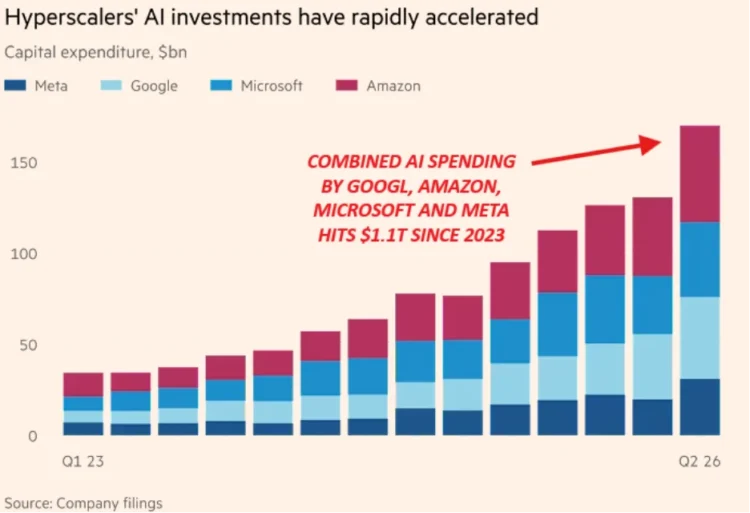
Global hyperscale cloud service providers are committing hundreds of billions of dollars to AI infrastructure in a bid to dominate computing power. Yet, their existing cash flows are often insufficient to fully cover such colossal capital expenditure gaps. Consequently, these tech titans frequently resort to large-scale external financing through methods like stock offerings and the issuance of substantial corporate bonds. The Financial Times reported that the cumulative AI capital investment by the four major Silicon Valley giants had already reached a staggering $1.1 trillion by the second quarter of this year. JPMorgan’s research further highlights that AI-related debt now constitutes over 15% of the US investment-grade bond market, making it the largest single debt segment. This raises a critical concern: if the monetization of downstream AI applications falls short of projections, this aggressive borrowing could pose a significant threat to corporate credit ratings.
As the secondary market is persistently “drained” of funds, the tightening capital supply naturally exerts downward pressure on valuations. In essence, the more aggressive the expansion of computing power, the more pronounced its siphoning effect on overall market liquidity.
3. Interest Rate Clouds: Valuation Compression from Inflation’s Resurgence
Macroeconomic variables emerged as the final, decisive factor in compressing elevated valuations.
Escalating geopolitical conflicts in the Middle East drove international oil prices higher, reigniting market anxieties about persistent inflation. This, in turn, fueled expectations of further interest rate hikes by the Federal Reserve. An upward trajectory in the risk-free rate directly increases the discount rate applied to future cash flows. For AI ventures still in their intensive investment phase, where substantial cash flows have yet to materialize, this elevated discount rate serves to further depress their valuations.
Under the weight of these three formidable pressures, the once-lucrative business of “selling shovels” suddenly became a much tougher proposition.
AI Investment’s New Trajectory: Prioritizing ROI and Securing Hard Assets
Insights from Goldman Sachs and Morgan Stanley suggest a fundamental shift: the focus is moving from foundational model training to large-scale inference deployment. The simple narrative of merely accumulating computing power and competing on parameter counts is losing its marginal impact. The capital market’s valuation benchmarks are now recalibrating towards proven commercialization capabilities and the inherent resource bottlenecks of the physical world.
1. AI Application End: From Narrative to Net Return (ROI)
The next phase of AI investment will be a rigorous elimination contest centered on financial realization capabilities.
In the initial stage, any asset merely associated with the “AI concept” could command a valuation premium. Now, however, the sheer scale of parameters is no longer the primary metric. Instead, the return on investment (ROI) derived from AI implementation will be the cornerstone for achieving high valuations. The market will increasingly scrutinize a company’s ability to leverage AI for tangible cost reductions, efficiency enhancements, and, most importantly, for translating these into measurable revenue and cash flow growth.
As the costs associated with AI inference continue their downward trend, application-oriented enterprises boasting robust closed-loop ecosystems, proprietary data assets, and high customer stickiness are poised to excel. Consider companies embedding AI into game development, advertising campaigns, or digital business processes; these can significantly slash unit operating costs, effectively transforming AI technology into an intrinsic engine for efficiency and a powerful lever for product pricing.
This gravitational pull of capital towards ROI will compel AI vendors to pivot from “parameter wars” to “practical implementation,” accelerating AI’s transition from research labs to real-world industries. Currently, in the AI application space, while a select few pioneers like Palantir (PLTR) have demonstrated financial growth, most other players still await market data to validate their commercial viability.
2. HALO Assets: The Physical Core of AI’s Future
“The end of AI is energy and raw materials” – this profound statement by Goldman Sachs last month is rapidly evolving into a prevailing market consensus.
HALO (Heavy Assets, Low Obsolescence) assets refer to physical resources characterized by significant tangible capital barriers and inherent resistance to rapid technological obsolescence. Examples include copper mines, electrical grids, critical infrastructure equipment, and nuclear energy resources. These indispensable physical “hard assets” – which cannot be easily moved, dismantled, or spontaneously generated for AI’s expansive needs – are anticipated to become highly sought after by global capital.
In its influential report, “The HALO Effect,” Goldman Sachs articulates that the global market is undergoing a profound “repricing of scarcity.” The past decade saw a fervent embrace of “light asset, high expansion” software models. However, AI’s ability to lower information processing thresholds has substantially compressed the valuation and profit margin ceilings for many software and IT service companies. Conversely, the replacement costs of physical assets have surged dramatically, driven by inflationary pressures and the ongoing regionalization of supply chains.
To put it simply: while large models iterate on a weekly basis, and the barriers to algorithms and software services are increasingly flattened, many light-asset SaaS companies relying on simple code or intermediary services face the disruptive risk of being supplanted by AI Agents. Algorithms can be surpassed by open-source models, and software can be rewritten by AI Agents. Yet, a power grid cannot be casually duplicated, copper cannot be conjured from thin air, and a nuclear power plant cannot be erected overnight.
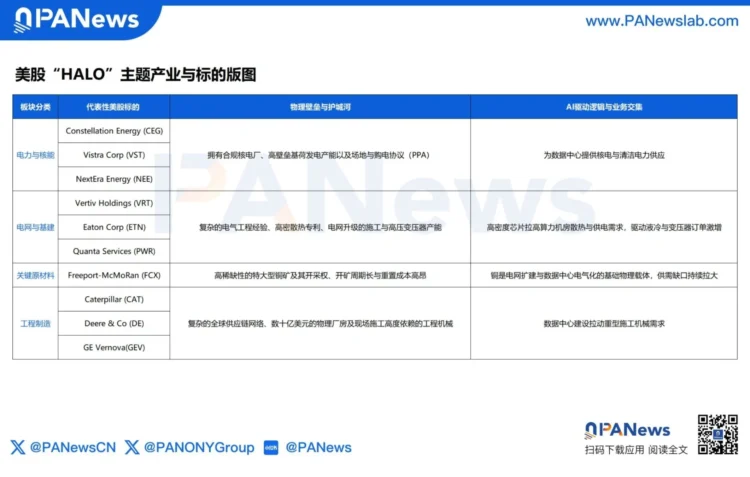
According to Wall Street institutions, the HALO theme encompasses four primary sectors: power and nuclear energy, power grids and infrastructure, critical raw materials, and engineering manufacturing. Each represents a crucial physical bottleneck that AI computing power expansion simply cannot circumvent. Within these sectors, there are numerous potential targets enjoying high consensus from major institutions like BlackRock and Goldman Sachs.
In the **power and nuclear energy** domain, independent nuclear power giants such as Constellation Energy (CEG), Vistra Corp (VST), and NextEra Energy (NEE) are capturing significant capital attention. Amid constraints on public grid expansion, these companies leverage their licensing advantages and “behind-the-meter” direct power supply model (e.g., building data centers adjacent to power plants). Nuclear power facilities are emerging as primary energy suppliers for data centers, attracting tech giants to sign multi-year Power Purchase Agreements (PPAs) with guaranteed prices. This effectively transforms traditionally stable utility businesses into highly predictable, high-certainty assets.
Within the **power grid and infrastructure** sector, the widespread adoption of high-power GPUs has pushed conventional air-cooling solutions to their physical limits, making the transition to liquid cooling technology for data centers an inevitable trend. Vertiv (VRT), with its leadership in precision cooling and thermal management, is poised to capitalize on the lucrative market for data center cooling upgrades. Eaton (ETN) and Quanta Services (PWR), by controlling the construction capabilities for power distribution equipment, transformers, and high-voltage grids, directly influence the pace of grid expansion. Furthermore, the long-cycle engineering involved in upgrading physical power grids establishes substantial competitive barriers for these firms.
In the **critical raw materials** sector, Freeport-McMoRan (FCX) possesses premium, large-scale copper mine resources and mining rights. Copper remains an indispensable physical conductor for everything from power transmission and transformer windings to internal data center cabling. Challenges such as lengthy mine development cycles and declining ore quality have significantly curtailed the supply elasticity of new copper mines. This long-term widening gap between supply and demand is expected to continuously bolster the pricing power of copper resources.
Finally, in the **engineering manufacturing** domain, industry stalwarts like Caterpillar (CAT) and Deere & Co (DE) command vast physical factories, proprietary engineering technologies, and expansive global supply chain networks. These attributes construct formidable physical barriers that are exceptionally difficult to replicate with mere code or algorithms, enabling them to consistently secure orders amidst the ongoing infrastructure boom.
In this evolving landscape of AI investment, assets once categorized as “old economy” – such as Eaton’s transformers, Caterpillar’s colossal excavators, and Newmont’s copper mines – are suddenly being imbued with renewed strategic significance. The repricing of HALO assets by capital is set to forge the foundational physical infrastructure required for the next, even more expansive, phase of AI development.
However, HALO assets are characterized by protracted construction cycles and substantial capital outlays. Should the commercialization pace of downstream AI applications fall short of expectations, the extensive upfront investments in energy and computing power infrastructure could potentially lead to risks of overcapacity and stranded assets.
This “half-time break” is a vital and necessary phase for the capital market to undergo rational differentiation. Future outsized returns will gravitate towards two distinct areas: genuine commercial applications that demonstrate clear value, and robust, tangible hard assets. Ultimately, only those players who possess both strong commercial monetization capabilities and formidable physical moats will be able to sustain their lead in the long race that unfolds after this crucial market recalibration.




