Author: Nancy, PANews
Cloudflare Unleashes AI Agent Wallets: Pioneering a “Headless Marketplace” and Sparking a Digital Identity Rush
On August 5th, a vibrant “orange storm” swept across social media, as numerous bloggers on X (formerly Twitter) proudly showcased their new orange wallet IDs. This digital buzz was ignited by Cloudflare, often dubbed the “Cyber Buddha” for its ubiquitous internet infrastructure, which unveiled its groundbreaking AI Agent programmable wallet, Cloudflare Wallets, on the evening of August 4th. This innovation not only empowers AI Agents with the autonomy to engage in online transactions but also propels the concept of crypto infrastructure further into mainstream consciousness.
Simultaneously, Cloudflare’s decision to open registrations for cloudflare.pay wallet names unexpectedly triggered a fervent rush to claim unique digital identities for AI Agents.
Programmable Wallets for AI Agents: Facilitating Seamless Micro-Payments with Stablecoins
Cloudflare’s latest blog post heralded the launch of Cloudflare Wallets, a programmable wallet meticulously designed for AI Agents. Its core mission is to enable AI Agents to autonomously execute API purchases, consume digital content, and conduct service transactions.
As AI Agents evolve from mere assistive tools to independent task executors, a critical challenge has emerged: how can an AI seamlessly pay for APIs, data services, or digital content? The current web ecosystem, largely built for human interaction, presents significant hurdles. AI Agents typically face a cumbersome process involving account registration, payment method binding, API key applications, and even manual approvals – all of which inflate access costs and stifle an Agent’s ability to independently explore, compare, and leverage diverse services.
Cloudflare Wallets is engineered to bridge this gap, addressing the fundamental issues of payment, identity, and permission management that AI Agents currently lack in the digital realm.
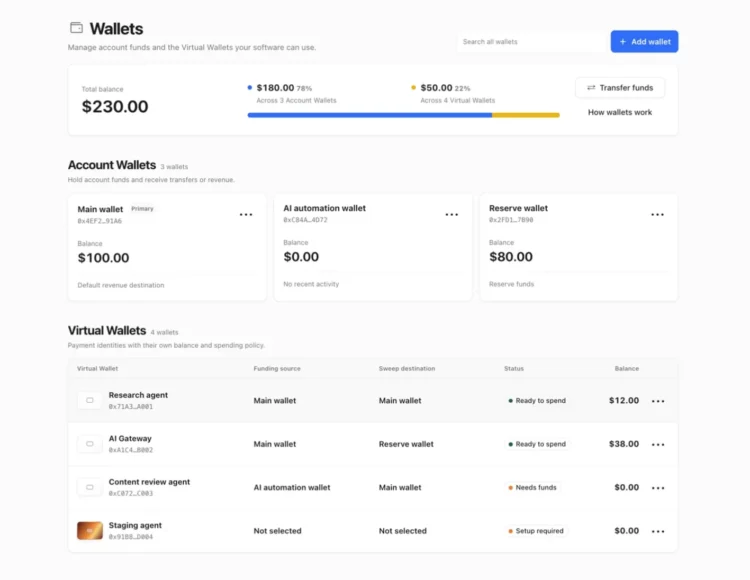
The wallet system comprises two main types: Account Wallets and Virtual Wallets. Account Wallets cater to individuals and enterprises, serving as a hub for depositing funds, managing assets, and allocating spending limits to AI Agents. The true innovation lies in the Virtual Wallets, specifically tailored for AI Agents to autonomously complete purchases on behalf of their users.
The market’s keen interest is primarily focused on these Virtual Wallets. To mitigate the inherent risks of automated payments, users can pre-configure spending rules for each Virtual Wallet. These rules encompass single transaction limits, whitelists, and overall spending caps. This intelligent design liberates users from manual confirmation for every single operation, instead authorizing Agents to execute tasks autonomously within predefined financial boundaries. This approach not only enhances efficiency but also keeps financial exposure within acceptable limits.
This architectural choice grants Agents unprecedented freedom to navigate and explore online services. With spending limits typically constrained to small amounts, users can confidently allow Agents to experiment with a vast array of APIs and tools, alleviating concerns about significant losses due to erroneous calls or malicious services.
A cornerstone of Cloudflare Wallets’ micro-payment capability is the integration of Coinbase’s open-source payment protocol, x402. This protocol facilitates machine-to-machine micro-payments using the USDC stablecoin, empowering AI Agents to directly access and purchase API services without the need for traditional account registrations or linked bank cards. This dramatically reduces the cost and friction associated with testing and integrating new services. Currently, x402 boasts support across multiple blockchain networks, including Base, Polygon, Arbitrum, World, and Solana, and its foundation is backed by industry titans such as Visa, Mastercard, American Express, Stripe, Google, AWS, and Cloudflare itself.
The Unexpected “Identity Land Grab” as Agents Gain Digital IDs
Beyond empowering payment capabilities, Cloudflare is also tackling the crucial issue of AI Agent identity on the internet.
In the traditional web, websites and service providers rely on account systems to verify user identities. However, as AI Agents independently access sites, invoke APIs, and conduct transactions, it becomes increasingly challenging for service providers to discern whether the entity behind the action is a genuine human user, a legitimate corporate entity, or a potentially malicious actor.
For instance, while a company can readily offer free trials or discounts to human users, identifying genuine demand from AI Agents lacking stable identities is problematic. A single user could deploy numerous Agents, making it difficult for service providers to differentiate between legitimate usage and bulk abuse.
To resolve this, Cloudflare introduced cloudflare.pay, effectively a digital ID card for Agents. By linking it to the robust Cloudflare account system, Agents are endowed with identifiable and traceable digital identities. While disclosing an Agent’s identity remains optional and user-controlled, enterprises can choose to prioritize services for Agents possessing certified identities based on their operational needs.
The official opening of cloudflare.pay wallet name reservations, operating on a first-come, first-served basis, quickly ignited a frenzied rush to claim unique IDs.
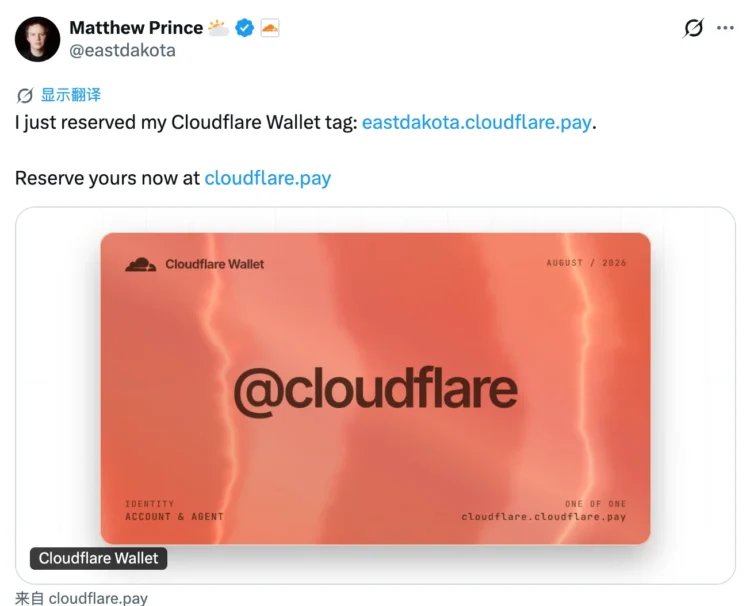
Cloudflare CEO Matthew Prince publicly displayed his chosen handle, inspiring a wave of users to share their own successful registrations on social media. Names associated with celebrities, popular brands, and leading AI companies were swiftly claimed, creating a scene eerily reminiscent of the heated Web3 domain speculation years ago. Some users even went as far as to build dedicated query websites to help others discover available popular handles.
Years prior, the Web3 era witnessed a similar on-chain domain gold rush, where users vied for coveted domain names, often driving popular names to exorbitant speculative prices. Now, a comparable battle for digital identity is unfolding in the AI age.
For participants, motivations vary: some aim to preemptively secure identities for future AI Agent payment scenarios, while others adopt an investment mindset, viewing these handles as potentially valuable digital assets.
This handle registration frenzy has not only amplified Cloudflare Wallets’ market visibility but has also, for the first time, introduced concepts previously confined to the crypto sphere – such as wallets, stablecoin payments, and on-chain identity – to a broader audience of ordinary internet users.
Crucially, Cloudflare’s immense industry influence provides a more accessible and credible gateway for these crypto-native concepts to penetrate the mainstream market. As a global internet infrastructure behemoth, Cloudflare stands as one of the world’s most widely utilized Content Delivery Network (CDN) providers. Its critical role was underscored in the past when service outages led to widespread internet paralysis, affecting countless prominent websites. Cloudflare has also cultivated deep market trust, earning its “Cyber Buddha” moniker by consistently offering extensive free infrastructure services to developers and users, thereby democratizing advanced capabilities like global acceleration and security protection, once exclusive to large enterprises.
Compared to purely crypto-native ventures, the entry of a Web2 giant like Cloudflare, with its colossal user base and infrastructural footprint, is uniquely positioned to accelerate the mainstream adoption of crypto concepts and integrate crypto infrastructure into the broader internet landscape.
Wallets: The Genesis of Cloudflare’s “Agentic Headless Marketplace” Vision
Cloudflare’s ambition extends far beyond merely launching a wallet; its true objective is to construct an “Agentic Headless Marketplace” tailored for the AI era.
A headless marketplace envisions a future where transactions transcend traditional web interfaces, manual clicks, and complex registration processes. Instead, AI Agents will autonomously discover services, match demands, compare prices, settle payments, and acquire resources.
In this transformative paradigm, AI Agents will no longer be mere tools executing human commands but will evolve into active participants within the network. They will possess the capability to independently seek out services, invoke tools, and complete transactions within their authorized parameters based on task requirements.
This forms the bedrock of Cloudflare’s “Agentic Internet” business ecosystem vision: to embed payments and transactions as native capabilities of the internet, rather than additional, manually-driven steps.
Cloudflare has been strategically building its AI infrastructure, previously rolling out products like Workers AI, Agents SDK, AI Crawl Control, and Monetization Gateway. These offerings span critical areas such as AI inference, Agent development and operation, content access management, and resource monetization. The introduction of Wallets now completes the most vital piece of Cloudflare’s headless marketplace puzzle: the payment mechanism.
Looking ahead, AI Agents may transcend their current role as command-executing tools. They could, much like human users, possess distinct identities, manage budgets, and engage in transactions, thereby becoming a new class of participants in the internet economy. As Cloudflare aptly notes, the internet’s transition to an Agent economy won’t happen overnight. However, the foundational groundwork being laid around identity, payments, and infrastructure represents a pivotal first step toward the full realization of an Agentic business ecosystem.
Disclaimer: This article is provided for market information purposes only. All content and opinions are for reference only and do not constitute investment advice. They do not represent the views and positions of BlockTempo. Investors should make their own decisions and transactions. The author and BlockTempo will not bear any responsibility for direct or indirect losses resulting from investor transactions.