JPMorgan Report: Hyperliquid’s Market Dominance Under Threat from U.S. Regulated Platforms and Stiff Competition
A recent report from Wall Street investment bank JPMorgan Chase suggests that the market dominance of decentralized exchange Hyperliquid is facing increasing pressure. This challenge stems from two primary factors: the burgeoning rise of U.S.-regulated cryptocurrency perpetual futures trading platforms and intensifying competition within the prediction market sector. Furthermore, the report notes a distinct cooling in capital inflows to the native token HYPE’s Exchange Traded Fund (ETF), signaling a potential slowdown in market enthusiasm.
Led by Managing Director Nikolaos Panigirtzoglou, JPMorgan’s analysis team stated, “We believe that decentralized trading platforms like Hyperliquid are confronting significant challenges to their market share. Whether HYPE can surpass other tokens such as Solana (SOL) or Ripple (XRP) in market capitalization remains to be seen.”
U.S. Compliant Platforms Emerge, Poised to Reshape Liquidity Landscape
Analysts pinpoint the emergence of U.S.-compliant cryptocurrency perpetual futures trading platforms as a major hurdle for Hyperliquid. The report highlights several long-standing structural concerns associated with decentralized derivatives platforms, including:
- Operating unlicensed derivatives services.
- Weak Anti-Money Laundering (AML) and Know Your Customer (KYC) mechanisms.
- Potential risks of market manipulation and hacking.
- Vulnerabilities related to oracle failures.
- A relative scarcity of consumer protection measures.
JPMorgan emphasizes, “As U.S.-compliant cryptocurrency perpetual futures products increasingly come to market, we anticipate a rapid reshuffling of liquidity. Capital flows are expected to accelerate their migration from offshore and decentralized platforms back to regulated domestic markets within the United States.”
Intense Competition Looms in the Prediction Market Sector
Beyond its core derivatives trading, Hyperliquid has strategically expanded into prediction markets, aiming to tap into new avenues of trading demand. Following successful testing earlier this year, the platform officially launched “Outcomes” in May, offering contract products akin to prediction markets that enable users to trade on the results of various events.
However, JPMorgan’s analysis suggests that the prediction market itself is already a crowded arena. With numerous existing platforms and innovative startups vying for market share, Hyperliquid is expected to face substantial competitive pressure in this new venture. Analysts further note that the value of the HYPE token is highly correlated with Hyperliquid’s platform trading activity, particularly its reliance on trading fee revenue generated from perpetual futures. A slowdown in platform trading volume would, therefore, directly impact HYPE’s fundamental performance.
HYPE ETF Funding Momentum Stalls
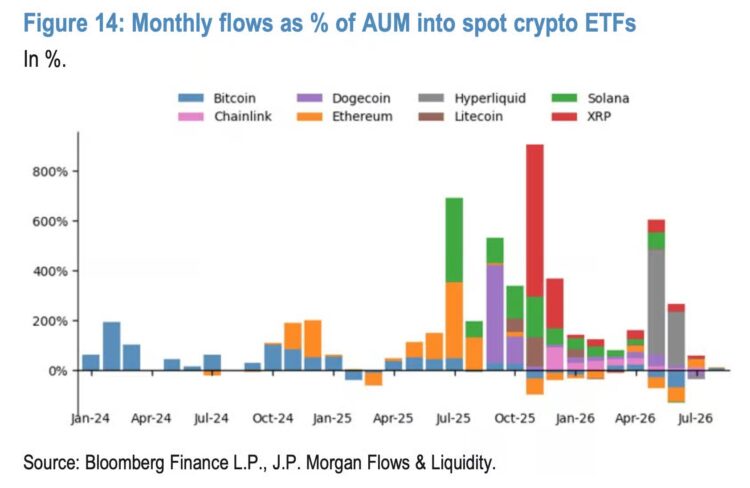
The competitive pressures facing Hyperliquid are also reflected in the performance of the HYPE ETF’s capital flows, according to JPMorgan. The report indicates that while the HYPE ETF recorded its highest percentage of Assets Under Management (AUM) inflows in May and June, market buying interest has noticeably dwindled since July.
Notably, this trend diverges from the overall cryptocurrency ETF market. JPMorgan points out that the broader crypto ETF market experienced more substantial outflows in May and June but has since seen a modest return to net inflows starting in July.
Currently, Bitcoin ETFs and Ethereum ETFs continue to dominate the market, commanding approximately $77 billion and $10 billion in AUM, respectively. Other cryptocurrency ETFs, primarily covering products related to Solana (SOL), Ripple (XRP), and Hyperliquid (HYPE), typically range between $2 billion and $3 billion in scale.
Despite the stagnation in ETF buying, institutional interest in HYPE remains noteworthy. JPMorgan data reveals that HYPE currently ranks as the 4th largest asset in corporate cryptocurrency reserves, trailing only Bitcoin, Ethereum, and Solana (SOL).
Looking ahead, the analysis team concludes, “Continuously tracking the capital flows into the HYPE ETF, alongside changes in Hyperliquid’s market share within both the derivatives and prediction markets, will be the most critical indicators for assessing the future prospects of both the platform and its token.”
Disclaimer: This article is for market information purposes only. All content and opinions are for reference only and do not constitute investment advice, nor do they represent the views and positions of BlockTempo. Investors should make their own decisions and trades. The author and BlockTempo will not bear any responsibility for direct or indirect losses incurred by investors’ trading activities.