

Bitcoin Surges Past $75,000, Igniting Over $1.2 Billion in Liquidations
Bitcoin has demonstrated remarkable strength this week, with its price briefly soaring past the $75,000 mark on the morning of August 21st, reaching an impressive peak of approximately $75,528. According to CoinGecko data, as of around 10 AM, Bitcoin was trading at roughly $74,784, representing a substantial 7.3% increase over the past 24 hours. This rapid ascent saw BTC’s price climb over $6,000 from its intraday low of $68,898, establishing a new high not seen since June.

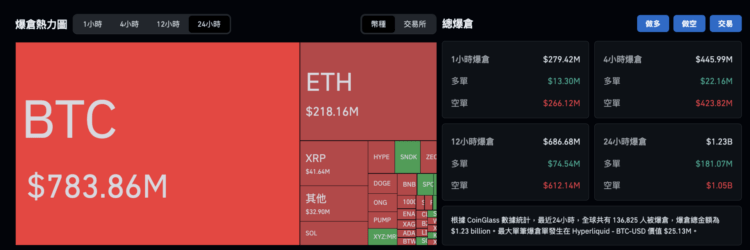
This meteoric rise triggered a cascade of short liquidations across the cryptocurrency market. Data from CoinGlass reveals that over the past 24 hours, a staggering 136,825 traders were liquidated, with total liquidations amounting to approximately $1.23 billion. Short positions bore the brunt of this volatility, accounting for about $1.05 billion in liquidations, while long positions saw around $181 million. This disparity clearly indicates a significant short squeeze. Bitcoin alone contributed approximately $784 million to these 24-hour liquidations, with Ethereum accounting for about $218 million. The single largest liquidation during this period was a BTC-USD position on Hyperliquid, valued at approximately $25.13 million.
ETF Inflows and Institutional Optimism Drive Liquidity Expectations
The spot market is also signaling a robust recovery, bolstered by significant institutional interest. US spot Bitcoin ETFs recorded their largest single-day net inflow in over three months, totaling approximately $517 million. BlackRock’s IBIT was a major contributor, attracting around $285 million of this capital. Ishmael Asad, a research analyst at Bitwise, views this rally as one of the clearest indications of a market bottom. He points to several catalysts improving market sentiment: the Treasury’s expanded bond buybacks, the US Securities and Exchange Commission’s (SEC) proposed new regulatory framework for crypto assets, and recent White House initiatives on crypto policy.
Mark Connors, CIO of Risk Dimensions, offers an even more bullish perspective. He contends that if the US Treasury’s monthly bond buyback program expands from its current $4 billion to a range of $10 billion to $30 billion, it could effectively depress long-term bond yields. This would reduce the “crowding-out” effect, where funds are diverted from Bitcoin to government bonds. Connors has set an ambitious next target for Bitcoin at $180,000, with a projected cyclical range of $180,000 to $360,000 by 2030.
Technical Outlook: Bulls Target $76,000, Bears Warn of $50,000 Retest
The technical landscape presents a clear divergence among analysts. Veteran trader Peter Brandt suggests that with Bitcoin having completed its bottoming pattern, the previously bearish market structure has fundamentally shifted. If the cryptocurrency can firmly hold its key breakout level, the next objective could be a challenge to $76,000. With Bitcoin already touching $75,528, it is less than $500 shy of this target. However, technical models also caution that a failed breakout could see the price retest approximately $53,000, potentially reigniting discussions about the $50,000 psychological barrier.
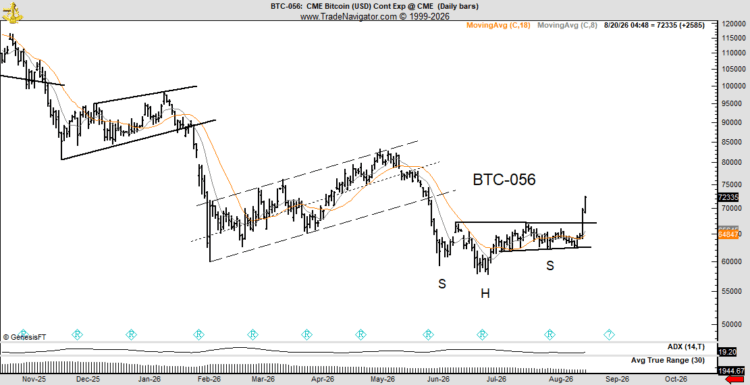
Nicolai Sondergaard, a Senior Research Analyst at Nansen, identifies the 200-day moving average near $69,000 as a critical inflection point. Bitcoin has successfully reclaimed this average, and the MACD momentum indicator has turned bullish. Yet, a decisive drop back below $69,000 would significantly undermine the credibility of the current breakout. CryptoQuant maintains a cautious stance, noting that its proprietary bull-bear indicator has not yet confirmed a bullish trend. For a higher-level confirmation, Bitcoin’s 365-day moving average, positioned around $83,000, remains a key threshold.
Peter Schiff Dismisses Rally as a “Fake Breakout”
While market sentiment rapidly improved, long-time Bitcoin critic, economist Peter Schiff, once again voiced a contrarian view. After Bitcoin surpassed $72,000, he labeled the rally a “fake breakout.” Schiff argues that the Treasury’s expanded bond buybacks have indeed altered market expectations for liquidity, providing a temporary boost to risk assets. However, he believes investors are overestimating the long-term impact of such loose financial conditions on Bitcoin.

Schiff contends that while a shift towards more accommodative monetary and fiscal environments is beneficial for gold, Bitcoin may not receive the same sustained support. He reiterated his public call for investors to sell Bitcoin and reallocate funds into gold. With Bitcoin now firmly above $74,000 and even breaching $75,000, the debate between bulls and bears over the sustainability of this breakout has intensified. Key indicators to watch for future market direction include ETF capital flows, sustained spot market buying pressure, and whether the current price can be maintained after the large-scale short covering concludes.
Disclaimer: This article is provided for market information purposes only. All content and views are for reference only and do not constitute investment advice, nor do they represent the views and positions of BlockTempo. Investors should make their own decisions and trades. The author and BlockTempo will not bear any responsibility for direct or indirect losses resulting from investor transactions.




