Author: Jae, PANews
Ethena’s Bold Tokenomics Overhaul: A New Era for ENA?
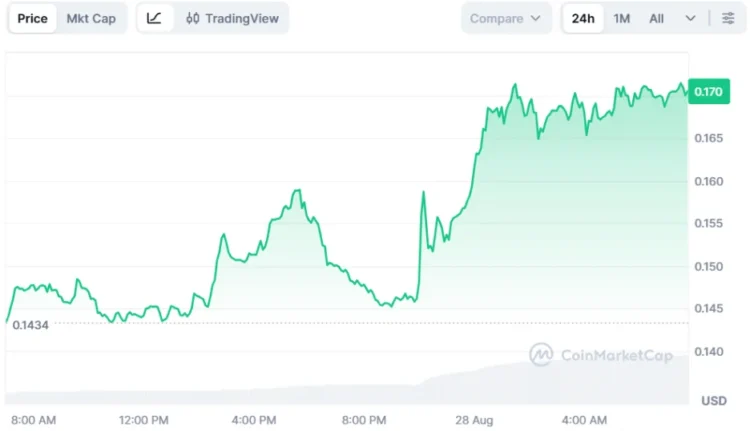
The Ethena Foundation has ignited market excitement with a comprehensive overhaul of its protocol ecosystem and tokenomics. Following the announcement on the evening of August 27th, the ENA token surged over 20% in a single day, accumulating a nearly 60% rebound within the week and extending its robust upward trajectory from the past month.
These four interconnected adjustments by the Ethena Foundation are meticulously designed to achieve a singular objective: to eliminate the persistent selling pressure from monthly VC token unlocks that has shadowed the project for the past two to three years, and to more effectively channel the protocol’s inherent economic value directly to ENA token holders.
Ethena’s Strategic Four-Pronged Approach to Tokenomics Reform
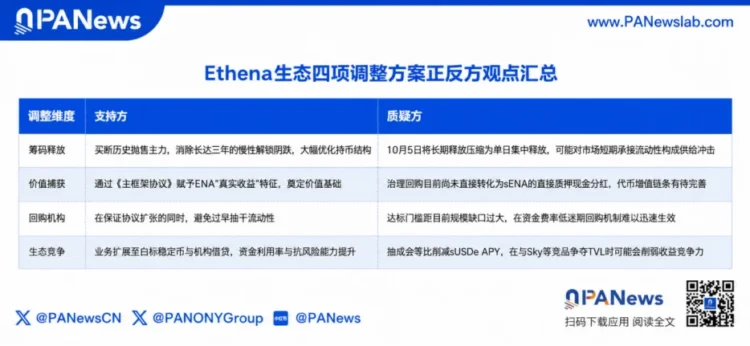
Ethena is executing a systematic reshaping of its tokenomics, spanning from repurchasing early investor stakes and discontinuing monthly unlocks to integrating protocol economic rights and initiating a tiered income buyback mechanism.
1. Eradicating Early Selling Pressure: A “Strategic Cleanse” of Unstable Capital
Ethena’s initial move involved repurchasing a segment of early investors’ locked tokens. The Foundation identified seed-round investors whose initial allocation exceeded 0.25% of the total supply. For institutions that had previously divested holdings in the secondary market after last October’s market peak, Ethena offered to buy out all their remaining locked tokens (with one wallet declining the offer). For those who had never sold, an option to exit at original face value was provided, though no institution opted to surrender their tokens.
This action is fundamentally a “targeted clearing of unstable capital.” By neutralizing the holdings of previous sellers, these locked tokens will no longer pose a threat of future market dilution. While Ethena has not disclosed the exact volume or value of tokens involved, the long-term impact on circulating supply is anticipated to be positive, removing a significant overhang.
2. Ending Monthly Unlocks: From “Lingering Pain” to “Decisive Resolution”
The second critical adjustment is the cancellation of the 3-year monthly unlock schedule for VC investors. Instead, all remaining unlocked tokens will be released in a single, full distribution on October 5th. Team allocations, however, will adhere to their original vesting schedules and will not participate in this early unlock. Post-adjustment, the proportion of tokens locked across the network will decrease to approximately 12%, primarily comprising team, ecosystem, and Foundation holdings.
The monthly unlock mechanism’s primary drawback was the “perpetual expectation of selling pressure,” which consistently dampened valuations. This concentrated release aims to absorb the impending supply shock in one go, transforming a prolonged period of uncertainty into a swift, decisive event. While this could mean a larger short-term supply impact, the long-term benefit lies in clearing the air, with the ultimate outcome dependent on the released token volume and actual investor selling behavior.
3. Introducing the Master Framework Agreement: Aligning Protocol Value with Token Governance
The third adjustment tackles a persistent challenge in DeFi: defining who truly benefits from the protocol’s generated revenue. The Ethena Foundation and Ethena Labs, its development entity, have formalized a “Master Framework Agreement,” set for public release in October. This agreement stipulates that Ethena’s core intellectual property and the economic value generated by the protocol will be owned by the Foundation and its ecosystem, with governance entrusted to ENA token holders.
This pivotal change means ENA’s value proposition extends beyond mere governance rights; the protocol’s economic earnings will now be directly integrated into the token holders’ value capture framework, creating a more tangible link between protocol success and token appreciation.
4. Tiered Income Buyback: A Revenue Flywheel Linked to USDe Growth
The most anticipated and market-moving adjustment is the Tiered Income Buyback Mechanism, or “Fee Switch.” Approved by the Risk Committee, this proposal is currently undergoing governance voting, with results expected on September 2nd.
This mechanism proposes a direct correlation between the protocol’s net income allocation and the supply volume of USDe. Upon USDe supply reaching a $7.5 billion activation baseline, 95% of the net income collected by the Foundation will be utilized for programmatic ENA buybacks on the secondary market, with the remaining 5% dedicated to ecosystem growth. As USDe supply escalates to higher tiers, the buyback ratio and scale will progressively increase.
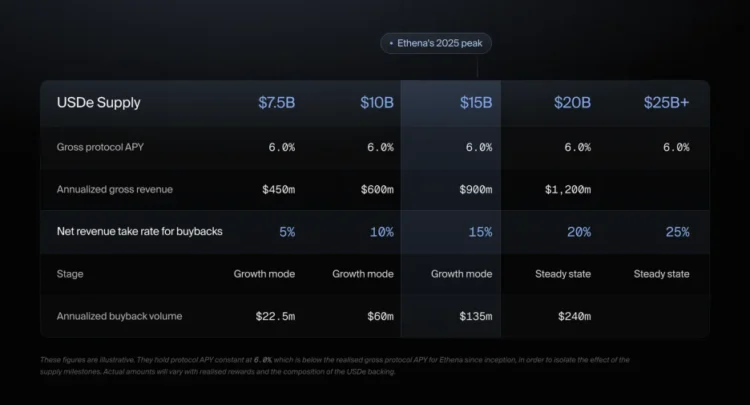
Funding for these buybacks will originate from Ethena’s three core business lines: USDe savings yield, its white-label stablecoin services, and the net income from Ethena [X], which is slated for launch next week.
Essentially, this mechanism endows the ENA token with an income-driven deflationary engine. However, its activation hinges on USDe returning to a growth trajectory. Given the current subdued derivatives market and low funding rates, the buyback engine may remain idle in the short term. Investing in ENA now could be viewed as a “forward growth option,” anticipating future expansion.
From $15 Billion to $4 Billion: USDe’s Contraction Drives Business Evolution
This radical restructuring is an inevitable response to Ethena entering a critical bottleneck phase. USDe, once a leading synthetic dollar protocol, leveraged a Delta-neutral hedging strategy (“spot long + futures short”) to capitalize on basis arbitrage in a bullish derivatives market. Its circulating supply briefly neared $15 billion. However, with the cooling crypto market and a sharp decline in derivative funding rates, USDe’s market cap has shrunk to $4 billion. This revenue contraction left ENA in a dual predicament: “supply-side selling pressure and a lack of clear value anchor.”
Ethena’s challenge extended beyond mere token supply pressure; it faced a stagnation in the crucial positive feedback loop of “USDe growth — protocol revenue — token value.”
Proactively addressing this, Ethena has pursued several strategic initiatives this year:
- A $1 billion financing facility established with FalconX, integrating USDe collateral assets into the institutional overcollateralized lending market.
- Attracting investment from traditional finance giant Janus Henderson into ENA and exploring new distribution channels for USDe.
- A partnership with Coinbase to introduce savings derivative products for both retail and institutional clients.
The protocol is actively diversifying its revenue streams, moving beyond its sole reliance on crypto derivatives funding rates to embrace stablecoins, savings products, and institutional credit.
This tokenomics adjustment is fundamentally a re-architecture of the value model to complement this business transformation. Previously, USDe expansion primarily boosted protocol revenue without directly benefiting ENA holders. Now, Ethena aims to channel the gains from business growth back to the token through its buyback mechanism.
Short-Term Sentiment vs. Long-Term Performance
In the short term, the anticipated improvements on the supply side and the promise of buybacks are likely to bolster market sentiment. However, the ultimate success of these reforms hinges entirely on the sustained growth of Ethena’s underlying business.
The single decisive factor is whether Ethena can successfully transition from a “pro-cyclical high-yield product” to a “diversified income infrastructure.”
If USDe can regain its growth momentum, and new ventures like white-label stablecoins and institutional lending consistently contribute revenue, then a virtuous cycle of “revenue growth → buyback expansion → token appreciation → ecosystem expansion” can be ignited. This would position ENA to evolve from a mere governance token into a deflationary asset backed by tangible earnings.
Conversely, if revenue remains heavily dependent on the crypto market cycle and new business expansion falls short of expectations, the buyback mechanism will serve merely as a valuation adjustment tool during downturns, rather than a robust, stable value capture engine.
In essence, these adjustments address the “tokenomics problem” but do not inherently solve the “business growth problem.” While short-term sentiment can be swayed by expectations, long-term value must ultimately be delivered through performance.
Placing Ethena’s restructuring within the broader DeFi landscape, it represents another compelling example of protocols striving to re-establish tangible value capture. For too long, the value of many DeFi governance tokens relied heavily on narratives and speculation, with protocol earnings having little direct impact on token holders. Unlocks and inflation have been persistent pressures. Now, an increasing number of leading protocols are confronting these issues, linking buybacks to revenue, and using governance to capture intrinsic value.
Crucially, all token economic designs must be built upon robust protocol fundamentals. A buyback engine requires sustained business growth to operate, and value capture demands real, consistent income. Without growth in scale and protocol profitability, even the most intricately designed token model remains an unsustainable construct.
For Ethena, the concentrated token unlock on October 5th will serve as the first significant test following its ambitious value restructuring reforms.
(The above content is an excerpt and reproduction authorized by partner PANews, original link)
Disclaimer: This article is for market information purposes only. All content and opinions are for reference only, do not constitute investment advice, and do not represent the views and positions of BlockBeats. Investors should make their own decisions and trades. The author and BlockBeats will not bear any responsibility for direct or indirect losses caused by investor transactions.