
Author: Ariel, CryptoCity
US Public Strongly Opposes Cryptocurrency in Retirement Plans: NIRS Survey Reveals Widespread Skepticism
Would you welcome the inclusion of cryptocurrencies in your retirement savings plan?
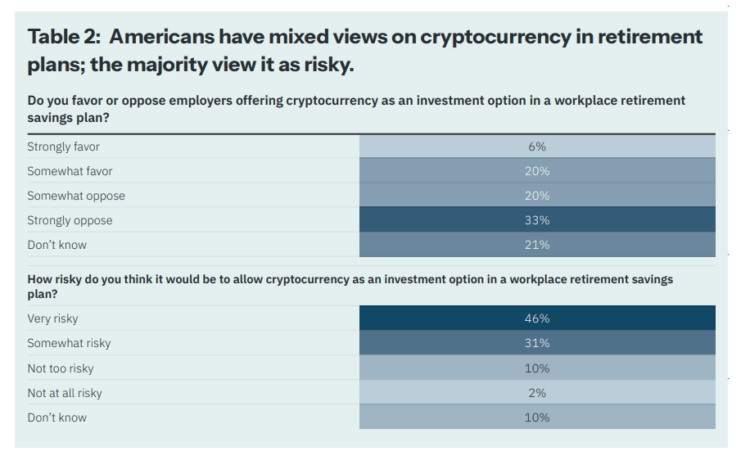
A recent survey by the National Institute on Retirement Security (NIRS) reveals a significant aversion among the American public to integrating digital assets into their long-term savings. Specifically, 53% of U.S. respondents explicitly oppose employers incorporating cryptocurrencies into workplace 401(k) and similar retirement savings programs. Further underscoring this caution, a substantial 77% of the public classifies cryptocurrencies as high-risk assets, with a notable 46% identifying them as “extremely high-risk” investments.
The comprehensive survey engaged 1,203 adults aged 25 and over, conducted between October 24 and November 14, 2025.
These findings clearly demonstrate that the general American populace maintains an exceptionally cautious and reserved stance regarding the inclusion of volatile crypto assets in their crucial retirement savings accounts.
A Looming Crisis: 80% of Americans Perceive a Severe Retirement Shortfall
Beyond the debate on digital assets, the NIRS survey casts a stark light on a broader national concern: a staggering 80% of Americans believe the nation is facing a severe retirement crisis, a significant increase from 67% in a similar 2020 survey. Among these, 61% of respondents admit to being deeply worried about achieving adequate financial security in retirement.
The primary drivers of this widespread anxiety are soaring inflation (cited by 73%) and extreme financial market volatility (62%). Additionally, 76% of respondents expressed concern that government Social Security benefits could face cuts if Congress fails to take timely action. The survey also revealed that 68% of the public feels that preparing for retirement has become increasingly challenging, with skyrocketing prices and stagnant wages identified as leading detrimental factors.
Dan Doonan, Executive Director of the National Institute on Retirement Security, highlighted the immense pressure Americans face from escalating living costs, including housing, healthcare, and debt repayment. These expenditures, he notes, are severely eroding the capacity for retirement savings, all while individuals must navigate the transformations and risks introduced by emerging financial technologies like cryptocurrencies and artificial intelligence (AI).

AI in Personal Finance: Generational Divide in Adoption
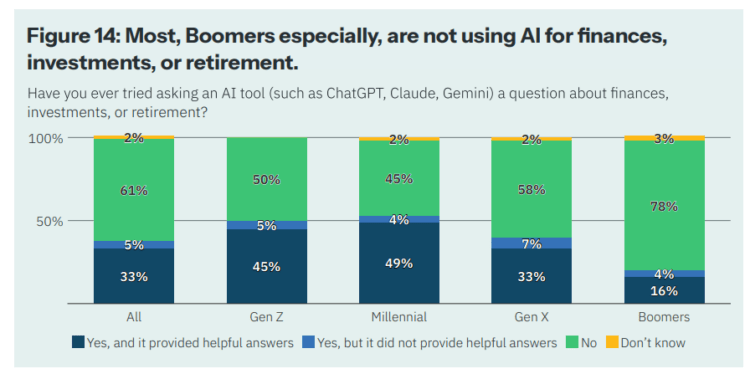
The NIRS survey also explored the application of AI in personal finance. The results indicate a mixed reception: while 63% of respondents have used AI tools in some capacity, 61% have yet to leverage AI for core financial matters such as personal budgeting, investment allocation, or retirement planning.
Furthermore, 45% of respondents confessed discomfort with AI directly providing financial advice, with younger generations showing significantly higher acceptance of AI in financial management compared to older demographics.
Despite these reservations, public interest remains strong for utilizing AI as an assistant in areas like budget planning (38%), investment support (34%), retirement preparation (32%), and tax planning (24%). This suggests consumers are more inclined to view AI as a valuable financial aid rather than fully delegating investment decisions to it.
Political Pushback: Democratic Lawmakers Call for Withdrawal of 401(k) Crypto Rule
The public’s skepticism towards integrating volatile assets into retirement plans is mirrored in the political arena. Even before this survey’s release, the potential loosening of restrictions on alternative assets in U.S. 401(k) retirement schemes had sparked significant political controversy.
Representative Maxine Waters (D-CA), Chairwoman of the House Financial Services Committee, previously penned a letter to Acting Secretary of Labor Keith Sonderling, demanding the withdrawal of a proposed rule that would permit 401(k) accounts to invest in alternative assets, including cryptocurrencies, private equity, and commodities.
This contentious draft rule, formulated under a Trump administration executive order, aimed to establish a “safe harbor” mechanism, offering legal protection to retirement plan fiduciaries who include crypto assets.
In her letter, Waters sharply criticized the policy, arguing it would strip retirement savers of long-held investor protections and encourage high-risk, high-cost speculative behaviors.
- Related Report: Opposing U.S. Retirement Funds in Crypto! Lawmaker: Don’t Let People’s Hard-Earned Money Bear Crypto Risks
Acting Secretary Sonderling publicly responded by clarifying that the draft rule explicitly mandates fiduciaries to evaluate investments through a prudent process, indicating no relaxation of oversight. Nevertheless, recent joint protests from high-profile Democratic figures, including Senators Bernie Sanders and Elizabeth Warren, signal that the political debate surrounding the introduction of cryptocurrencies into retirement funds continues to intensify.
(The above content has been excerpted and reproduced with authorization from our partner CryptoCity)
Disclaimer: This article is for market information purposes only. All content and views are for reference only and do not constitute investment advice. They do not represent the views and positions of BlockTempo. Investors should make their own decisions and trades. The author and BlockTempo will not bear any responsibility for direct or indirect losses incurred by investors’ transactions.