El Salvador’s Bitcoin Beach: A Cooling Tide for Daily Crypto Payments?
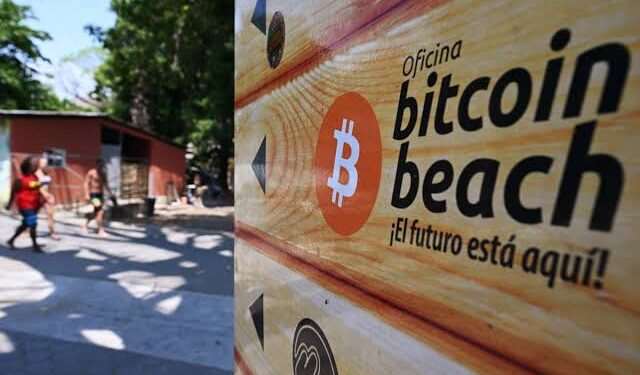
Once hailed as a pioneering global experiment in Bitcoin ($BTC) adoption, El Salvador’s “Bitcoin Beach” in El Zonte is now facing a stark reality: a significant decline in its everyday use. A recent firsthand account from Bitcoin Core developer Jon Atack has brought this trend into sharp focus, revealing that a local restaurant reported receiving only a single Bitcoin payment throughout the entire month of August.
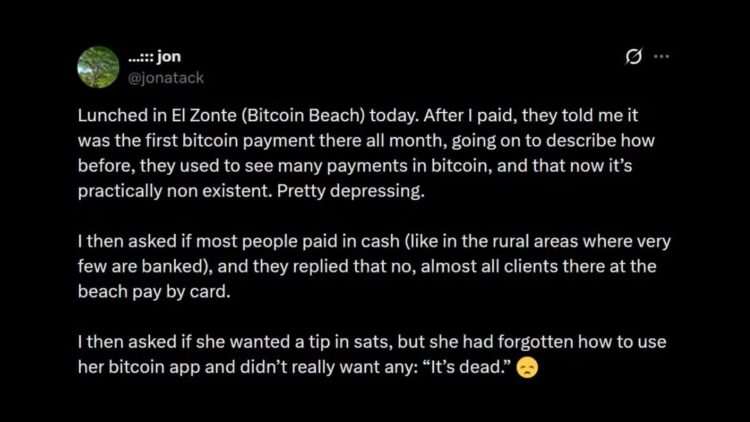
Atack, who has resided in El Salvador since 2022, recounted a recent dining experience in El Zonte where he opted to pay with Bitcoin. To his surprise, the staff informed him it was the first Bitcoin transaction the establishment had processed that month. This stood in stark contrast to previous years, when Bitcoin payments were “quite common” but have now become “almost non-existent.”
When Atack inquired about the prevailing payment methods, the restaurant staff indicated that credit cards were now overwhelmingly preferred by customers in the beach area. In a telling exchange, when Atack attempted to tip in Satoshis, the server politely declined, admitting they had forgotten how to operate the Bitcoin application.
However, it’s crucial to note that Atack’s experience stems from a single merchant, and thus may not fully represent the broader Bitcoin payment landscape across all of El Zonte or El Salvador. Other recent visitors to the area have reported successful Bitcoin transactions and observed some merchants still prominently displaying “Bitcoin Accepted” signs.
National Bitcoin Usage Plummets to 8.1% in 2024
The observations from El Zonte align with a broader national trend in El Salvador. A comprehensive survey conducted by the Public Opinion Institute of the Central American University (UCA) reveals that in 2024, only 8.1% of Salvadorans reported using Bitcoin for purchasing goods or services. This marks the lowest recorded usage since Bitcoin was granted legal tender status in 2021.
Bitcoin payment adoption has seen a consistent decline since its peak. In 2021, usage stood at 25.7%, falling to 21% in 2022, then to 12% in 2023, and now to a mere 8.1% in 2024. The UCA survey encompassed 1,266 individuals, with a confidence level of 95% and a margin of error of approximately 2.75 percentage points.
Further corroborating these findings, a separate study by Francisco Gavidia University yielded similar results, with approximately 92% of respondents stating they had not used Bitcoin for transactions in 2024, placing the actual usage rate around 7.5%.
While these surveys rely on self-reported usage and do not directly measure the total volume of Bitcoin transactions by merchants, the long-term data consistently indicates a dwindling proportion of Salvadorans utilizing Bitcoin for their daily payment needs.
From Mandate to Voluntary: El Salvador’s Evolving Bitcoin Policy
El Salvador made global headlines in September 2021 by becoming the first nation to officially adopt Bitcoin as legal tender. The government launched initiatives like the official Chivo Wallet, deployed Bitcoin ATMs nationwide, and established mechanisms for seamless USD-to-Bitcoin exchange, all aimed at fostering widespread adoption among citizens and businesses.
However, a significant policy shift has occurred, notably influenced by El Salvador’s pursuit of a $1.4 billion, 40-month financing package from the International Monetary Fund (IMF). To secure this agreement, amendments were made to the original Bitcoin Law. Crucially, the requirement for private businesses to accept Bitcoin payments was changed to a voluntary basis, and all tax payments were mandated to be made in US dollars.
Concurrently, the government began phasing out certain mechanisms that guaranteed free exchange between Bitcoin and USD, and progressively reduced public sector involvement in the Chivo Wallet. This policy relaxation empowers merchants to decide whether to continue offering Bitcoin payment options, based on customer demand, operational costs, and their own willingness.
The removal of the mandatory acceptance clause has naturally diminished the incentive for businesses lacking genuine transaction demand to maintain the necessary equipment and operational procedures for Bitcoin. For the average consumer, factors such as Bitcoin’s price volatility, the perceived complexity of wallet operations, and a prevalent “HODL” (hold on for dear life) mentality among holders likely further contribute to a reluctance to use Bitcoin for everyday transactions.
Diverging Paths: Government Bitcoin Accumulation vs. Civilian Payment Retreat
An intriguing dichotomy is emerging in El Salvador: while the government’s Bitcoin reserves appear to be growing, civilian usage for daily payments seems to be receding. Publicly tracked data indicates that as of August 25th, wallets associated with the Salvadoran government hold approximately 7,756 Bitcoins, valued at roughly $615 million. This year alone, the reported on-paper holdings have increased by about 240 Bitcoins.
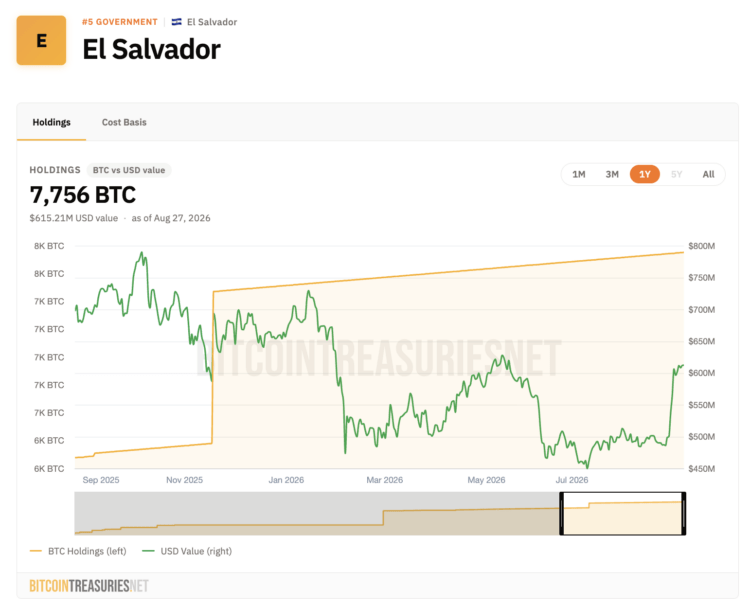
However, documents from the IMF offer a nuanced perspective on these government holdings. The agreement signed between the Salvadoran government and the IMF indicates that the total public sector Bitcoin holdings have not actively increased since the financing package was approved. The apparent growth in some government wallets might, in fact, stem from internal asset transfers between different government-controlled addresses rather than new purchases. Therefore, changes displayed by public wallets cannot be directly interpreted as a reflection of increased Bitcoin payment frequency by the Salvadoran populace.
- Related Reading: Is El Salvador’s Bitcoin Buying a Lie? IMF Report: Internal Transfers, No New Accumulation
El Zonte, the birthplace of El Salvador’s audacious Bitcoin experiment, saw its community championing the Lightning Network and Bitcoin payments even before the national policy was enacted. Today, while the Bitcoin payment infrastructure remains largely intact, the fundamental challenge persists: how to reignite and sustain public willingness to integrate Bitcoin into their daily routines for purchases like coffee, meals, and everyday shopping. This remains a pivotal question for the ongoing national Bitcoin endeavor.
(The above content has been excerpted and reproduced with authorization from our partner CryptoCity.)
Disclaimer: This article provides market information only. All content and views are for reference purposes only and do not constitute investment advice. They do not represent the views or positions of BlockTempo. Investors should make their own decisions and trades. The author and BlockTempo will not bear any responsibility for direct or indirect losses incurred by investors’ transactions.