
Author: Nancy, PANews
Robinhood Chain’s Explosive Growth: Unpacking the Dynamics of Its Rapid Ascent
Over the past weekend, Robinhood Chain, a network less than two months old, experienced another surge in on-chain activity. Key metrics like transaction volume and active users shattered previous records, while protocol revenue saw significant growth, surpassing many established L2s.
For an early-stage network, such rapid and sustained growth is uncommon. The immense traffic quickly converging on Robinhood Chain is a testament to how funds, users, and assets are flowing into a single chain through various entry points.
Launchpads: Catalysts for New Assets, Pons as the Premier Traffic Magnet
The initial gateway for Robinhood Chain’s traffic was its Launchpad, which continuously introduces new assets, thereby generating trading demand and retaining liquidity within the ecosystem. In the current competitive Launchpad landscape, Pons has emerged as a standout player.
Pons’ on-chain data consistently hits new highs, solidifying its position as one of Robinhood Chain’s primary trading hubs and capturing significant market attention.
Dune analytics reveal that Pons recently deployed over 22,000 tokens in a single day, marking a new all-time high and accounting for 67.8% of Robinhood Chain’s total token deployments for that day. Daily transaction volume also broke records, exceeding $308 million and representing over 78.2% of the entire chain’s volume. Concurrently, Pons recorded 115,000 active wallets in a single day, more than six times that of its closest competitor, Pools.
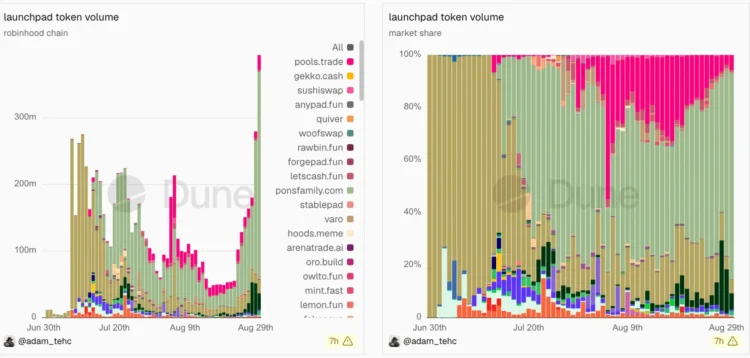
Furthermore, Pons reinforces its ecosystem dominance through creator incentives. The platform allocates 70% of transaction fees to token creators, boosting their potential earnings and stimulating more token issuance. Official data indicates that Pons has paid approximately $20.93 million to token creators over the past 47 days.
As trading volume continues to flow into Pons, the platform’s captured fees grow steadily. These fees are then reinvested into the PONS token through a buyback and burn mechanism, creating a powerful growth flywheel.
According to Pons’ disclosed economic model, 80% of protocol revenue is used to continuously buy back PONS via a TWAP mechanism, which is then permanently burned. DeFillama data shows Pons’ cumulative revenue has exceeded $10.14 million, with daily revenue briefly surpassing $1 million. It currently stands as the second-highest revenue-generating protocol on Robinhood Chain.
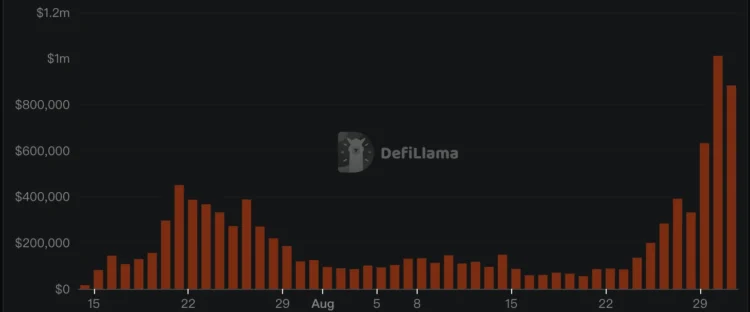
With protocol revenue consistently increasing, the scale of PONS buybacks and burns is also expanding. To date, official disclosures show that cumulative burns account for approximately 29% of its total supply.
This mechanism is reshaping how the market values the PONS platform token. Particularly when compared to Pump.fun, a leading Launchpad in the Meme sector, Pons demonstrates superior value capture through its protocol revenue buyback ratio, token burning, and recent revenue growth. Given PUMP’s already high market capitalization, PONS’ relatively lower valuation offers significant upside potential for the market.
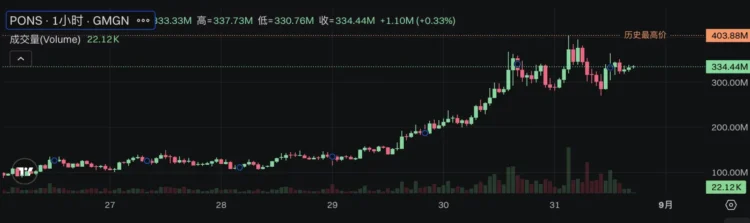
The PONS token has seen a sustained rally recently. GMGN data indicates that PONS’ market cap surged from less than $30 million a week ago to over $400 million at its peak, making it the highest market cap token on Robinhood Chain.
In essence, Pons has become the primary engine for continuous new asset creation within the Robinhood Chain ecosystem.
Trading Terminals: Driving Incremental Users, Fomo Expands the User Frontier
While Launchpads are responsible for manufacturing assets and initial liquidity, trading terminals cater to the subsequent demand generated by these assets.
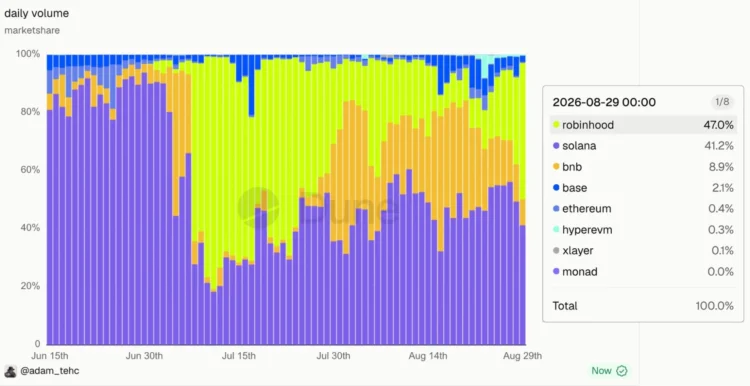
Currently, trading terminals on Robinhood Chain contribute nearly half of the network’s total transaction volume. Dune data shows that trading terminals account for 47% of the network’s daily transaction volume, approximately $280 million, with over 110,000 daily active wallets—all new highs since launch.
Among these, Fomo stands out as one of the fastest-growing products. Since Robinhood Chain’s mainnet launch, Fomo has rapidly become a crucial on-chain trading gateway. The Fomo team has previously disclosed that on Robinhood Chain, one out of every two active wallets originates from Fomo. Fomo users are frequently observed among the top profit-makers for popular tokens.
Fomo aims to transform complex on-chain trading into an experience akin to a social app. Users can browse tokens, watch trades, follow other traders, and execute transactions directly within their information feed. This design significantly lowers the barrier to entry for on-chain trading and imbues the trading process with a stronger social dimension.
High-yield success stories on the platform further amplify user attraction. According to official Fomo disclosures, 26 traders have cumulative profits exceeding $1 million to date, and over the past 30 days, 25 users have achieved profits exceeding $1 million. In contrast, analysis by @0xAvast indicates that over the same 30-day period, only one wallet on the Pump application achieved over $1 million in PNL (unrealized profit); on Fomo, users need to reach over $1 million in PNL just to enter the top 30 on the profit leaderboard.
From a user structure perspective, Fomo’s significance extends beyond merely contributing to transaction volume; it lies in broadening Robinhood Chain’s user base.
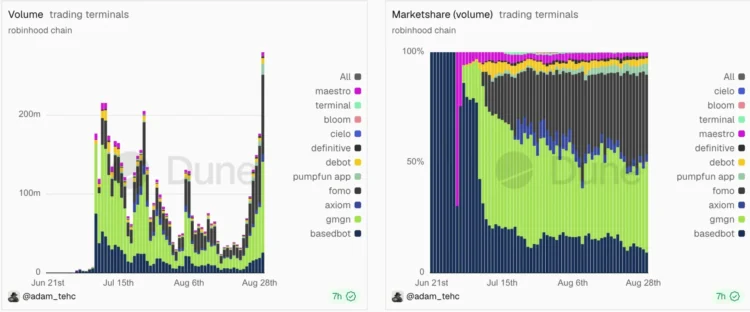
In terms of trading scale, Dune data shows that GMGN’s latest daily transaction volume on Robinhood Chain reached $1.115 billion, accounting for 41.2% of the entire network and ranking first. Fomo’s daily transaction volume was approximately $101 million, representing about 36%.
While GMGN clearly handles a larger trading volume, a closer look at address counts reveals distinct user profiles. GMGN has approximately 17,700 daily active addresses, corresponding to an average daily transaction value of about $62,800 per address, primarily serving professional traders, high-frequency traders, and users with substantial capital. In contrast, Fomo boasts over 64,000 daily active addresses, but the average daily transaction value per address is only about $1,565, a fraction of GMGN’s, indicating a much broader coverage of general users.
However, Fomo CEO Se Yong recently disclosed that existing on-chain data might underestimate the platform’s true scale by 20% to 40%, attributing this to the significant challenge of simultaneously collecting comprehensive data from 6 to 7 chains. Moreover, Fomo adds approximately 40,000 new users daily from the App Store. He believes it’s unlikely this entire influx comes from existing crypto users, suggesting a substantial portion are new users previously inactive in the crypto market.
For Robinhood Chain, Fomo brings not just transaction volume but also expands on-chain trading from professional traders to a much wider audience of everyday users.
The Spreading Wealth Effect: Listing Expectations Fuel Capital Dynamics
For an early-stage public chain, the “wealth effect” often serves as the most potent magnet, consistently attracting capital and users.
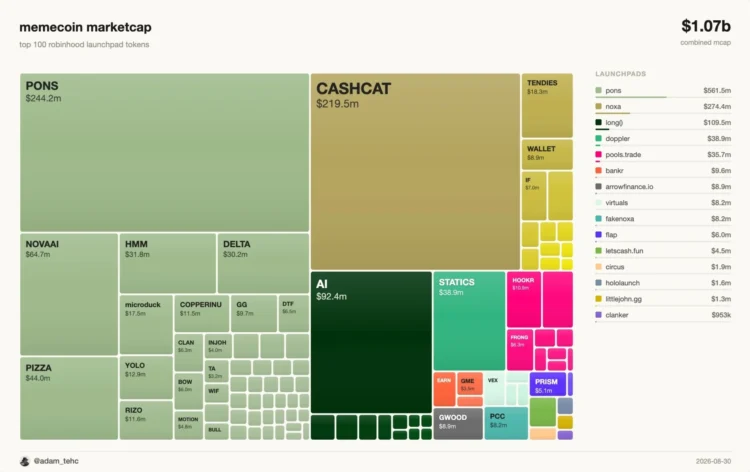
In recent days, tokens like PONS, AI, and NET on Robinhood Chain have experienced continuous price surges, with some assets reaching all-time highs. Dune data reveals that the total market capitalization of the top 100 tokens on Robinhood Launchpad has surpassed $1 billion, increasing by 123% over the past six days.
Numerous high-yield success stories have emerged on-chain. For instance, according to monitoring by on-chain analyst @ai_9684xtpa, one address purchased PONS at a low point 46 days ago, investing only $115,000, and is now sitting on over $2.82 million in unrealized gains, representing a staggering 2456.6% return. The same address also profited approximately $598,000 from liquidating CASHCAT.
KOL (Key Opinion Leader) holdings further amplify market attention. For example, crypto KOL Bonkguy previously spent 67,304 USDG to acquire 10.96 million PONS, which he still holds, with its value now approaching $3.8 million. Ansem invested approximately $57,600 into NET tokens of the DeFi protocol NetNet Capital, and over $21,000 into Artificial In (AI) tokens. Him accepted about 40% of the token allocation for the community token COPPERINU and, mimicking ANSEM’s token strategy, conducted manual airdrops to the community, briefly boosting its market cap.
Market expectations for Robinhood listings continue to drive up the visibility of on-chain tokens. Following Robinhood’s listing of CASHCAT, the token’s market cap surged significantly. For the market, a token gaining Robinhood’s attention or being listed on its trading platform could unlock massive user traffic, trading access, and brand exposure, prompting early capital speculation. This mirrors the market anticipation seen previously when MEME tokens on the BSC chain were listed on Binance.
Stock Memes in Liquidity Pools: RWA as Programmable Building Blocks
Stock Memes are emerging as a unique differentiator for Robinhood Chain, opening new liquidity avenues for tokenized stocks. Currently, related tokens on Robinhood Chain such as CASHCAT, STONKBROKER, INDEX, and microduck have garnered considerable market interest, with some leading assets achieving substantial market capitalizations.
Unlike traditional Meme coins, which primarily rely on narrative, community sentiment, and capital speculation, some Stock Memes are experimenting with combining Meme assets with tokenized stocks. This introduces new on-chain traffic to stock tokens that previously lacked diverse use cases.
Crypto analyst Qinbafrank points out that Robinhood Chain has pioneered a mechanism where stock tokens and Meme coins form LP (Liquidity Provider) pools. Trading these Memes directly generates trading volume for stock tokens and simultaneously locks a portion of stock tokens into LP pools. This is one reason why the trading volume of tokenized U.S. stocks on Robinhood Chain has surpassed that of some competitors on Solana.
Notably, Robinhood itself did not officially develop “Meme-ing stocks” as a product. Robinhood CEO Vlad Tenev previously mentioned in a podcast that developers created liquidity pools the team hadn’t initially envisioned, combining Memes, crypto assets, and stock tokens. Memes became a gateway for users to real stock tokens—a development that even exceeded the company’s expectations.
From this perspective, this phenomenon can be seen as a natural outcome of permissionless on-chain deployment. Qinbafrank highlights its significance in several key areas:
- **RWA’s Cold Start Solution:** Previously, tokenized stocks had limited use cases once on-chain. Now, Memes first attract users, fees, and attention, then funnel trading volume back to the stock tokens.
- **Stock Tokens as True “Programmable Building Blocks”:** In the past, tokenized stocks mostly allowed for buying, selling, and viewing charts. Now, more on-chain combinations are emerging, with future potential for integration with lending, indices, agents, and other products. The industry is shifting from merely “displaying stocks on-chain” to “using stocks as DeFi primitives.” This represents the true direction of tokenization: composability, rather than simply replicating an on-chain brokerage page.
- **Diversified On-Chain Liquidity Pairing Assets:** In the future, Meme quoting assets may not be limited to ETH, SOL, BNB, or stablecoins. Real-world assets like stocks, government bonds, and gold could become new liquidity pairing assets.
More importantly, the boundaries between the crypto and stock markets are blurring. This development may not primarily stimulate TVL (Total Value Locked) but rather the user mindset. For the first time, users can simultaneously engage with high-volatility crypto-native speculation and traditional pricing anchors like U.S. stocks within the same pool, linking speculative flow with real financial assets. This reinforces a broader trend: quality financial assets will continue to be tokenized, re-priced, re-distributed, and re-combined on-chain.
He concludes that Robinhood Chain offers a valuable blueprint for other traditional financial institutions (TradFi): when entering the blockchain space, it’s not always necessary to first establish a strictly regulated financial special zone. Activating the chain first and then embedding proprietary assets into existing speculative and DeFi activities might prove faster than the “compliance first, then wait for adoption” approach.
Viewed through this lens, Robinhood Chain’s sustained surge in popularity is easily understood. Continuous token issuance creates new assets, active trading drives traffic, the wealth effect attracts more capital, and RWA innovation provides novel asset combination methods, drawing more users and funds into Robinhood Chain and progressively forming a powerful growth flywheel.
(The above content is an authorized excerpt and reproduction from our partner PANews. Original Article Link)
Disclaimer: This article is for market information purposes only. All content and views are for reference only and do not constitute investment advice. They do not represent the views and positions of the BlockBeats. Investors should make their own decisions and trades. The author and BlockBeats will not bear any responsibility for direct or indirect losses incurred by investors’ transactions.