
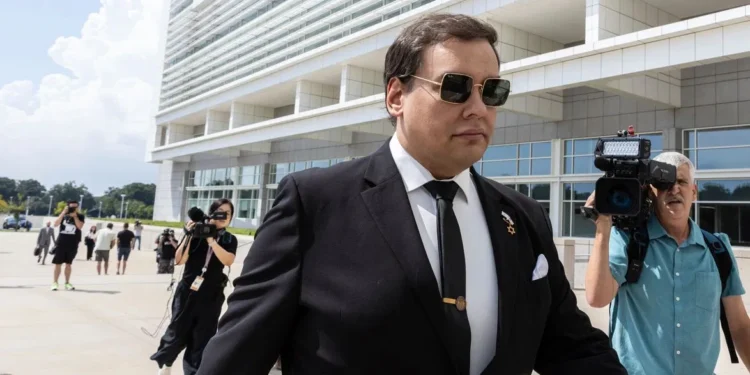
Prediction Market Kalshi Delivers Historic Lifetime Ban and Fine to George Santos for Market Manipulation
In an unprecedented move, U.S. prediction market platform Kalshi announced a permanent ban on former Congressman George Santos, prohibiting him from directly or indirectly using its platform. The platform also levied a significant fine of $71,356 against him. This landmark disciplinary action, which took effect on August 28th, marks Kalshi’s first-ever lifetime trading ban since its inception, underscoring its commitment to market integrity.
The controversy centers on Kalshi’s “Who will attend the State of the Union address” event contract, which included a specific market on whether Santos would attend the February 24, 2026, address. According to Kalshi’s rules, individuals who can directly determine or influence an event’s outcome are explicitly prohibited from participating in related trades—a fundamental rule Santos allegedly violated.
Documents from the Commodity Futures Trading Commission (CFTC) detail Santos’s alleged manipulative tactics. He initially established a “Yes” position, betting on his attendance at the State of the Union. Following this, he took to social media, publicly discussing his potential attire for the address. This engagement reportedly caused the contract price to surge dramatically from a mere 15 cents to 70 cents per share within hours, prompting Santos to promptly close his position for a swift profit.
Santos’s alleged manipulation continued as he then pivoted, establishing a “No” position, betting against his attendance. Even after his flights and train travel were reportedly canceled, he continued to publicly affirm his intention to attend the State of the Union, further muddying market expectations and creating confusion for other traders.
On the very day of the address, Santos posted on social media, claiming he could only watch the speech from an airport television. This public declaration immediately triggered a sharp decline in the “Yes” contract price, which plummeted from 73 cents to just 2 cents, thereby significantly boosting the value of his “No” position. Kalshi’s investigation concluded that some of Santos’s public statements were false or misleading, deliberately engineered to influence contract prices, and ultimately netted him approximately $17,800 in illicit profits from these trades.
This action by Kalshi follows an independent disciplinary action by the CFTC on July 31st for the very same incident. The CFTC ordered Santos to disgorge $17,569.98 in trading profits and pay an additional civil monetary penalty of $17,500, totaling $35,069.98. Furthermore, the CFTC banned him from trading on any CFTC-registered entity for a period of three years. Santos accepted this settlement without admitting to the findings.
Santos later responded on X (formerly Twitter), mocking Kalshi’s lifetime ban and derisively labeling the platform a “gambling platform.” This high-profile case vividly underscores a critical challenge inherent in prediction markets: the profound conflict of interest that arises when the individual whose actions are being predicted in a contract is also a participant in the market. Such individuals not only possess non-public information but also wield the power to directly control outcomes or manipulate market expectations through public pronouncements. Consequently, prediction platforms must enforce far more stringent rules and oversight regarding participant eligibility than traditional financial markets, ensuring fairness and transparency for all.
Related: Former White House Teleprompter Operator Accused of Insider Trading in Prediction Markets, Ordered to Forfeit $172,000 After Betting on Presidential Speech Leaks.
Disclaimer: This article is intended for market information purposes only. All content and views expressed are for reference and do not constitute investment advice. They do not represent the opinions or positions of BlockTempo. Investors should make their own decisions and conduct their own transactions. The author and BlockTempo will not assume any responsibility for direct or indirect losses incurred by investors’ trading activities.




