By: Max, CryptoCity
Unraveling the Satoshi Mystery: New Documentary Claims Bitcoin Founder is a Duo
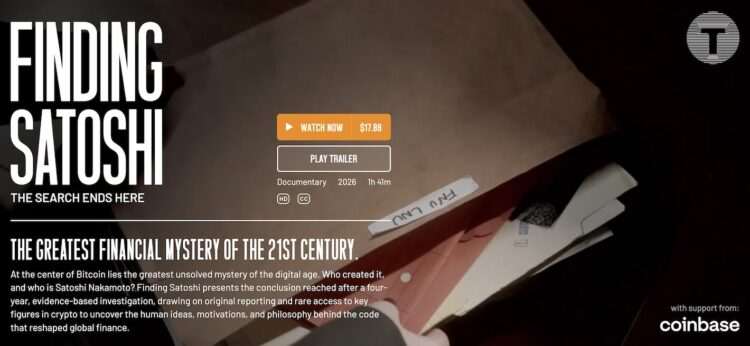
Since its inception in 2009, the true identity of Bitcoin’s enigmatic founder, “Satoshi Nakamoto,” has remained one of the 21st century’s most profound financial puzzles. Despite years of intensive investigative journalism, academic analysis, and rampant speculation, the mysterious individual—or group—who fundamentally reshaped the global financial landscape has remained shrouded in digital anonymity. On April 22, 2026, a groundbreaking new documentary, Finding Satoshi, officially premiered, promising to finally lift the veil.
The production team behind Finding Satoshi asserts that after four years of meticulous investigation, they have unearthed “definitive answers” to this decade-long question. Crafted by acclaimed investigative journalists William D. Cohan and private detective Tyler Maroney, and directed by Tucker Tooley and Matthew Miele, the film bypasses traditional distribution channels. It opts for an exclusive release on FindingSatoshi.com, a distribution model designed to echo Bitcoin’s core ethos of decentralization and foster direct engagement with its audience.
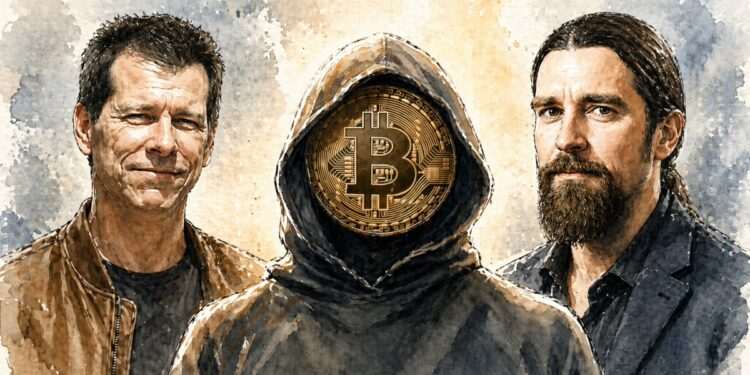
The documentary’s central thesis challenges the long-held belief that Satoshi Nakamoto was a single entity. Instead, the investigative team posits that Satoshi was, in fact, a collaborative technical team comprising two brilliant, albeit deceased, senior cryptographers: Hal Finney and Len Sassaman. Both figures held revered positions within the cryptography community and were deeply involved in the development of PGP (Pretty Good Privacy) encryption software, possessing the formidable technical foundations necessary for Bitcoin’s creation.
Finding Satoshi meticulously details how Bitcoin’s genesis was a fusion of Hal Finney’s exceptional coding prowess and Len Sassaman’s unparalleled academic logic and writing acumen. This proposed division of labor elegantly explains the rigorous precision of Bitcoin’s core codebase alongside the highly professional academic discourse evident in its whitepaper, collectively forging an unassailable prototype for digital finance.
Four Years of Forensic Investigation: Unveiling the Truth Behind Bitcoin’s Origins
To substantiate its groundbreaking conclusions, the production team embarked on an exhaustive, cross-disciplinary forensic investigation. Their journey traced the very origins of cryptography, leading to in-depth interviews with over 20 pivotal figures in the cryptocurrency industry. This esteemed roster included Michael Saylor, Chairman of MicroStrategy; Joseph Lubin, co-founder of Ethereum; Gary Gensler, former Chairman of the U.S. Securities and Exchange Commission (SEC); and Bitcoin security expert Jameson Lopp, among others.
Furthermore, the team even consulted Bjarne Stroustrup, the creator of the C++ programming language, seeking to uncover traces of Bitcoin’s code creation within the evolution of programming languages. A critical component of their investigation involved enlisting Kathleen Puckett, a former FBI behavioral analyst renowned for her work on the “Unabomber” case and her expertise in analyzing the behavioral patterns of anonymous creators.
Puckett’s stylistic forensic analysis of Satoshi Nakamoto’s whitepaper and early emails revealed a consistent use of the plural pronoun “we” in communications, a characteristic indicative of group authorship. Her analysis also highlighted Satoshi’s citation of a 1950s probability theory textbook, “An Introduction to Probability Theory and Its Applications,” suggesting a deep mathematical background and specific academic lineage—a profile that aligns perfectly with Len Sassaman’s academic career trajectory.
On a technical front, the investigative team meticulously cross-referenced Satoshi’s early online activity timestamps. Data indicated a strong correlation with U.S. Eastern Time, effectively ruling out many popular candidates based in Europe or Asia.
Further corroboration came from data scientist Alyssa Blackburn, whose stylistic analysis and server log comparisons statistically linked Finney and Sassaman’s writing habits and coding styles to Satoshi’s recorded patterns. This comprehensive theory resolves the perceived professional discrepancies between Satoshi’s coding and textual discourse, redefining Bitcoin as a profound collaboration of interdisciplinary intelligence.
Debunking the Alibi: Widows’ Testimonies Bolster Documentary’s Credibility
In past community discussions, while Hal Finney was often considered a prime candidate for Satoshi Nakamoto, Bitcoin developer Jameson Lopp had presented a crucial “alibi.” Lopp noted that during a period of active email correspondence between Satoshi and other developers, Hal Finney was participating in a marathon in Santa Barbara. Finding Satoshi offers a compelling counter-narrative, arguing that this very event serves as proof of the duo’s collaborative dynamic. While Finney was focused on the marathon, Len Sassaman, the other half of the team, was handling textual communications and replies, thereby maintaining the illusion of Satoshi’s round-the-clock operational presence.
The documentary features poignant interviews with the widows of both alleged founders. Fran Finney, Hal Finney’s wife, candidly admits her belief that her husband played a central role in Bitcoin’s creation. Meredith L. Patterson, Sassaman’s wife, recounts her late husband’s fervent dedication to anonymity and privacy technologies throughout his life. These deeply human perspectives add emotional resonance to the technical deductions.
Notably, these findings stand in stark contrast to recent reports from other media outlets. For instance, The New York Times, following an 18-month investigation, previously asserted that British cryptographer Adam Back was Satoshi Nakamoto. Back himself has vehemently denied these claims, clarifying that while he invented Hashcash, a foundational technology for Bitcoin, he is not its creator.
- Related News: The New York Times Reignites “Satoshi Identity Mystery,” Adam Back Swiftly Clarifies After Being Targeted
The Finding Satoshi production team acknowledges Adam Back’s technology as a vital cornerstone of Bitcoin but contends that his activity timeline does not fully encompass all of Satoshi’s digital footprints. The documentary also reveals that the team interviewed FTX founder SBF in 2021. Although this 90-minute interview was ultimately excluded from the final cut due to his subsequent fraud scandal and its divergence from the documentary’s core focus, it underscores the comprehensive nature of the team’s investigation.
With Finney having passed away in 2014 and Sassaman in 2011, this conclusion—that Satoshi is comprised of individuals no longer living—has brought a sense of relief to many industry leaders. The estimated 1.1 million Bitcoin held by Satoshi Nakamoto may forever remain dormant, alleviating market fears of a massive sell-off and allowing the legend of this “digital deity” to endure on a purely technical plane.
Industry Leaders Divided: The Dialogue Between Anonymous Legend and Technical Faith
Following its release, Finding Satoshi ignited a fervent discussion within the cryptocurrency community. Brian Armstrong, CEO of Coinbase, expressed his conviction after viewing the film, stating his belief that the production team had indeed uncovered “the correct answer.” Vijay Boyapati, author of The Bitcoin Standard, hailed the documentary as the definitive exploration of Satoshi and the underlying technical spirit of Bitcoin.
However, not everyone agrees that unveiling the truth is a necessary, or even beneficial, endeavor.
Charles Hoskinson, founder of Cardano, eloquently articulated that Bitcoin’s greatest fortune lies in “the absence of its founder.” He argues that tying Bitcoin to a specific individual would expose the project to that individual’s reputational risks, potentially compromising its integrity.
Satoshi Nakamoto’s decision to step away as Bitcoin gained traction, entrusting its stewardship to the community, is seen by many as a stroke of genius—a profound political and sociological maneuver that imbued Bitcoin with a near-mythical purity. For many purist technologists, Satoshi’s identity has perhaps ceased to be relevant. The documentary itself highlights that Bitcoin was initially conceived as a privacy tool against surveillance capitalism, its soul deeply rooted in cypherpunk culture.
Even if Finding Satoshi definitively points to Finney and Sassaman as the dual architects, Bitcoin’s inherently decentralized nature ensures that the protocol possesses an independent vitality that transcends its creators.
As global regulatory frameworks, such as the U.S. CLARITY Act, continue to advance, and various active virtual asset ETFs are listed, Bitcoin has evolved from a mysterious digital experiment into an indispensable asset class within the global financial system. The legend of Satoshi Nakamoto’s identity imparts an enduring literary allure to this journey, serving as a timeless reminder of the pioneers who, in the digital wilderness, fought for freedom through code.
(The above content is an authorized excerpt and reprint from our partner CryptoCity. Original Link)
Disclaimer: This article provides market information only. All content and views are for reference only and do not constitute investment advice. They do not represent the views and positions of BlockTempo. Investors should make their own decisions and trades. The author and BlockTempo will not bear any responsibility for direct or indirect losses incurred by investor transactions.