Quantum Computing and Bitcoin: Debunking the Doomsday Scenario
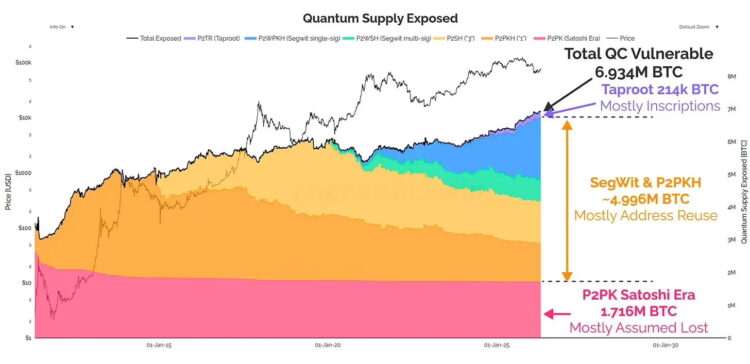
The accelerating pace of quantum computing research has reignited a familiar fear within the cryptocurrency community: could quantum computers ultimately crack Bitcoin’s defenses? The specter of “Satoshi-era” wallets, holding an estimated 1.7 million Bitcoins (valued at approximately $145 billion), being compromised and subsequently dumped on the market raises concerns of an unprecedented collapse. But is this a genuine existential threat, or an exaggerated doomsday prophecy?
The Theoretical Threat: A Deep Dive into Quantum Vulnerabilities
The concern isn’t entirely unfounded. As Bitcoin analyst James Check highlights, sufficiently powerful quantum computers could theoretically execute a “brute-force” attack on Bitcoin’s elliptic curve digital signatures. This vulnerability primarily targets wallets where the public key has already been exposed, with early “Satoshi-era” addresses being particularly susceptible due to their age and potential for public key exposure through transactions.

Proponents of the “quantum apocalypse” theory warn of a catastrophic market event should these ancient whale wallets be breached, unleashing a torrent of Bitcoin onto exchanges and triggering an epic crash. However, a closer examination of market dynamics and historical data paints a far less dramatic picture.
Market Resilience: Can Bitcoin Absorb a Quantum Shock?
While 1.7 million Bitcoins residing in potentially vulnerable early addresses represents a staggering $145 billion at current valuations, it’s crucial to consider this figure within the broader context of the cryptocurrency market’s immense liquidity and transactional capacity. What appears to be a “nuclear-level” threat on paper proves to be surprisingly manageable when viewed through the lens of practical market absorption.
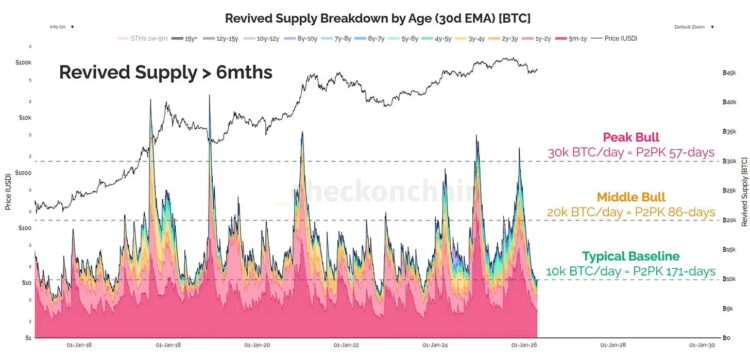
Historical trends reveal that during bull market cycles, long-term holders – those steadfast investors retaining Bitcoin for at least 155 days – routinely sell between 10,000 and 30,000 Bitcoins daily. Applying this historical precedent, the entire trove of 1.7 million Satoshi-era Bitcoins, if released, would equate to merely two to three months of typical profit-taking activity. This is a significant volume, but far from an instantaneous market-shattering event.
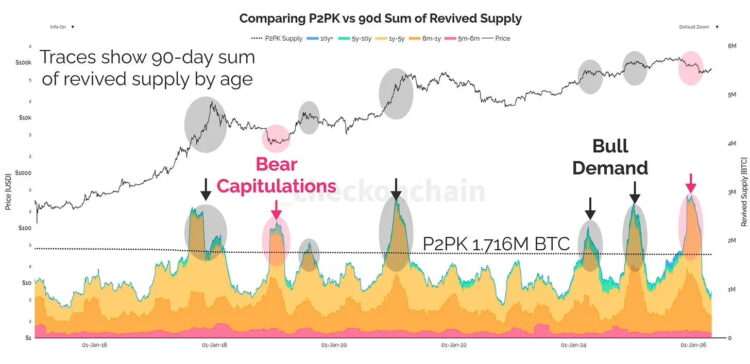
Furthermore, the market has demonstrated its resilience in the face of even larger sell-offs. During a recent bear market, over 2.3 million Bitcoins changed hands within a single quarter – a volume that surpasses the entire theoretical quantum attack target. Yet, the market absorbed this pressure without experiencing a systemic collapse, underscoring its inherent robustness.
Ancient Whales, Not Tsunami Triggers
Consider the sheer scale of Bitcoin’s daily and monthly trading volumes. Cryptocurrency exchanges witness monthly inflows of nearly 850,000 Bitcoins. In the derivatives market alone, the notional trading volume generated every few days is sufficient to offset the entirety of these “Satoshi-era” Bitcoins. While $145 billion is an astronomical sum in isolation, it pales in comparison to Bitcoin’s existing liquidity and rapid turnover rates.
James Check also offers a crucial counterpoint regarding the behavior of potential attackers. Any hacker possessing the sophisticated capabilities required to breach and steal such a colossal sum would undoubtedly prioritize profit maximization. A sudden, massive “dump” would be economically irrational, crashing the price and severely diminishing their gains through extreme slippage. Instead, a rational attacker would employ a strategic, phased selling approach, potentially utilizing derivatives for hedging, to minimize market impact and optimize their illicit profits.
The True Quantum Test: Governance, Not Sell Pressure
History consistently shows that the Bitcoin market possesses ample resilience to smoothly absorb sell-offs of this magnitude within months, not years. Consequently, the ultimate challenge posed by a quantum computing threat isn’t a simple mechanical selling pressure; it’s a profound question of governance.
Should the quantum threat materialize, how will the Bitcoin community and its developers respond? The central debate transcends concerns of a market crash and delves into fundamental principles: Should the network activate a mechanism, perhaps akin to BIP-361, to forcibly “freeze” these threatened early addresses? Or should the community uphold Bitcoin’s core tenets of decentralization and censorship resistance, trusting market mechanisms to resolve the situation organically? This is the ultimate philosophical and practical dilemma that the quantum computing era presents to the entire crypto ecosystem.
Disclaimer: This article provides market information only. All content and views are for reference purposes and do not constitute investment advice. They do not represent the views or positions of BlockTempo. Investors should make their own informed decisions and execute trades at their own discretion. The author and BlockTempo assume no responsibility for any direct or indirect losses incurred by investors as a result of their transactions.