The $15 Billion Web3 Gaming Implosion: Why Players Never Showed Up
The Web3 gaming industry, in its fervent pursuit of a “token-driven” future, invested a staggering $15 billion. Yet, the harsh reality has emerged: players never truly bought into the vision.
According to the latest data released by market maker and trading firm Caladan, a sobering 93% of “blockchain games” (GameFi) projects are now effectively defunct. Token values have plummeted by approximately 95% from their 2022 peak, while funding flowing into game development studios has withered by an astonishing 93% by 2025.
In retrospect, investors and developers poured billions into tokens and NFTs, often before a single viable game had even been conceptualized. Today, as capital pivots sharply towards Artificial Intelligence (AI), Real World Asset (RWA) tokenization, and foundational infrastructure, over 300 Web3 games have quietly ceased operations.
The meteoric rise and precipitous fall of Web3 gaming serve as a stark cautionary tale, illustrating the perils of blind speculative fervor that disregards fundamental product-market fit.
A Comprehensive Collapse: No Corner Spared
The Caladan report characterizes this as an industry-wide capital unraveling. From venture capitalists and retail NFT enthusiasts to prominent gaming guilds and the 300 million users touted by the Telegram “click-to-earn” craze, all have become casualties of a widespread bubble.
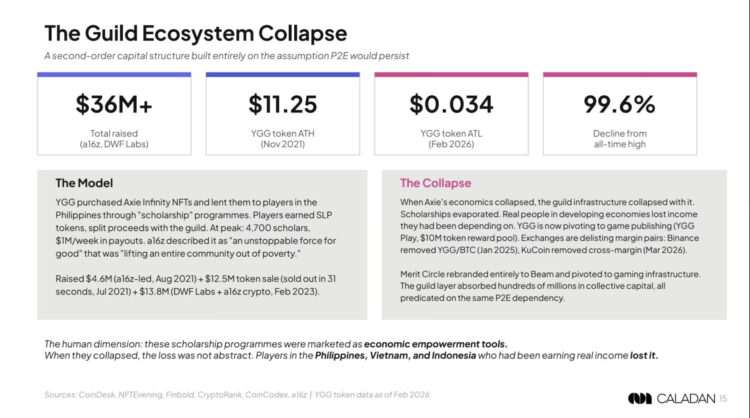
Consider the case of Hamster Kombat, which witnessed a staggering 96% of its player base vanish within a mere six months of its launch. Similarly, YGG, once the flagship token for leading gaming guilds, now trades at an abysmal 99.6% below its all-time high set in November 2021.
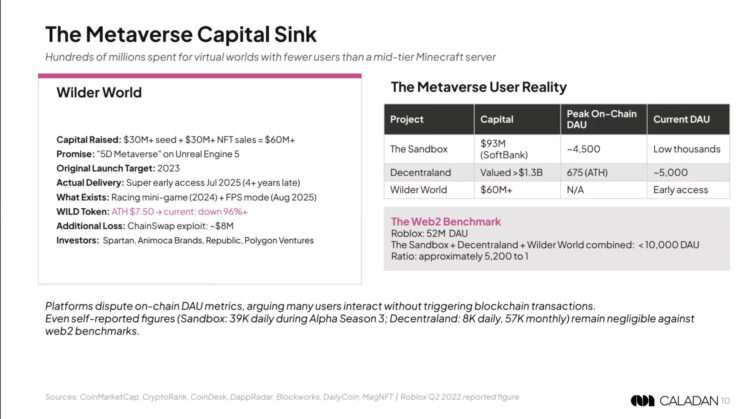
The individual “autopsy reports” of specific projects paint an even grimmer picture. Pixelmon, which famously raised $70 million through NFT sales, still lacks a public beta game after four years of development. Ember Sword, after seven years of development and burning through $18 million, announced its termination in May of last year, notably refusing refunds to its community. Industry leader Gala Games is embroiled in a major lawsuit, with co-founders accused of misappropriating tokens valued at $130 million. Even Japanese gaming giant Square Enix quietly halted its Web3 experimental project, Symbiogenesis, in July last year.
Players Crave Entertainment, Not Financial Engineering
This widespread collapse is not attributable to a poor economic climate or a lack of team execution. Instead, it stems from a fundamental misjudgment of player needs. Blockchain games were built upon the “Play-to-Earn” (P2E) incentive model, yet what players truly desired was an immersive and entertaining experience.
The P2E model typically required players to purchase tokens or NFTs upfront to gain entry, earn identical assets through gameplay, and then cash out as “new players” entered the ecosystem with fresh capital. This inherently unsustainable business model collapsed the moment new funding inflows dwindled: token prices plummeted, in-game rewards diminished, and users abandoned the games en masse, dragging the entire in-game economy down with them.
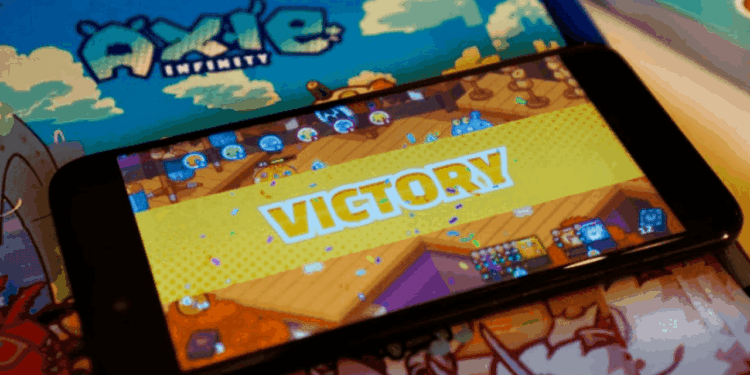
Statistics from blockchain data platform DappRadar underscore this dramatic decline: Axie Infinity, once a trailblazing blockchain gaming sensation, has seen its daily active users plunge from a peak of 2.7 million to approximately 5,500 today – a truly sobering trajectory.
Crucially, genuine market demand never kept pace with the torrent of capital investment. Caladan, citing research from Coda Labs, highlights that even at the peak of the Web3 gaming frenzy, only 12% of players had ever attempted a Web3 game.
Easy Funding, Protracted Development: A Recipe for Disaster
The misallocation of capital further exacerbated the crisis. Development teams frequently secured tens, even hundreds of millions of dollars with remarkable ease, often long before a viable product was even on the horizon. This abundance of funding, paradoxically, removed the urgency to build games that could genuinely captivate and retain players.
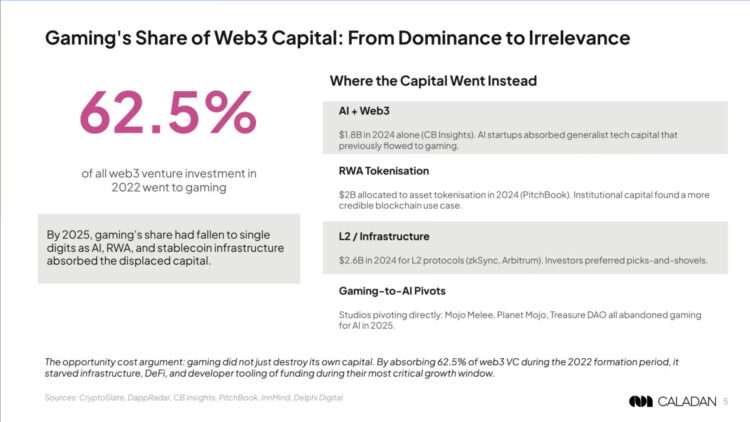
The “dramatic shift in capital flow” serves as the most honest indicator of this recalibration. In 2022, the Web3 gaming sector commanded a staggering 62.5% of all Web3 venture capital. By 2025, this figure has plummeted to single digits, with funds aggressively rerouted to Artificial Intelligence (AI), Real World Asset (RWA) tokenization, and Layer 2 scaling infrastructure.
Even Animoca Brands, historically one of the most prolific investors in Web3 gaming, has now reduced its gaming project investment share to approximately 25%, strategically shifting its focus towards stablecoins, RWA, and AI.
Furthermore, a critical disconnect existed between development timelines and market dynamics. A typical game development cycle spans three to five years, whereas tokens trade instantly on volatile markets, requiring constant hype and sustained interest to maintain their price. Many projects found their native tokens had already crashed into oblivion long before their games were even ready for public launch.
Once heralded as the “future of the gaming industry,” Web3 gaming now serves as a stark, expensive lesson: a chilling illustration of the inevitable collapse when financial engineering races ahead of genuine product-market fit.
Disclaimer: This article is for market information purposes only. All content and views are for reference only and do not constitute investment advice, nor do they represent the views and positions of BlockTempo. Investors should make their own decisions and transactions. The author and BlockTempo will not be held responsible for any direct or indirect losses incurred by investors’ transactions.