Author: Nancy, PANews
As cryptocurrency enthusiasts excitedly shared their SpaceX subscription orders and the thrill of securing a stake in the highly anticipated IPO, Trade.xyz on Hyperliquid found itself embroiled in a storm of controversy. The focal point of market debate? The pricing rules governing its SPCX pre-market perpetual contracts.

Trade.xyz Under Scrutiny: The SPCX Pricing Dilemma
On June 10th, Trade.xyz issued an official statement addressing the recent pricing disputes surrounding its SPCX pre-market perpetual contracts, a move that has intensified the trust test for the platform.
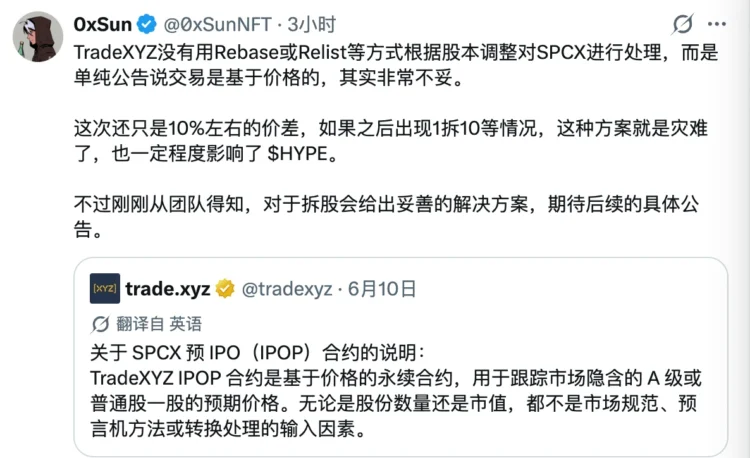
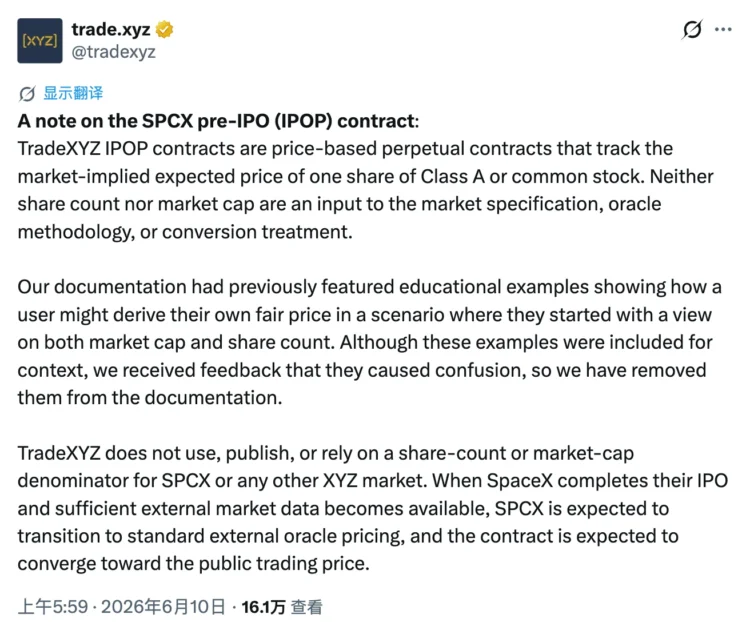
According to the statement, Trade.xyz’s IPOP contracts are a type of price-tracking perpetual contract. Their primary objective is to reflect market expectations for the per-share price of Class A common stock, rather than the company’s overall valuation. Consequently, information such as the total share count or market capitalization is not integrated into the contract rules, oracle pricing logic, or future contract conversion mechanisms. In essence, the SPCX price on Trade.xyz is designed to be an indicator of market sentiment and trading expectations, distinct from a theoretical share price calculated based on fundamental company metrics.
Trade.xyz also acknowledged that early product documentation included illustrative examples demonstrating how users could combine their own judgments on company valuation and total share count to derive a reasonable per-share price. While these examples were intended solely to aid understanding of the product mechanism, some users mistakenly inferred that the platform itself would price contracts based on market capitalization or share data. As a result, these specific examples have since been removed from the official documentation.
The statement emphatically clarifies that Trade.xyz “does not use, publish, or rely on share counts or market capitalization as a pricing basis for SPCX or any other XYZ market.”
The catalyst for this recent controversy emerged a few days prior with the disclosure of SpaceX’s latest prospectus. The document revealed SpaceX’s true total share count to be 13.08 billion shares, approximately 10% higher than the 11.87 billion shares previously assumed by the market. This discrepancy implied that, assuming a constant overall company valuation, the theoretical per-share price of SpaceX stock would need to be adjusted downwards by roughly 10%.
Following this revelation, several centralized exchanges (CEXs) opted to temporarily halt trading on related contracts, subsequently resuming after repricing based on the updated share data. Trade.xyz, however, maintained that its product logic did not depend on share count data and therefore did not synchronize its pricing structure. The emergence of these two divergent pricing systems quickly triggered a wave of cross-platform arbitrage, propelling Trade.xyz into the center of public debate.
Regarding future resolution of this divergence, Trade.xyz stated that once SpaceX officially completes its IPO and sufficient external trading data becomes available in the public market, SPCX will transition to a standard external oracle pricing mechanism. At that point, the contract price is expected to gradually converge with the actual trading price of SpaceX shares on the open market.
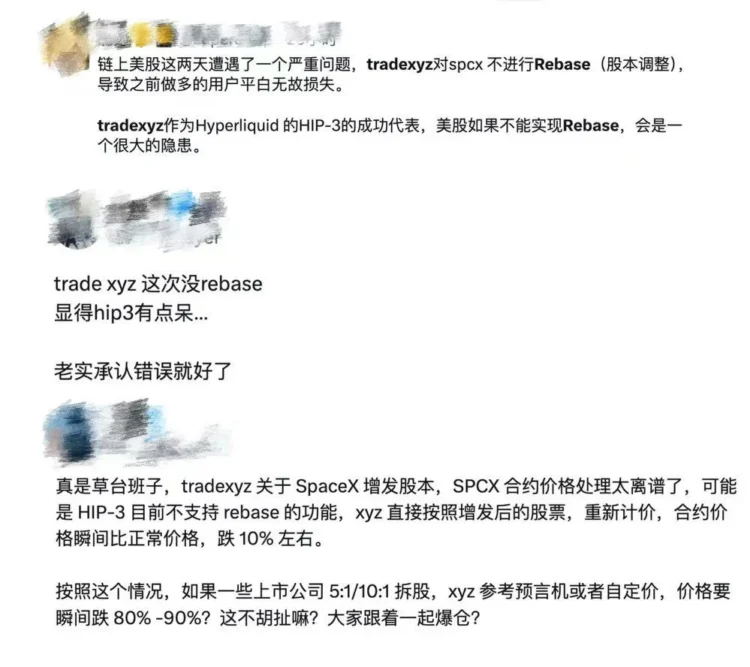
However, this clarification only served to intensify market contention. Many users argued that during the product’s initial launch, Hyperliquid failed to adequately and clearly disclose the contract rules. Furthermore, the UI interface and official documentation contained descriptions that were easily misinterpreted for an extended period. The platform’s hurried release of a clarifying announcement and modification of documentation only after the IPO approached and the controversy erupted struck many as a reactive, post-facto correction that lacked credibility.
A more significant source of discontent stemmed from the tangible financial losses incurred by users. Due to the inherent design of the HIP-3 mechanism, which lacks the “Rebase” (base price reset) capability found in traditional exchanges, the SPCX contract price was forced to passively gap down by approximately 10% when the market repriced according to SpaceX’s updated share count. This abrupt adjustment led to a substantial reduction in the value of long positions, forcing numerous high-leverage users into liquidation or even complete account wipeouts. These losses, critically, translated directly into gains for short-sellers and arbitrageurs.
From the perspective of these affected users, the platform not only failed to express sufficient concern for those who suffered losses but also offered no compensation or mitigation plans. Instead, its response, citing “product mechanism,” was perceived as cold, detached, and lacking accountability.
In a broader sense, this debate over SPCX pricing authority serves as a crucial case study for the future design and rule disclosure of more on-chain Pre-IPO assets.
The Rebase Conundrum: A Critical Challenge for On-Chain Pre-IPO Assets
For perpetual decentralized exchanges (Perp DEXs), the absence of a “Rebase” capability carries significant implications. It means that any Pre-IPO asset, if subjected to common traditional stock market actions such as stock splits, secondary offerings, or dividends, could trigger an instant revaluation of contract prices. This, in turn, risks cascading liquidations, unfair losses for users, and a severe erosion of trust in the platform.
To grasp the importance of Rebase, one must first understand what it entails and why it has become a pivotal element in the design of Pre-IPO perpetual contracts.
Simply put, Rebase is a value-neutral adjustment mechanism. The platform synchronously adjusts both the contract price and the user’s position quantity by the same proportion, ensuring that the overall value of a trader’s holdings remains essentially unchanged before and after the adjustment. This mechanism is crucial because, during the Pre-IPO phase, a company’s actual total share count is typically not publicly disclosed. Exchanges must therefore design the contract’s initial price and multiplier based on estimated share counts. When the company officially files its S-1/S-1A documents and reveals the true share count, a Rebase is necessary to calibrate contract parameters if the actual figures differ from estimates. Without it, contract prices would gradually diverge from the true per-share value, creating opportunities for cross-platform arbitrage and passively burdening one-sided holders with losses.
However, implementing Rebase on a Perp DEX presents significantly greater challenges compared to a centralized exchange (CEX).
Specifically, CEXs rely on centralized databases and specialized risk management teams. This allows them to swiftly halt trading upon a corporate action (such as a share issuance or stock split), uniformly adjust all user positions, and then resume market trading. The entire process is handled by the exchange’s backend, ensuring that the nominal value of users’ holdings remains smoothly continuous. Nevertheless, even for large CEXs with mature trading systems and expert technical teams, Rebase operations involving synchronous adjustments across all market positions remain a complex engineering feat.
Moreover, Perp DEXs operate their matching, liquidation, and position states entirely on smart contracts, precluding direct data modification in the same way a CEX can. Achieving a similar Rebase effect often necessitates designing additional monitoring logic, special hooks, or upgrading the underlying contract mechanisms. This not only increases Gas costs and system complexity but also expands the potential attack surface, introducing new security vulnerabilities.
Beyond these technical hurdles, Rebase could further exacerbate the inherent liquidity fragmentation issues already present in decentralized markets. The same Pre-IPO asset might exist across multiple DEXs, each with limited market depth. Liquidity Providers (LPs), facing the added uncertainty introduced by Rebase, might become less willing to commit capital. This could ultimately lead to decreased liquidity, wider slippage, and a further deterioration of the trading experience.
Of course, Rebase is not entirely unachievable within a decentralized architecture. Some community members have pointed out that platforms like Aster have successfully performed similar asset Rebase adjustments, suggesting that the true challenge lies not in an inherent inability of DEXs to support it, but rather in a platform’s willingness to design the necessary additional mechanisms and bear the associated development and operational costs.
In contrast, Trade.xyz, while adhering to its more market-driven pricing philosophy, leverages the HIP-3 architecture, which allows developers to independently deploy their own perpetual markets. While this model benefits from Hyperliquid’s high-performance order book system, each market possesses entirely independent contract specifications, oracle definitions, and parameter settings. This structure inherently lacks platform-level unified native Rebase support, making batch adjustments to all positions a non-trivial task. However, some community insiders have hinted that Trade.xyz is actively researching corresponding solutions for potential future special events like stock splits.
From a longer-term perspective, the SPCX pricing incident exposes not merely a product design flaw but a fundamental challenge that current Perp DEXs must confront as they explore the integration of Real World Assets (RWA). As more Pre-IPO assets are tokenized and mapped onto the blockchain, these on-chain Pre-IPO perpetual contracts serve as a preliminary market for price discovery before public trading. The ultimate question remains: can they establish sufficiently reliable price discovery mechanisms? Can they withstand the scrutiny of real-world corporate actions and information disclosures, or will they devolve into speculative games divorced from underlying fundamentals? Only time and market evolution will provide the answers.
(The above content is an excerpt and reproduction authorized by our partner PANews. Original article link)
Disclaimer: This article provides market information only. All content and opinions are for reference only and do not constitute investment advice. They do not represent the views and positions of BlockTempo. Investors should make their own decisions and trades. The author and BlockTempo will not bear any responsibility for direct or indirect losses resulting from investor transactions.