Stablecoins, the foundational bedrock of the cryptocurrency market and its critical financial infrastructure, have become a fiercely contested arena. Amidst the established dominance of giants like USDT and USDC, a new contender with a remarkably unique lineage has rapidly ascended: USD1.
Issued by World Liberty Financial (WLFI), a DeFi protocol spearheaded by the Trump family, the USD1 stablecoin has achieved an astonishing market capitalization of $4.6 billion in just over a year since its launch, swiftly securing a position among the top five stablecoins globally. This meteoric rise isn’t merely a testament to market demand but a compelling narrative of strategic positioning, capital infusion, and political leverage, carving a distinct path that defies traditional crypto growth trajectories.
Unprecedented Leverage: Political and Business Capital Propel USD1’s Ascent
While the stablecoin sector is crowded with innovators, USD1 stands alone with its direct ties to the highest echelons of political power. Bloomberg reports that the Trump family’s stake in WLFI is valued at approximately $2.6 billion, representing a significant portion of their total assets.
This political backing has attracted substantial capital, strategically timed with shifts in global power dynamics. Last January, just four days before Trump’s inauguration, Aryam Investment, a private entity linked to the Abu Dhabi royal family (Tahnoon), injected $500 million to acquire a 49% stake in WLFI. This Middle Eastern capital not only provided crucial early liquidity for USD1’s issuance but also laid the groundwork for its ambitious international expansion.
Further solidifying its global footprint, Pakistan signed a memorandum of understanding with a WLFI-affiliated entity this January. This agreement explores integrating USD1 into Pakistan’s national payment and cross-border settlement infrastructure. Such sovereign endorsement could transform USD1 from a perceived “shadow banking tool” into a legitimate digital asset, assisting nations in optimizing foreign exchange clearing and mitigating local currency inflation.
USD1’s inherent political connections have enabled it to capitalize on the burgeoning policy landscape for the US crypto industry. The deep intertwining of political and business interests grants USD1 a level of governmental sensitivity and public trust rarely seen in nascent crypto protocols.
Its launch coincided perfectly with the US Congress’s push for the “GENIUS Act.” Signed into law by Trump on July 18 last year, this landmark legislation clarifies that qualifying payment stablecoins are not “securities” or “commodities” under federal law, effectively streamlining regulatory oversight by assigning authority to federal banking regulators rather than the SEC and CFTC. This historic shift provided USD1 with a significant compliance advantage, as it operates as a payment stablecoin under this framework, issued by a regulated WLFI entity with 1:1 reserves in highly liquid assets.
A Pragmatic and Potent Business Model
- Stable Yield Generation: By selecting BitGo as its primary custodian for $4.6 billion in reserves, and leveraging an approximate 3.5% annualized US Treasury yield, USD1 is projected to generate around $150 million in annual interest income for WLFI, establishing a robust “money printing” mechanism for the protocol.
- Direct Federal Reserve Ambition: WLFI is actively pursuing a national trust bank charter from the US Office of the Comptroller of the Currency (OCC), signaling its intent to transition USD1 from a “crypto asset” to a fully recognized “regulated financial instrument.”
- Strategic Ecosystem Partnerships: Last March, Abu Dhabi sovereign wealth fund MGX utilized $2 billion in USD1 to settle its investment in Binance, a leading centralized exchange. This initiated a close collaboration, with Forbes estimating Binance holds roughly 87% of USD1. Binance offers exclusive incentives to USD1 holders, including zero transaction fees and WLFI governance token airdrops, significantly accelerating USD1’s early settlement network expansion. Bolstered by WLFI’s substantial transaction subsidies and Binance’s support for USD1 as margin, its average daily trading volume has surged tenfold, from $200 million to an impressive $2 billion.
Over the past six months, WLFI has deployed over $115 million in interest subsidies, catalyzing more than $1.2 billion in USD1 market capitalization growth—a remarkable tenfold leverage.
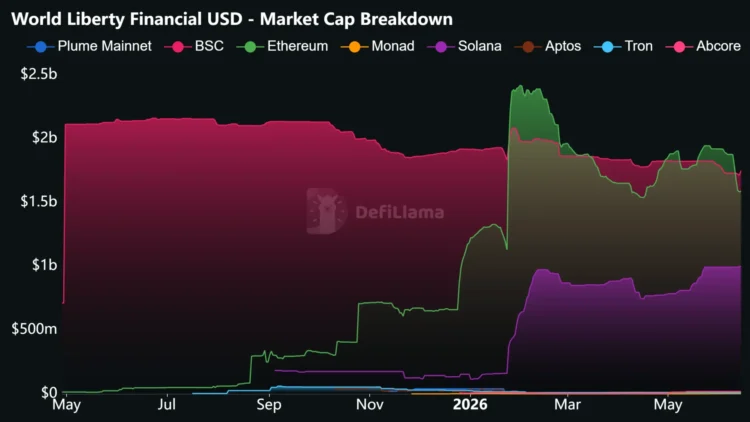
On-chain data reveals Solana as a key driver of this growth, with USD1’s supply on the network escalating from over $160 million at the year’s start to nearly $1 billion, an increase of approximately $840 million. The remaining growth is largely concentrated on Ethereum.
However, this rapid ascent under the spotlight also invites scrutiny. The US House of Representatives has initiated an investigation into WLFI’s equity transaction with Aryam Investment, probing potential conflicts of interest and demanding full communication records and compliance documents. Every expansion move by USD1 will undoubtedly face heightened regulatory examination.
Redefining the Digital Dollar: Paving the Way for Borderless Payments
Mainstream stablecoins serve as crucial conduits for “tokenizing the dollar,” and USD1 is poised to push these boundaries further. Its core objective is to dismantle the friction between traditional finance and decentralized finance (DeFi), embedding on-chain liquidity deeply within the global real economy and fundamentally redefining the scope of the digital dollar’s applications.
Traditional approaches to dollar tokenization face two significant structural hurdles:
- Limited Application Scope: Even when tokenized, the dollar often remains confined to crypto-native use cases like trading, lending, and market making, struggling to achieve widespread penetration into the real economy and daily consumer transactions.
- Geographical Constraints: In regions with underdeveloped ground infrastructure or limited internet access, the digital dollar struggles to reach the “last mile” of the real economy, rendering stablecoins largely ineffective.
In essence, while existing on-chain dollar paths have achieved tokenization, the issues of high friction costs and coverage gaps persist.
WLFI, however, aims to transcend these limitations, evolving USD1 into a unified settlement layer that directly connects with bank accounts, payment networks, and even global communication infrastructure.
At the Consensus conference in Hong Kong this February, WLFI co-founder Zak Folkman announced plans for World Swap, an innovative foreign exchange and cross-border remittance platform. This initiative targets a colossal market: global daily foreign exchange volumes exceed $9.6 trillion, with personal remittances nearing $892 billion annually. Yet, this century-old system, dominated by traditional networks like SWIFT, remains burdened by high fees and slow processing.
World Swap’s disruptive strategy leverages USD1 as the settlement medium, bypassing complex intermediary bank networks. By directly linking on-chain stablecoins with global debit cards and bank accounts, it promises to reduce cross-border remittance costs to a mere “fraction” of traditional services, enabling low-friction, instant, 24/7 clearing.
Beyond remittances, WLFI expanded its DeFi ecosystem in January with the launch of World Liberty Markets, a lending protocol that has already amassed over $600 million in capital. By seamlessly integrating savings, lending, and exchange functionalities, USD1 is building a comprehensive on-chain financial ecosystem that extends far beyond the singular payment utility of conventional stablecoins.
USD1’s ambition isn’t limited to terrestrial internet infrastructure. While many protocols focus on online applications, WLFI is looking towards the vastness of low-Earth orbit. Through a strategic partnership and token swap agreement with Spacecoin, a satellite communication startup, USD1 will be natively integrated into Spacecoin’s DePIN (Decentralized Physical Infrastructure) network.
This groundbreaking collaboration addresses a critical payment challenge: in remote or disaster-stricken areas lacking ground infrastructure and traditional financial gateways, users are often unable to conduct transactions. Spacecoin’s low-Earth orbit satellites will independently facilitate on-chain settlement flows, allowing users to make international payments and micro-settlements with USD1 directly upon connecting to the satellite network. From ground networks to low-Earth orbit, USD1 aims to expand the reach of the digital dollar to previously inaccessible corners, truly realizing “geographically unrestricted” stablecoin usage.
Powering the Future: USD1 in the AI-Driven Economy
While strategic policy positioning and real-world payment expansion represent USD1’s strategy for capturing existing financial market share, its focus on AI payment infrastructure is a forward-looking “incremental bet” on the future digital economy.
As intelligent agents (AIs) assume increasingly autonomous roles in workflows, a significant challenge has emerged: the lack of a payment system tailored to their unique characteristics. Traditional financial accounts require physical KYC and cannot support the high-frequency, low-value Agent-to-Agent (A2A) settlements essential for AI operations. Conventional crypto wallets, while lacking KYC barriers, often lack sophisticated on-chain budget controls and struggle to interface with offline physical consumption. This creates a growing chasm between rapidly evolving AI agents and lagging payment infrastructure.
To bridge this critical gap, WLFI has introduced the open-source AgentPay SDK. Its modular architecture clearly delineates the AI’s operational capabilities from the user’s financial controls, designating USD1 as the default settlement token. This allows agents to independently execute, manage, and clear accounts in a decentralized and user-custodial manner.
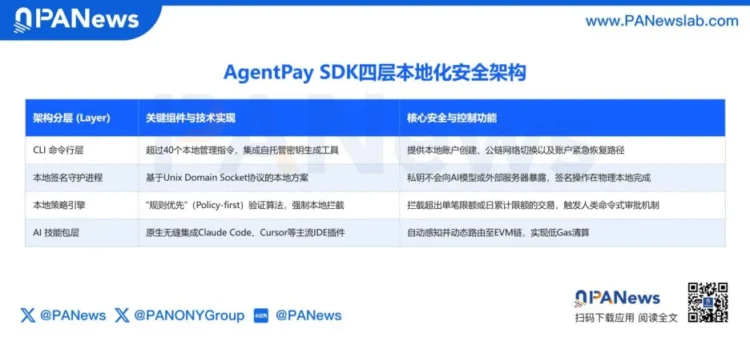
To accommodate the specific nature of agent transactions, the AgentPay SDK incorporates “Recoverable Workflows.” If an agent attempts tasks like purchasing computing power or subscribing to APIs but fails due to insufficient wallet balance or lack of Gas, the SDK doesn’t simply return an error code. Instead, it provides the agent with a prompt, detailing the required Gas token, chain ID, and a QR code for top-up, which is then relayed to the user in a human-friendly format. Upon successful top-up, the system automatically retries the transaction, significantly enhancing the continuity of automated workflows.
Beyond online settlements, WLFI is also extending its reach into offline consumption. Through native integration with Bitrefill, a global leader in gift cards and telecom services, agents equipped with the AgentPay SDK can autonomously purchase virtual credit cards, global eSIMs, and a wide array of lifestyle gift cards using USD1. This empowers cloud-based agents to not only manage computing bills and API subscriptions but also autonomously book flights, acquire communication services, and even purchase physical goods.
From on-chain A2A settlements to comprehensive real-world consumption, USD1, powered by the AgentPay SDK, is establishing a bidirectional “on-chain-to-physical” transaction channel, laying the commercial foundation for the nascent intelligent agent economy.
Conclusion: USD1’s Ambitious Trajectory
As a stablecoin project directly endorsed by the Trump family, USD1 has, in little over a year, dramatically reshaped the competitive landscape of the stablecoin market. Its strategic political positioning and substantial adoption by sovereign capital have been instrumental in its rapid ascent.
The next critical test for USD1 will be its ability to transition beyond the “policy dividend escort” that has nurtured its early growth. Its long-term success hinges on cultivating endogenous growth driven by widespread cross-border remittance settlements and innovative AI agent payments.
In the dynamic realm of stablecoins, USD1’s emergence represents a high-stakes endeavor. While its powerful background has accelerated its development, the true measure of its impact will be its capacity to transform the ambitious blueprints of “borderless payments” and the “silicon-based economy” into tangible, widespread reality.