By Ariel, CryptoCity
Taiwan’s Financial Sector Poised for Stablecoin Revolution: Six Banks Emerge as Frontrunners
Taiwan is on the cusp of a significant transformation in its digital finance landscape. The draft “Virtual Asset Service Act” has successfully navigated the Executive Yuan, and while awaiting its final legislative approval, the Financial Supervisory Commission (FSC) is proactively developing crucial sub-laws. Initial plans indicate a strategic move to exclusively permit domestic financial institutions to issue stablecoins, a development that has ignited considerable interest across the banking sector.
According to a report by the Economic Daily News, market speculation points to six prominent banks as potential pioneers in stablecoin issuance: CTBC Bank, Cathay United Bank, Taishin Bank, KGI Bank, Union Bank, and Taipei Fubon Bank.
These institutions are not newcomers to the digital realm; they have already made substantial strides in blockchain and virtual asset integration:
- CTBC Bank: This banking giant has received FSC approval to pilot virtual asset custody services, initially focusing on Bitcoin and Ethereum. Their robust security framework utilizes cold wallets and private key sharding technology. Demonstrating long-term commitment, CTBC Bank publicly recruited blockchain engineers as early as 2025.
- Cathay United Bank: Also approved for virtual asset custody, Cathay United is targeting high-net-worth individual clients. Furthermore, the bank is actively involved in the FSC’s Real World Asset (RWA) tokenization working group, with plans to trial the issuance of on-chain bonds.
- Taishin Bank: Currently undergoing guidance for custody services, Taishin Bank recently forged a partnership with Taiwanese exchange HOYA BIT to offer 24/7 New Taiwan Dollar (NTD) trust services, ensuring seamless fund flows.
- KGI Bank: Following its pilot qualification, KGI Bank has collaborated with leading Taiwanese regulated trading platforms like MaiCoin and BitoPro. This collaboration involves transferring a portion of assets to bank cold storage for enhanced security. KGI Bank also innovatively launched the “KGI Crypto Rewards Card,” allowing customers to earn cryptocurrency rewards through their spending.
- Union Bank: Beyond securing approval for pilot custody services, Union Bank has strategically invested in MaiCoin, acquiring approximately 9.67% equity. This move significantly deepens its engagement within Taiwan’s burgeoning crypto market.
- Fubon Bank: Fubon has established the “TWEX Taiwan Mobile Virtual Asset Exchange” through its affiliate, Taiwan Mobile. Fubon Bank plays a critical role by providing the essential trust custody and cold wallet technological infrastructure for the exchange.
The enthusiasm extends beyond these six. State-owned banks such as First Bank and Hua Nan Bank have also expressed considerable interest in stablecoins to the Commercial Times. E.SUN Financial Holding Chairman previously affirmed that the institution intends to be a key player in the stablecoin and tokenization markets.
Further signaling the market’s readiness, Capital Layer, a blockchain enterprise settlement infrastructure provider, has entered into a strategic distribution partnership with Advanced Tek, Taiwan’s largest system integrator, a move widely interpreted as foundational for stablecoin deployment.
A Look Back: The Untimely Exit of Taiwan’s First NTD Stablecoin in 2018
While the current outlook for stablecoins in Taiwan is optimistic, it’s not the nation’s first foray into this digital asset class. Years ago, Taiwanese third-party payment provider ECPay launched CryptoDT blockchain financial services and introduced TWDT-ETH, dubbed the “Taiwan Dollar Stablecoin.” Built on the Ethereum ERC-20 standard, each TWDT token was meticulously pegged 1:1 to the New Taiwan Dollar, with a corresponding NTD held in a trust account. The total circulating TWDT consistently matched the trust balance, supported by regular balance disclosures and certified by accountants.
Ironically, Dr. Qu of Qu’s Tech Classroom, a prominent tech YouTuber who has recently been a vocal critic, famously calling stablecoins “stored-value cards” and alleging they are merely speculative tools for crypto operators, once lauded TWDT as “Taiwan’s first stablecoin” and expressed immense anticipation for blockchain’s future development in Taiwan.
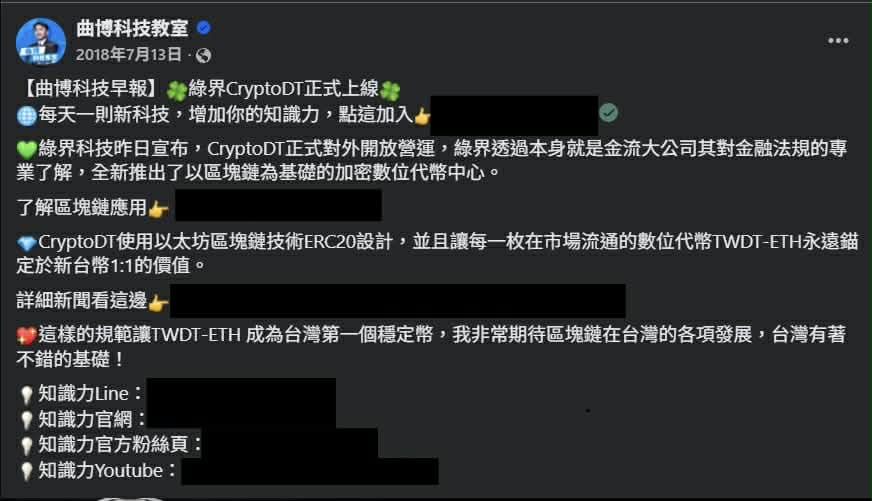
However, despite its innovative structure, TWDT ultimately failed to gain traction due to a lack of market demand and practical application scenarios. It was swiftly delisted by its partner exchange, making a quiet exit from the market. With Taiwan’s regulatory framework now clearer and global interest in stablecoins surging, the question remains: will ECPay re-enter the arena, or will other payment providers seize this renewed opportunity?
2026: Is Taiwan Truly Prepared for a Stablecoin Future?
The proposed regulations stipulate that stablecoin issuers must maintain full reserves of the underlying fiat currency and are explicitly prohibited from distributing interest or rewards. This raises pertinent questions about the future profitability models for these issuers.
Industry insiders, speaking to the Economic Daily News, suggest that banks’ primary motivation for issuing stablecoins is to capitalize on emerging opportunities in blockchain finance and the rapidly expanding field of Real World Asset (RWA) tokenization.
FSC Vice Chairperson Chuang Hsiu-yuan has previously highlighted that certain Taiwanese import and export traders are already actively using stablecoins for payments. As these traders accumulate increasing amounts of stablecoins, the demand for seamless integration with traditional financial institutions will inevitably grow.
Years after the initial failure of TWDT, is the Taiwanese market genuinely ready to embrace domestic stablecoins? Chuang Hsiu-yuan expresses optimism, stating, “I am confident that future demand for NTD stablecoins will be driven by supply chain payment needs. In this evolving landscape, financial institutions are poised to play a crucial role in providing a seamless bridge between fiat currency and stablecoins.”
(The content above is an authorized excerpt and reprint from our partner CryptoCity. Original link)
Disclaimer: This article is for market information purposes only. All content and views are for reference only and do not constitute investment advice. They do not represent the views and positions of BlockTempo. Investors should make their own decisions and trades. The author and BlockTempo will not bear any responsibility for direct or indirect losses resulting from investor transactions.