
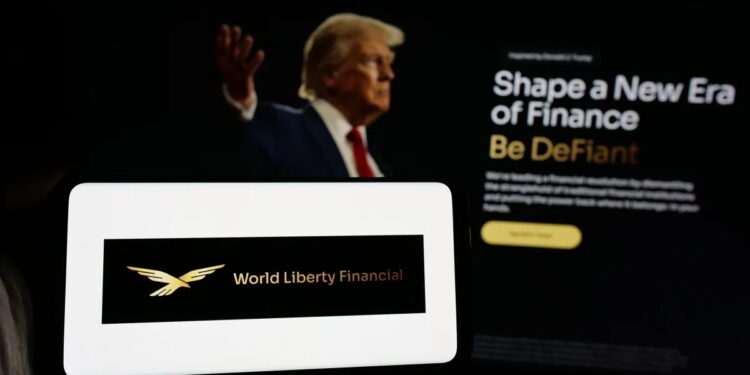
Trump-Backed DeFi Project $WLFI Plunges into Crisis: Justin Sun Slams ‘Absurd Governance Scam’ Amidst Investor Fury
World Liberty Financial ($WLFI), a decentralized finance (DeFi) project associated with the Trump family, is currently embroiled in a significant trust crisis. The project team has recently unveiled a highly contentious governance proposal aimed at extending the lock-up period for early supporters’ $WLFI tokens by up to four years. This move has triggered widespread investor outrage, prompting prominent crypto figure and Tron founder Justin Sun to denounce it as the “most absurd governance scam” he has ever witnessed.
The escalating conflict between Justin Sun and the World Liberty Financial management team stems from the unexpected freezing of his $WLFI tokens by the project. Sun took to X (formerly Twitter) on Wednesday, to publicly express his condemnation:

“This is not community governance at all! They package this proposal as ‘building governance consensus’ and ‘long-term commitment,’ but beneath this layer of hypocrisy, this is the most absurd governance scam I have ever seen.”
Details of the Controversial Token Lock-up Proposal
According to the specifics outlined by World Liberty Financial, the proposal seeks to convert over 62.2 billion $WLFI tokens from an “indefinite lock-up” status to a “phased unlock” mechanism. This involves distinct terms for different token holders:
- Founders, Team Members, Advisors, and Partners: The 45.2 billion tokens held by this group would be subjected to a two-year lock-up period, followed by a three-year linear unlock schedule. Additionally, 4.5 billion $WLFI tokens would be permanently burned.
- Early Supporters: Holders of over 17 billion $WLFI tokens would face a two-year lock-up period, succeeded by a two-year linear unlock schedule. This effectively means early investors would need to wait a full four years to regain access to all their tokens.
However, the most contentious element of the proposal is a “hegemonic clause” stating: “If explicit consent to accept the new proposal is not given, holders’ tokens will remain ‘indefinitely locked’ according to existing terms.” This ultimatum has been a primary driver of investor fury.
Governance Mechanism Under Scrutiny: A Path to Manipulation?
Critics also highlight the project’s governance voting mechanics as a potential avenue for manipulation. Previous World Liberty Financial governance votes, particularly those enabling token trading, saw participation from up to 11.1 billion $WLFI in voting power. In stark contrast, the current proposal sets an exceptionally low passing threshold of just 1 billion $WLFI tokens, requiring only a simple majority to pass. This disparity suggests that the founders and management team could potentially leverage a minimal portion of their holdings to easily sway the outcome and force through this highly controversial proposal.
Justin Sun’s “Logical Trap” Accusation and Allegations of Centralized Control
Justin Sun vehemently argues that the proposal is fundamentally a “logical trap.” He points out that casting a “no” vote would result in investors’ tokens being locked indefinitely, stating:
“In other words, if you vote against this proposal, you will be punished. This is not voting, this is coercion. What kind of democratic process rewards obedience and suppresses dissent?”
Sun further revealed that his governance tokens, along with those of several other significant holders (“whales”), have been frozen by the team, effectively disenfranchising them from participating in this critical vote. Beyond this, Sun alleges that the “actual control” of the $WLFI smart contract resides with an anonymous multisig wallet. Disturbingly, he claims an external account possesses the power to blacklist any token-holding address. Sun did not mince words:
“This anonymous multisig can overturn any voting result and execute any operation directly at the contract level. Frankly, the so-called governance proposals, on-chain voting, and community discussions are all just a show.”
Investor Outcry and Allegations of Fund Misappropriation
Justin Sun’s scathing critique has resonated widely across the crypto community on X, with many investors now exploring the possibility of initiating a class-action lawsuit against the project. A pervasive sentiment among users is that they are being coerced into accepting the proposal. Concerns are mounting that by the time tokens are finally unlocked, the political landscape may have shifted (post-Trump presidency), potentially rendering $WLFI’s value negligible. One user, kripu, emphatically advised:
“If you hold this garbage coin, never accept the terms. Trump will be out of office in 2 years, and by then, this thing will definitely go to zero.”
Another user, Isonips, expressed profound frustration: “We’ve been locked up for a year, and during that time the team did whatever they wanted, using tokens as collateral for loans… Now we’re forced to choose between ‘waiting another four years’ or ‘indefinite lock-up’?”
This widespread investor discontent is not new. Earlier, the World Liberty Financial team faced significant controversy when it was revealed they had used 5 billion $WLFI as collateral, depositing it into Dolomite—a DeFi lending platform co-founded by a project advisor—to borrow stablecoins valued at an astonishing $75 million. When the community raised questions regarding these suspicious fund movements, the project team dismissed the accusations as “FUD” (fear, uncertainty, and doubt), further eroding investor trust.
Disclaimer: This article provides market information only. All content and views are for reference purposes and do not constitute investment advice. They do not represent the views or positions of the author or BlockTempo. Investors should exercise their own judgment and make independent trading decisions. The author and BlockTempo will not be held responsible for any direct or indirect losses incurred by investors as a result of their transactions.




