By Fenrir, CryptoCity
US Crypto Regulation at a Crossroads: Senator Lummis Issues Urgent Ultimatum on CLARITY Act
U.S. Republican Senator Cynthia Lummis, long recognized as a prominent “crypto-friendly” voice, recently issued a stark warning on social platform X, declaring that the current moment represents the final opportunity to pass the CLARITY Act. She unequivocally stated that if Congress fails to enact this crucial legislation before the 2026 midterm election cycle, the regulatory framework for the U.S. digital financial industry faces a potential four-year stagnation, possibly extending its delay until 2030.
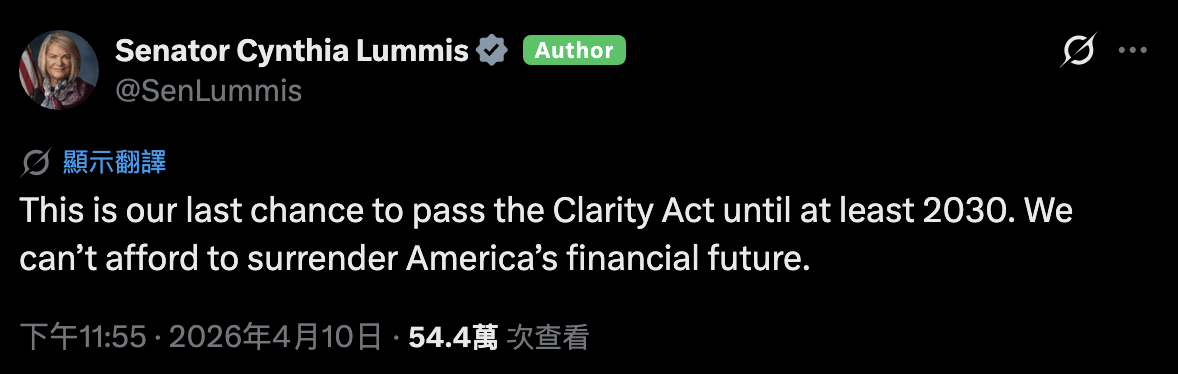
This pronouncement has sent ripples through both the cryptocurrency community and political spheres, turning the Senate Banking Committee’s deliberation phase, scheduled from April 13th to 20th, into a critical focal point. The urgency is underscored by a tight legislative calendar: the Senate is expected to enter recess around May 21st, after which the political landscape for the latter half of the year will be entirely consumed by midterm election campaigns.
Senator Lummis emphasized that without substantial progress on the bill before the recess, election-year considerations will inevitably overshadow policy priorities, rendering the legislation a casualty of political gridlock. To safeguard America’s financial future, she implored her colleagues to act decisively, asserting that the current administration is prepared, requiring only congressional consensus to move forward.
Unifying Voices: Treasury and Industry Giants Rally Behind the CLARITY Act
Despite the pressing timeline, support for the CLARITY Act has reached unprecedented levels across various sectors. U.S. Treasury Secretary Scott Bessent recently made a public appeal, urging the Senate Banking Committee to swiftly advance the bill to the President’s desk. Bessent highlighted that Congress has deliberated on these regulatory structures for over five years, emphasizing that precious Senate legislative time should not be squandered. He cautioned that the persistent lack of clear regulation has already prompted talent and businesses to migrate to more crypto-friendly jurisdictions like Singapore and Abu Dhabi, thereby eroding American competitiveness.
On the industry front, Coinbase CEO Brian Armstrong marked a significant shift in stance, publicly endorsing Bessent’s call and commending the Senate team’s efforts to refine the bill’s content. Furthermore, prominent industry leaders such as former White House advisor David Sacks, a16z Crypto partner Chris Dixon, and Immutable founder Robbie Ferguson have all voiced their conviction that clear regulatory guidelines will unlock immense innovation potential. Ferguson boldly predicted that the successful implementation of the CLARITY Act would make the industry’s growth over the past decade pale in comparison.
The Stablecoin Yield Debate: Balancing Traditional Banking Concerns with Digital Innovation
Despite broad support, the bill’s progression continues to face resistance, primarily centered on stablecoin yield regulations and their perceived conflict with traditional banking interests. Certain traditional financial institutions and lobbying groups contend that permitting stablecoins to offer yields would lead to a significant outflow of bank deposits and consequently diminish their lending capacity.
However, a report from the White House Council of Economic Advisers (CEA) presented a contrasting data perspective. The CEA report indicated that eliminating stablecoin yields would contribute negligibly to increasing bank loans, projecting an increase of only approximately $2.1 billion—a mere 0.02% of the total U.S. loan volume. The analysis further suggested that while a mandatory prohibition on yields might see a modest increase of $129 billion in community bank loans, the overall financial system would incur a net loss of $800 million, with these costs ultimately borne by consumers.
Coinbase Policy Chief Faryar Shirzad advocates for viewing stablecoins as a technological advancement that can empower banks of all sizes to optimize payment processing and services. Currently, the Senate is actively engaged in seeking a delicate balance among competing interests, with final revisions to the definition of yield still underway.
Global Ramifications: The CLARITY Act and America’s Position in Digital Finance
Beyond its domestic impact, the CLARITY Act is pivotal to the United States’ ability to maintain its dominant position in the global digital asset landscape.
Paul Atkins, former Commissioner of the Securities and Exchange Commission (SEC), underscored the need for Congress to establish forward-looking market structure legislation. Such legislation, he argued, would prevent regulatory bodies from resorting to aggressive or inconsistent enforcement actions, fostering a more predictable environment.
Should the bill successfully clear committee review and subsequent voting this month, the likelihood of it being signed into law is significantly high. According to prediction market data, investors currently estimate a 56% probability of the legislation being enacted within the current year.
Market analysts note that assets like $XRP are on the cusp of significant technical breakthroughs, and the clear delineation of regulatory jurisdiction will directly influence investor confidence. Failure to pass this legislation could result in the U.S. ceding its digital financial initiative to other nations. This intricate interplay of midterm elections, financial system transformation, and the establishment of global regulatory standards has entered a critical countdown, with the Senate’s decisions poised to determine whether the United States retains its global financial leadership.
(The above content is an authorized excerpt and reprint from our partner “CryptoCity”, original link)
Disclaimer: This article is for market information purposes only. All content and views are for reference only and do not constitute investment advice. They do not represent the views and positions of BlockTempo. Investors should make their own decisions and transactions. The author and BlockTempo will not bear any responsibility for direct or indirect losses resulting from investor transactions.