
By: Jae, PANews
The Pre-IPO Gold Rush: Crypto Exchanges Unlocking Exclusive Investment Opportunities
The battle for “Pre-IPO dividends” has dramatically shifted from the exclusive boardrooms of Silicon Valley venture capitalists to the bustling order books of cryptocurrency exchanges. With global unicorn powerhouses like SpaceX, OpenAI, and Anthropic now appearing on asset lists within platforms like the Binance Web3 Wallet, the lines between traditional private equity markets and the burgeoning world of crypto finance are rapidly blurring.
Major crypto exchanges are aggressively staking their claim in the Pre-IPO arena, each forging a distinct path. Binance leads with a wallet-centric approach, Bitget prioritizes regulatory compliance, and Gate.io ventures into pre-market derivatives. This convergence heralds a new era for everyday investors, offering unprecedented access to scarce equity stakes that were once the exclusive domain of family offices and private funds, now obtainable for as little as a few hundred dollars.
As the robust infrastructure of traditional equity meets the revolutionary power of blockchain, a powerful dual symphony of assets is resonating across two financial markets, promising both immense opportunity and intricate challenges.
Clash of Titans: Binance, Bitget, and Gate.io’s Diverse Pre-IPO Strategies
A closer look reveals that leading crypto trading platforms are carving out unique niches in the Pre-IPO landscape, eschewing a one-size-fits-all model and instead forming three distinct strategic schools of thought.
Binance: The Wallet-First Approach for Broad Accessibility
Likely driven by compliance considerations, Binance has opted not to list these assets directly on its exchange. Instead, it has strategically positioned its Web3 Wallet as the gateway. The Binance Wallet has introduced five highly sought-after Pre-IPO assets, featuring some of the tech world’s most compelling companies: SpaceX, OpenAI, Anthropic, Anduril, and xAI.
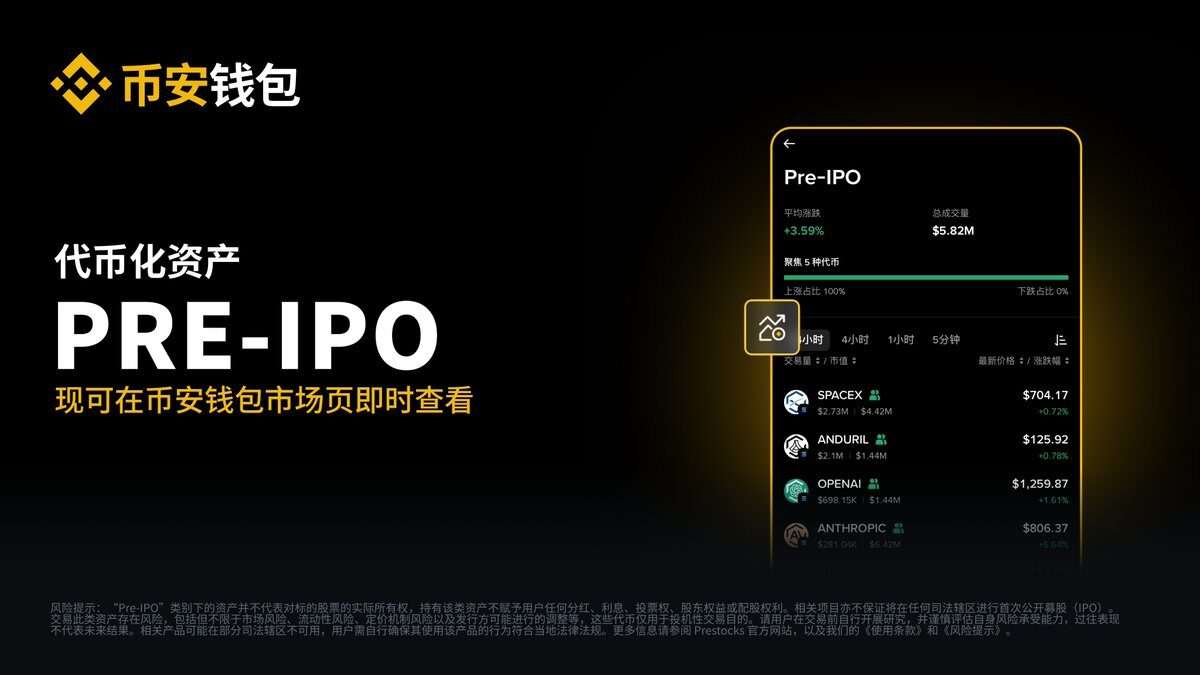
While the Binance Wallet serves as the primary entry and trading portal, the underlying assets are actually issued by PreStocks, a tokenization protocol operating on the Solana blockchain. This ingenious model leverages SPV (Special Purpose Vehicle) equity tokenization. PreStocks establishes a series of SPVs to hold the equity of these underlying companies, then mints mapped tokens at a 1:1 ratio based on the equity’s value, which are subsequently made available through the Binance Wallet.
For users, this innovative approach shatters the traditional private equity market’s entry barrier, reducing it from hundreds of thousands of dollars to mere tens, thereby truly democratizing fractional investment. For Binance, this move represents a significant first-mover advantage, transforming equity assets into a standard offering for crypto users, diversifying its commercial ecosystem, and attracting a broader user base.
Bitget: Compliance at the Forefront with “IPO Prime”
In contrast to Binance’s wallet-centric strategy, Bitget has chosen a path emphasizing regulatory adherence. It launched “IPO Prime,” a dedicated platform whose inaugural asset is preSPAX, an equity token representing SpaceX, backed by Republic – a licensed digital securities issuer.
Republic’s issuance of preSPAX tokens closely resembles a “debt financing” model, distinguished by its robust legal framework. Although preSPAX tokens do not confer direct voting or dividend rights, they are regulated assets issued under Reg S, defined as structured notes tied to the future IPO performance of the underlying asset.
Bitget has also integrated the “new issuance” strategy prevalent in both crypto and traditional stock markets into tokenized equity investment. Users receive tiered subscription quotas based on their VIP level, with direct subscription available using stablecoins like USDT and USDGO, eliminating the complexities of fiat currency exchange and providing seamless exposure to SpaceX.
Gate.io: High-Leverage Derivatives for Price Discovery
Gate.io has charted an entirely different course, opting for a derivative-based pricing model. It debuted pre-market contracts for SpaceX Pre-IPO stock, settled in USDT and supporting leverage from 1x to 10x.
This product does not involve the transfer of actual equity; it is fundamentally a mechanism for price discovery and market speculation on SpaceX’s post-listing valuation. The significance of this model lies in its ability to provide a public, real-time valuation benchmark for unicorns that have not yet gone public. Given that private company valuations are typically infrequent and opaque, Gate.io’s pre-market contracts empower investors to instantly price SpaceX’s value based on the latest company developments or prevailing market sentiment. This “synthetic asset” characteristic offers crypto-native users a highly capital-efficient participation method.
However, Pre-IPO assets are inherently highly volatile, and Gate.io’s 10x leverage introduces a significant double-edged sword. Private company valuations can fluctuate wildly based on mere rumors. Under 10x leverage, this could lead to widespread retail liquidations, potentially triggering irrational chain reactions across the broader crypto market.
Beyond these major players, platforms like StableStock are also enabling users to participate in Hong Kong IPO subscriptions using stablecoins, further diversifying the landscape.
The Dual Nature of Tokenized Equity: Empowerment Meets Peril
The rise of Pre-IPO asset trading transcends mere financial innovation within the crypto market; it is subtly reshaping the fundamental principles of wealth distribution.
The Promise of Democratization and Efficiency
Historically, private market access to SpaceX was exclusively reserved for top-tier Silicon Valley VCs, sovereign wealth funds, and billionaires. With its valuation soaring to $1.25 trillion in February and an IPO target exceeding $2 trillion, retail investors could only hope to partake in SpaceX’s growth after its public offering, by which time the lion’s share of valuation appreciation would have already been captured by institutional players. Now, even a student with $100 can gain exposure at a $1.5 trillion valuation (as offered by Bitget’s product). Equity tokenization has democratized the growth dividends of tech innovation, extending them from an exclusive Silicon Valley circle to every ordinary user.
Whether through on-chain transactions or pre-market contracts, Pre-IPO assets are transforming valuations from an “information black box” into transparent “pricing signals.” The price feedback generated by substantial trading volume in SpaceX, for instance, can feed back into traditional financial markets, providing more accurate data for LP valuations and effectively dismantling the information monopoly of private markets.
Furthermore, stablecoins are evolving beyond mere “speculative chips” within the crypto ecosystem. As users leverage stablecoins to trade Pre-IPO assets, these digital currencies become powerful productivity tools for cross-border equity transactions, deeply integrating with the real economy and advancing towards becoming a global financial “medium of exchange.”
The Unseen Pitfalls and Structural Risks
Despite the compelling narrative, equity tokenization navigates the precipice of structural risks, with potential dangers lurking at every turn. A critical vulnerability in virtually all current Pre-IPO products is the fundamental lack of shareholder rights: Pre-IPO token holders are typically not granted shareholder status, voting rights, or board seats.
Crypto analyst Phyrex astutely points out that current Pre-IPO products are essentially SPV mirrors. Users are not primarily trusting SpaceX itself, but rather the creditworthiness of the issuing entity. Should the underlying company undergo significant restructuring, bankruptcy, or implement malicious anti-dilution clauses before an IPO, token holders would possess minimal legal recourse.
Moreover, even if protocols like PreStocks operate on the Solana blockchain, the authenticity and backing of their assets remain intrinsically tied to the off-chain SPV manager. Any physical risks off-chain – such as insider trading, misappropriation of assets by the manager, or seizure by local regulators – could directly sever on-chain liquidity, revealing decentralization to be merely a superficial layer.
A significant cautionary note is that most Pre-IPO products restrict participation from U.S. users to circumvent SEC regulations. However, as the Pre-IPO asset class expands, regulators may re-evaluate and redefine the legal nature of these assets. In the future, if regulators mandate that tokenized equity must adhere to full IPO compliance procedures, the current advantages of these products could swiftly transform into burdensome regulatory shackles.
Why Now? Crypto’s Quest for Real-World Assets and Growth Dividends
This surge in Pre-IPO interest is fundamentally driven by a pervasive “asset drought” within the crypto market. As the global economy enters a new industrial cycle, a wave of AI unicorns are announcing IPO plans, with fundraising activities in full swing. Investors are increasingly seeking high-beta growth assets, and Pre-IPO assets like SpaceX, riding the crest of the AI wave, are essentially “long-term call options” with exceptionally high potential returns.
Consequently, exchanges are strategically introducing Pre-IPO offerings to infuse the crypto market with high-growth equity backed by tangible productivity. This diversification of the asset landscape is poised to further diminish the speculative nature of the crypto industry and smooth out its inherent cyclical volatility.
Traditional Pre-IPO transactions are notoriously plagued by lengthy settlement cycles and opaque processes. Tokenization technology, through on-chain atomic settlement, dramatically reduces equity transfer times from weeks to mere seconds. While legal ownership confirmation still requires off-chain processes, the instantaneous on-chain flow of economic rights is effectively simulating secondary market liquidity, thereby enhancing the pricing efficiency of unicorn equity valuations.
Bitget’s articulation of a “Universal Exchange” encapsulates the broader ambition shared by all major crypto exchanges: to evolve beyond mere cryptocurrency trading platforms and become unified portals where users can manage and trade cryptocurrencies, stocks, equity, bonds, and commodities. Pre-IPO assets are ideally suited as a powerful user acquisition tool for exchanges. By introducing these scarce and highly desirable assets, exchanges can effectively convert traditional investors interested in AI equity into engaged crypto users.
For investors embarking on this exciting journey, the paramount challenge lies in discerning genuine opportunities from “fake air certificates.” In the complex and often volatile financial markets, the authenticity and verifiable backing of the underlying asset remain the immutable anchor.
Tokenized equity is poised to transmit the dividends of technological advancement, via stablecoins, to every corner of the globe. In the ongoing dynamic interplay between regulation and innovation, a more transparent, efficient, and equitable global equity trading system is quietly taking shape, built upon the foundational principles of blockchain technology.
(The above content is an authorized excerpt and reprint from our partner PANews. Original article link)
Disclaimer: This article is for market information purposes only. All content and views are for reference only, do not constitute investment advice, and do not represent the views and positions of BlockTempo. Investors should make their own decisions and transactions. The author and BlockTempo will not bear any responsibility for direct or indirect losses incurred by investors’ transactions.