The year 2026 has just entered its summer prelude, yet the crypto financing market has been gripped by a severe “late spring chill.”
According to Cointelegraph data, the crypto venture capital market experienced a significant cooldown in April, with total crypto VC funding for the month plummeting by 74% from the previous quarter to $660 million. Only 63 deals were recorded, marking the lowest monthly funding level since July 2024. The chill permeated nearly every sector, causing investment institutions to collectively tighten their purse strings.
However, even in the depths of winter, new growth finds a way. In May, the on-chain derivatives sector defied the prevailing trend, witnessing an explosive surge. Three prominent protocols—PopDEX, Variational, and Liquid—attracted substantial institutional capital within two consecutive weeks. Beyond top-tier VCs like Dragonfly Capital, these platforms also garnered interest from growth-oriented traditional funds such as Left Lane Capital.
This nearly $100 million in fresh capital not only signifies a strong consensus on the high growth potential of the derivatives market but also heralds the dawn of a new battleground for the next generation of Perp DEXs (decentralized perpetual contract exchanges).
Beyond False Prosperity: PopDEX Leads the “Value Return” with $30 Million
The exceptional performance of the crypto derivatives trading sector provides strong logical backing for the significant funding secured by these three protocols. CoinGecko’s “2026 Crypto Perpetual Futures Market Report” highlights a subtle yet profound shift in the Perp DEX market landscape:
-
Perp CEX Trading Activity Contracts: The average monthly trading volume of the Top 11 Perp CEXs declined by 34% year-over-year in the first four months of this year, shrinking from $7.11 trillion last year to $4.69 trillion currently.
-
Perp DEX Market Share Surges: Conversely, the average monthly trading volume of the Top 12 Perp DEXs grew from $531.65 billion last year to $611.57 billion. More strikingly, Perp DEXs’ share of the total crypto derivatives market’s Open Interest (OI) skyrocketed from 3.6% at the beginning of last year to 13.5% by the end of April, achieving nearly fourfold growth.
Even JPMorgan Chase, in its research report, explicitly stated that Perp DEXs are gradually eroding the market share of mid-tier CEXs.
This dynamic interplay reveals an accelerated migration of capital towards Perp DEXs, which champion “non-custodial and self-sovereign asset ownership.”
However, during the last aggressive expansion cycle, the Perp DEX sector briefly lost its way. Protocols became overly reliant on incentive-driven airdrops to “subsidize” liquidity, creating a facade of prosperity. Once airdrop expectations were met, liquidity often evaporated, platforms fell silent, and token prices languished. The flip side was that active trading users, who genuinely contributed to platform fees, often found themselves at the bottom of the profit-sharing chain.
PopDEX aims to break this vicious cycle. It seeks to redefine the value distribution system, sustainably returning the ecological value captured by the platform directly to participants who make tangible contributions. This transforms traders from mere “contributors” into “co-builders,” aligning their interests with the platform’s long-term success.
On May 22, PopDEX successfully closed a $30 million strategic seed round, led by Foresight Ventures. Zac Tsui, a partner at Foresight Ventures, stated that the future of on-chain trading belongs to platforms built around the actual needs of active traders, and PopDEX’s uniqueness lies in its commitment to returning platform value to those who truly drive its development.
Reportedly, the $30 million funding will be allocated to injecting initial liquidity, enhancing trading depth, accelerating product security audits, and expanding the global team. PopDEX has already invited select elite traders to participate in a closed beta, with the team focusing on optimizing the cross-margin engine, risk control in extreme market conditions, and streamlining the trading process in preparation for its public launch.
In an era saturated with airdrops and opportunistic “farmers,” PopDEX has chosen a path of “value return.”
Capital Pours into “On-Chain Brokers”: Variational Crowned Funding King
While PopDEX’s funding amount is certainly impressive, Variational has claimed the title of the top fundraiser in the Perp DEX sector for the first half of 2026.
On May 20, Variational announced the completion of a $50 million Series A funding round led by Dragonfly Capital, with participation from leading institutions such as Bain Capital Crypto and Coinbase Ventures. Prior to this substantial round, Variational had already secured a $10.3 million seed round and a $1.5 million strategic round, bringing its cumulative funding to over $60 million.
Behind this colossal funding lies venture capital’s strong conviction in Variational’s “on-chain broker” model. While it appears to be a DeFi protocol on the surface, it fundamentally functions more like a centralized market maker built atop an on-chain settlement layer.
Most Perp DEXs exploring RWA perpetual contracts attempt to bootstrap liquidity from scratch via on-chain Central Limit Order Books (CLOBs), often leading to fragmented liquidity, wide spreads, and volatile prices.
Variational, therefore, eschewed the traditional CLOB mechanism, instead adopting a peer-to-peer Request for Quote (RFQ) system, akin to the broker model in traditional financial markets.
On Omni, Variational’s retail application, internal liquidity units (OLPs – Omni Liquidity Providers) act as market makers and counterparties to user trades. They hedge risk in real-time by connecting to major CEXs like Binance and Bybit, as well as traditional financial channels. Variational doesn’t need to create order books from thin air; it directly aggregates and routes existing liquidity from both traditional and on-chain markets. This abundance of liquidity allows Variational to offer users zero-fee trading, with the platform profiting solely from the bid-ask spread.
The Variational team boasts deep Silicon Valley and Wall Street backgrounds, with members hailing from Google, Meta, and top market-making firms like Virtu, IMC, and Jane Street. Co-founder and CEO Lucas Schuermann previously founded the quantitative hedge fund Qu Capital, which was later acquired by DCG, and served as VP of Engineering at the renowned crypto OTC giant Genesis Trading.
Capital injections often coincide with significant business turning points. This funding round aligns with Variational’s launch of its first real-world asset (RWA) derivatives markets. Phase 1 will support on-chain perpetual contract trading for commodities like gold, silver, copper, and WTI crude oil, while stress-testing its cross-margin engine and on-chain settlement market. Phase 2, expected to commence this summer, will see the protocol directly routing liquidity from traditional financial channels, introducing over 100 new markets.
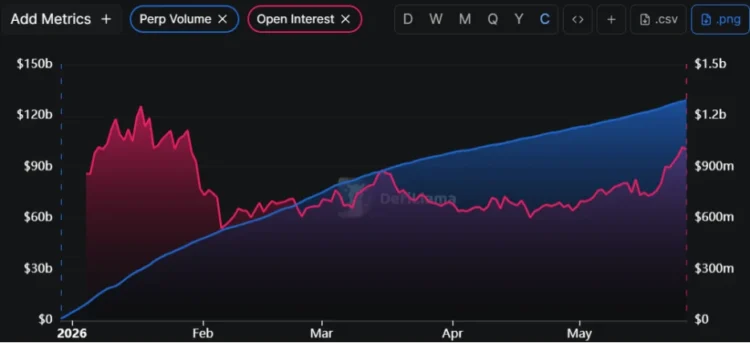
Since late 2025, the protocol has processed nearly $130 billion in cumulative trading volume, with Open Interest (OI) surpassing $1 billion.
Conversational Trading: Liquid Leverages AI Assistant for Front-End Dominance
Compared to the purely financial architectures of the previous two, Liquid tells a compelling story at the intersection of Silicon Valley and Wall Street: AI-powered trading.
On April 28, Liquid completed an $18 million Series A funding round co-led by Neo and Left Lane Capital. This follows a $7.6 million seed round exclusively led by Paradigm late last year, bringing the protocol’s total war chest to $25.6 million.
Liquid began as a Perp DEX aggregator and has since evolved into an all-weather trading platform supporting over 500 markets, including cryptocurrencies, US stocks, commodities, forex, prediction markets, and Pre-IPO equities, offering up to 200x leverage.
Crucially, Liquid maintains a non-custodial architectural design, meaning users always retain absolute control over their assets.
In traditional financial markets, the user-facing entry point—the front-end interface—typically captures the most lucrative portion of the entire value chain.
Liquid’s product logic is a direct projection of this principle into the crypto domain. The protocol deeply integrates an AI trading assistant to strengthen its front-end control over retail order flow.
Derivatives trading inherently involves high leverage, high risk, and high complexity, posing significant professional barriers for average traders. Liquid encapsulates complex leverage calculations, cross-asset risk control, and macro data research reports within a conversational AI interface. This allows retail users to access institutional-grade research depth and execution speed, replacing complex operations with simple dialogue, thereby enhancing user stickiness.
Since its launch in August 2025, Liquid has recorded over $3 billion in cumulative trading volume across 40,000 active users.
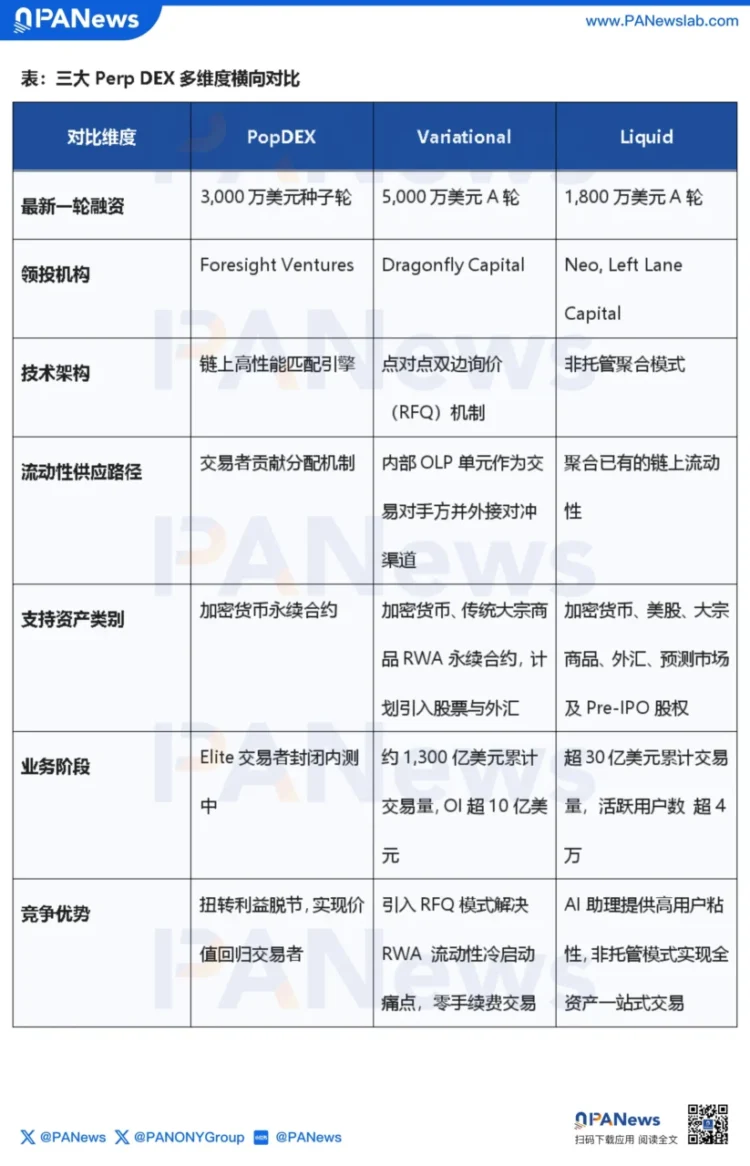
The nearly $100 million capital injection underscores the robust ability of Perp DEX protocols to attract funding and users, yet this merely marks the prologue to the next wave of transformation in the derivatives market.
PopDEX rectifies incentive distribution, Variational bridges traditional finance, and Liquid connects users with AI. These three protocols, from distinct dimensions, are constructing bridges for capital to flow into on-chain financial markets.
As these three protocols advance to the next steps of their roadmaps, the landscape of the Perp DEX sector is poised for a significant reshuffle.