
Securing Bitcoin’s Future: Pioneering Quantum-Resistant Solutions Emerge
By MAX, CryptoCity
Quantum Threats and Bitcoin’s Existential Challenge
The very foundation of Bitcoin’s security, relying on the Elliptic Curve Digital Signature Algorithm (ECDSA) and Schnorr signatures, faces a formidable, albeit future, threat from powerful quantum computers. Should quantum machines successfully execute Shor’s Algorithm, they could potentially decrypt existing cryptographic techniques, enabling attackers to derive private keys from publicly available blockchain information and illicitly seize funds.

This critical vulnerability has been a topic of extensive discussion within the developer community for years. One extreme proposal, an “emergency brake” upgrade, suggested disabling existing signature systems to defend against such attacks. However, this measure carried a severe drawback: it would effectively lock out users who hadn’t migrated their funds, potentially rendering millions of wallets, including modern Taproot implementations, permanently inaccessible due to a lack of alternative verification methods.
- Related News: Can a Quantum Attack Crack Bitcoin in 9 Minutes? Binance CZ: An Upgrade Can Block It, No Need to Panic
A Quantum Lifeline: Proving Wallet Ownership Without Revealing Seeds
In a significant development, Olaoluwa “Roasbeef” Osuntokun, CTO of Lightning Labs, publicly unveiled a prototype tool on April 9th via the Bitcoin developer mailing list. This innovative solution is designed to offer users a crucial escape route for their assets in a quantum-threatened future. The system, building upon Osuntokun’s earlier research into quantum-resistant signatures, empowers users to prove ownership of their wallets without ever exposing their original seed phrase.
The tool establishes a secure mathematical link between a wallet and its generating seed, ensuring that the rescue process for a single wallet does not compromise the security of other wallets derived from the same seed. This mechanism provides Bitcoin’s network with an alternative authorization method, granting users the ability to reclaim their assets even in extreme scenarios where traditional digital signatures are compromised or disabled.
Preliminary testing has shown promising results: the prototype generates a proof in approximately 55 seconds on a high-performance MacBook, with verification taking less than 2 seconds. The resulting proof file is roughly 1.7 MB, comparable in size to a high-resolution photograph. While currently an unoptimized prototype and not yet integrated into mainstream wallet software, this breakthrough successfully addresses a long-standing technical gap within the community.
Fundamentally, this solution redefines the proof of ownership from “I can digitally sign” to “I can prove this wallet originated from my seed.” This innovative approach maintains robust security while circumventing the risk of asset freezing that could arise from an emergency protocol upgrade.
Quantum-Safe Transactions Without Core Protocol Modifications
Concurrently, on the same day (April 9th), StarkWare developer Avihu Levy introduced groundbreaking research titled “Quantum Safe Bitcoin” (QSB). This proposal presents a method for achieving quantum-resistant transactions without necessitating any modifications to Bitcoin’s core consensus rules or requiring a soft fork.
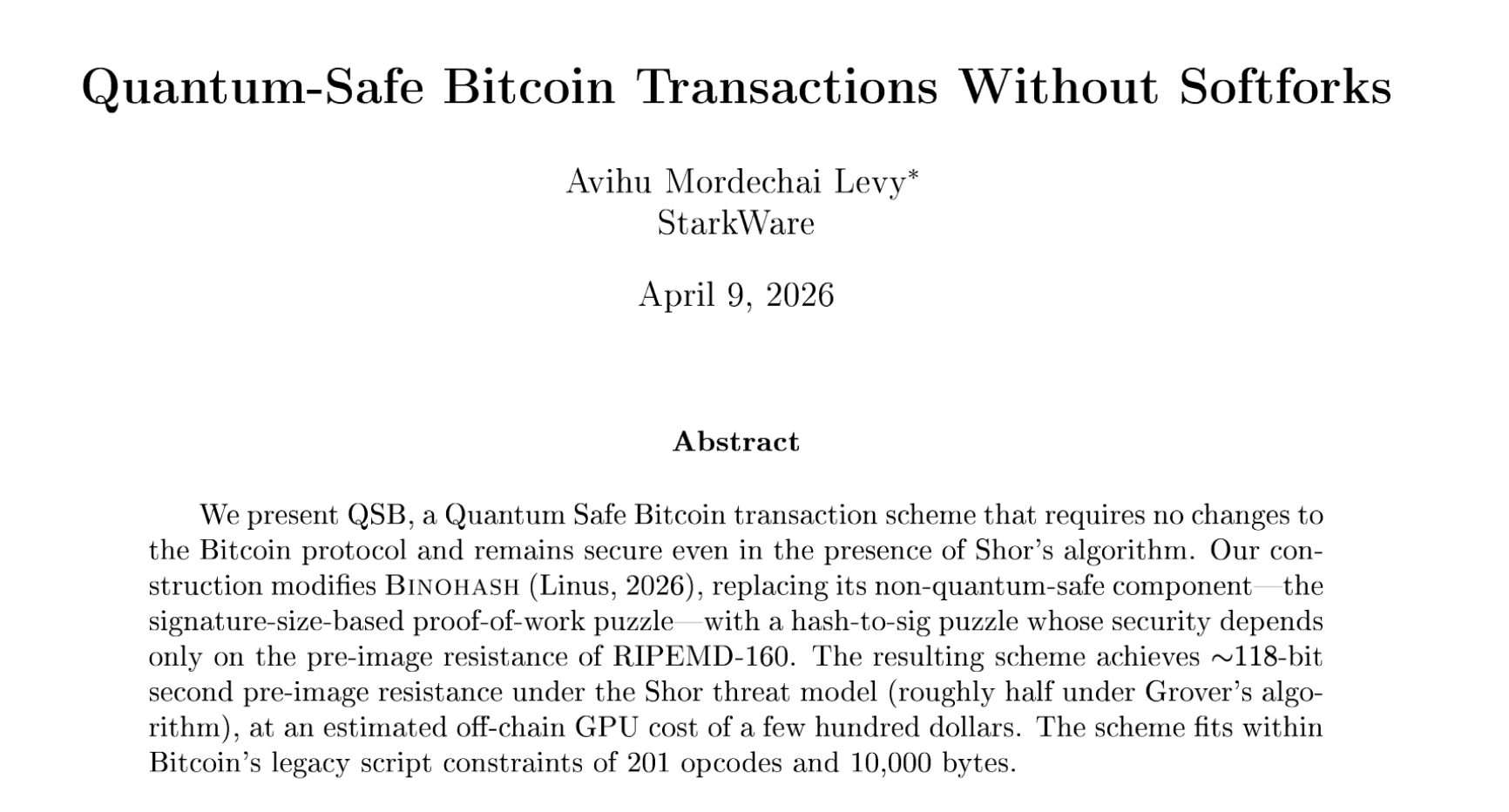
QSB’s technical core pivots the security assumption from elliptic curves to the pre-image resistance of hash functions. Given that quantum computers offer only limited acceleration in cracking hash functions, this architecture effectively defends against quantum attacks, maintaining an estimated security margin of approximately 118 bits.
QSB achieves this by embedding “hash-to-signature” puzzles within Bitcoin’s existing script limitations, utilizing functions like RIPEMD-160 to construct a unique verification mechanism. Users must discover specific transaction parameters to satisfy the hash proof conditions, a process akin to a miniature Proof-of-Work, with a success probability of roughly 1 in 70.4 trillion.
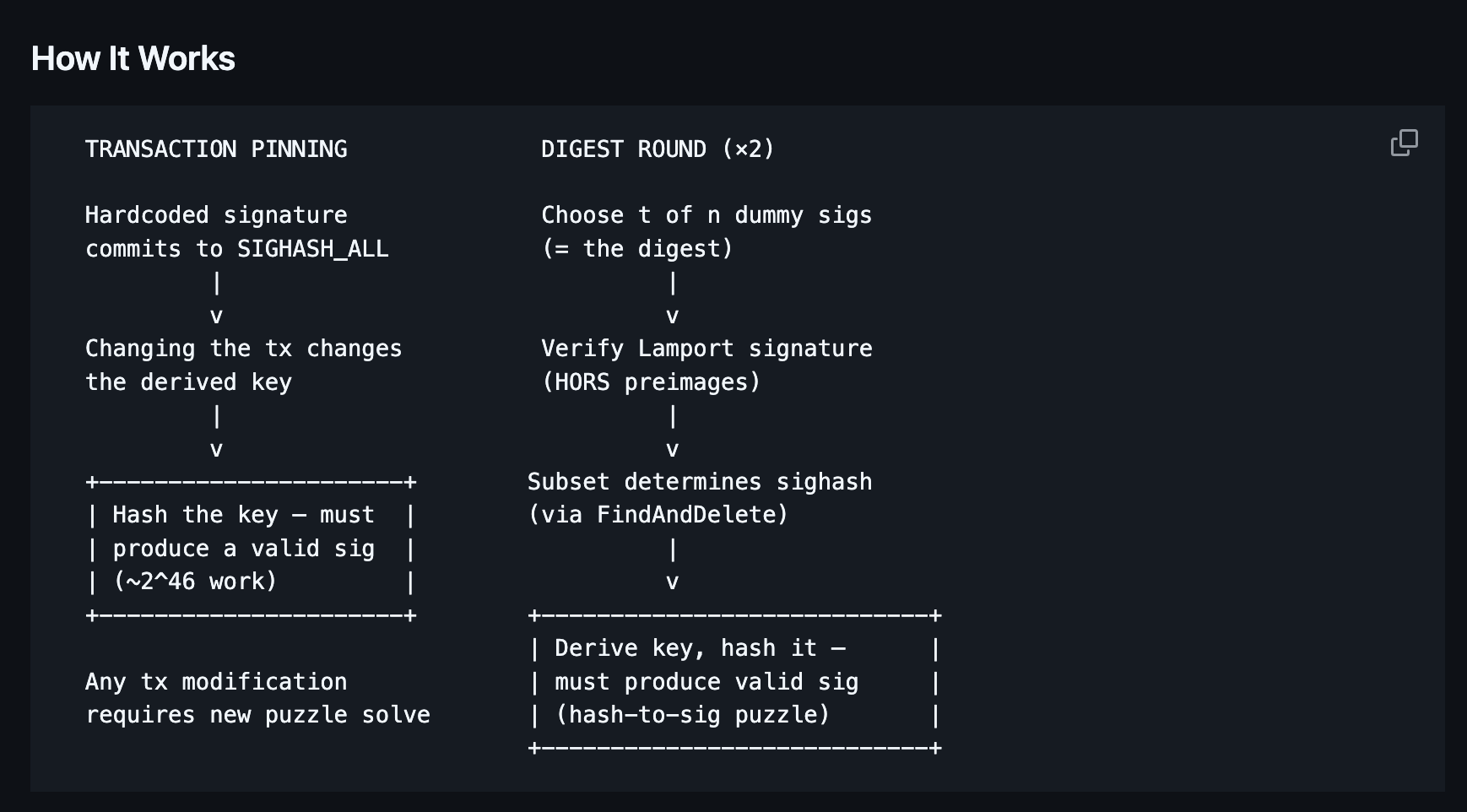
Research estimates suggest that generating such transactions using cloud GPUs would incur a cost of approximately $75 to $150. While QSB transactions are currently too large for standard node propagation and require direct submission to miners via services like Slipstream, this research underscores Bitcoin’s inherent flexibility to address future technological challenges without altering its foundational rules.
Evaluating Adoption and the Path Forward for Quantum Defense
The widespread adoption of quantum defense technologies will inevitably face hurdles related to cost and performance. Quantum-resistant signatures typically consume more block space, which could lead to increased transaction fees. The timeline for Bitcoin’s quantum upgrade remains a subject of debate within the market.
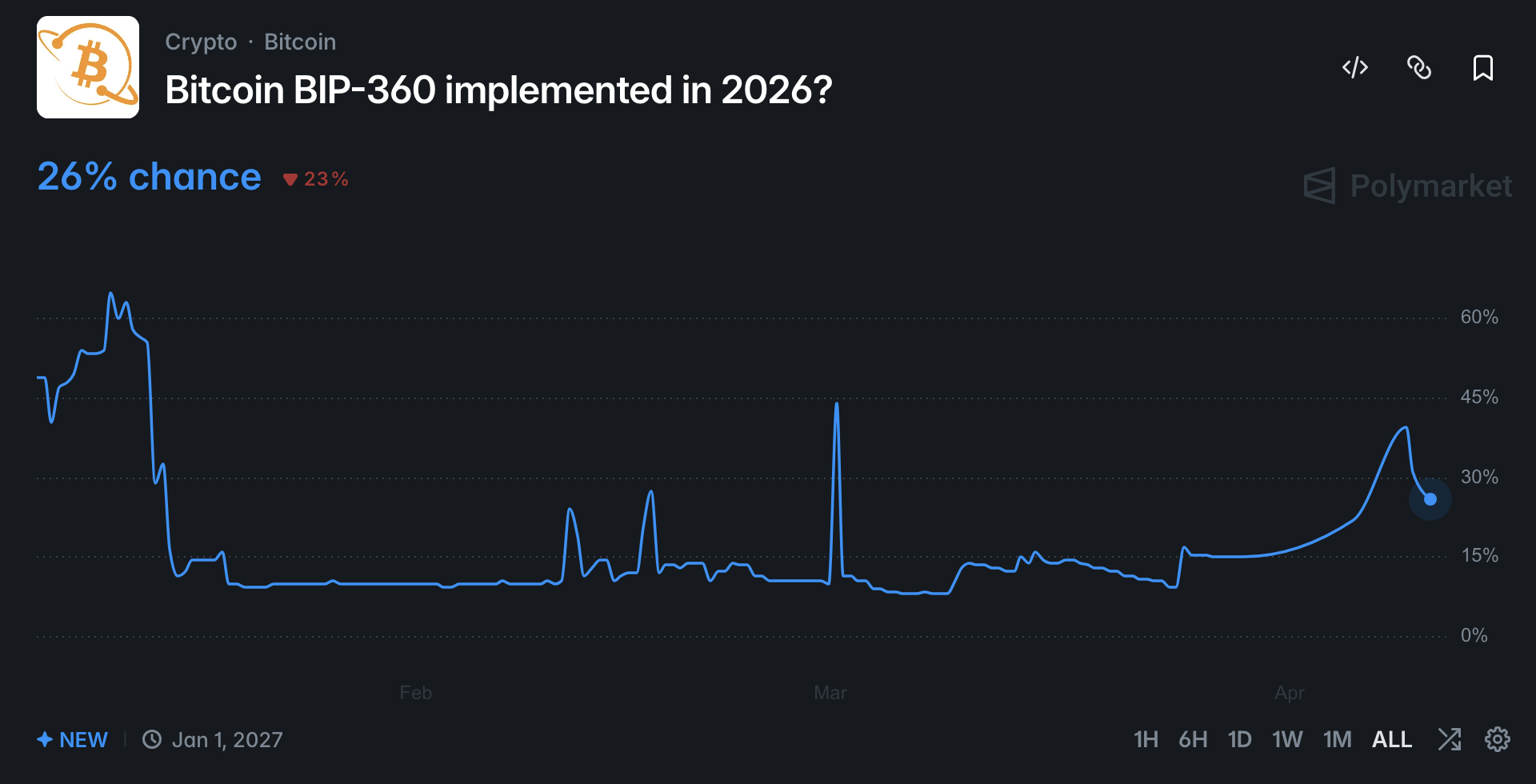
On the prediction platform Polymarket, traders currently assess the probability of a Bitcoin quantum-resistant upgrade proposal (such as BIP-360) being adopted by 2027 at approximately 26%. While academic discourse continues regarding the precise timing of large-scale quantum attacks, the recent emergence of these rescue tools and transaction proposals significantly bolsters the network’s resilience against future risks.
Through the development of these defensive prototypes, the Bitcoin community is steadily bridging the gap between theoretical vulnerabilities and practical applications. Osuntokun’s rescue prototype and Levy’s QSB solution offer diverse defense options tailored to different user needs. As computational resources are optimized and proof generation techniques advance, these tools are expected to become more lightweight and accessible to a broader audience. For the Bitcoin ecosystem, the continuous research and development of various quantum backup solutions are essential for preserving the long-term value of this digital gold. Before the threat truly materializes, these proactive technological reserves will serve as a critical moat, protecting user assets from obsolescence.
(The above content has been excerpted and reproduced with authorization from our partner “CryptoCity”. Original Article Link)
Disclaimer: This article is for market information purposes only. All content and views are for reference only and do not constitute investment advice. They do not represent the views and positions of BlockTempo. Investors should make their own decisions and trades. The author and BlockTempo will not bear any responsibility for direct or indirect losses resulting from investor transactions.