In the dynamic and ever-evolving landscape of Web3, few protocols have demonstrated the adaptive resilience and foresight of Near Protocol. Guided by Illia Polosukhin, a distinguished co-author of the seminal Transformer paper and widely recognized as one of Web3’s foremost AI visionaries, Near has consistently positioned itself at the vanguard of innovation. From high-performance public chains and sharding scalability to chain abstraction, Intents, and now the burgeoning AI Agent economy, Near has been a perennial presence in mainstream crypto narratives across multiple market cycles.
Despite navigating challenging bear markets, Near has delivered impressive results, establishing itself as a cross-chain infrastructure giant. It has successfully processed over $20 billion in cross-chain transactions and generated more than $34 million in protocol fees. Yet, Near’s remarkable journey began not with a grand philosophical quest for decentralization, but with a surprisingly pragmatic and pressing problem: the complexities of international payroll. Eight years ago, an AI startup co-founded by Illia Polosukhin was compelled to temporarily shelve its AI ambitions, pivoting instead to build a public blockchain to solve the intricate challenge of paying global developers. Today, as the AI revolution sweeps across the globe, this very blockchain, born out of an AI necessity and once a detour from AI, has come full circle, returning to its foundational roots.
The Unforeseen Genesis: How a Payroll Problem Forged a Blockchain
History, at times, unfolds in remarkable cycles. Nine years ago, Illia Polosukhin was not yet the AI-centric founder synonymous with the crypto industry. Near Protocol was founded in 2017 by Polosukhin, a former Google machine learning researcher and co-author of the Transformer paper, alongside Alexander Skidanov, an expert in distributed systems.
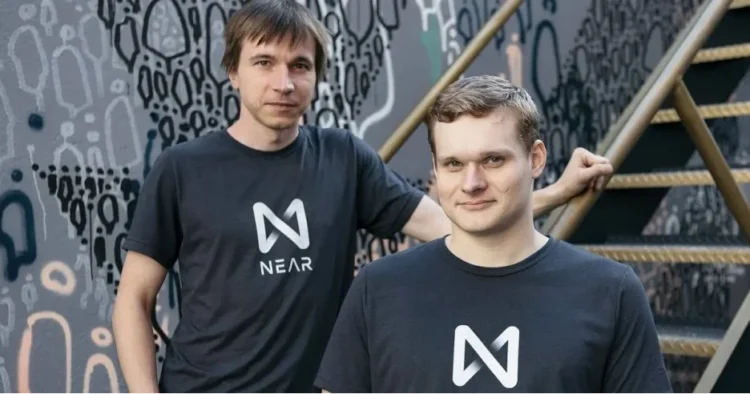
Initially, Near was conceived as an artificial intelligence startup focused on “Program Synthesis”—the ambitious goal of “teaching machines to write code” to automate software development. This vision shared conceptual parallels with later innovations like OpenAI’s CodeX, Anthropic’s Claude Code, and Cursor.
To train their algorithms and models, the team recruited computer science students globally to remotely write code snippets. However, the seemingly straightforward task of compensating these distributed developers quickly escalated into a monumental hurdle. The cross-border payment systems of the time were nascent and fraught with limitations. Mainstream platforms like PayPal and Wise faced severe restrictions in Eastern Europe and Asia-Pacific, leading to frustrating delays and significant exchange rate losses.
Adding to the predicament, when the founders attempted to leverage early public blockchains for bulk cross-border payments, they encountered prohibitive gas fees and abysmal settlement efficiency, rendering them impractical for low-cost, mass remuneration. For a resource-constrained AI startup, this presented an almost insurmountable dilemma. Faced with this impasse, the two founders, both possessing extensive backgrounds in large-scale distributed systems, made an extraordinary decision: to temporarily set aside their AI model development and instead build their own highly scalable, low-fee, and user-friendly public blockchain.
This “passive transformation,” triggered by the inability to process payroll, led to the birth of the Near Protocol in 2018.
However, the initial pivot away from AI was far from smooth. Near transitioned its focus to developing a high-performance public chain centered on sharding technology, aiming to resolve blockchain scalability challenges. Despite securing over $500 million in cumulative funding through its robust technical prowess, Near struggled to gain significant traction in the intensely competitive public chain arena. It lacked a killer application, failed to attract widespread developer adoption, and consequently, suffered from a sparse ecosystem and stagnant user growth. In an environment teeming with “Ethereum killers,” even with its leading sharding architecture, Near’s market attention was consistently diverted by other popular public chains, leading to a period where the protocol was “praised but not popular.”
The bull market of 2020-2021 marked a turning point, as Near capitalized on the cross-chain narrative. The launch of the Rainbow Bridge served as a crucial catalyst for its ecosystem’s explosion and a significant surge in its token price.
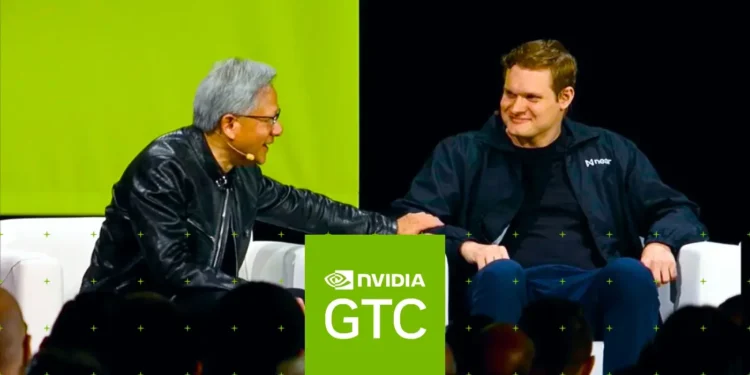
The true inflection point, however, arrived with the global AI boom. In March 2024, during Nvidia’s GTC Global Developers Conference, CEO Jensen Huang invited Illia Polosukhin and six other co-authors of the Transformer paper to a panel discussion. Huang lauded the paper for “transforming the world,” underscoring how the Transformer architecture became the bedrock of all AI industry achievements, reshaping global technology, content, and financial landscapes. This high-profile moment re-catapulted Illia Polosukhin and, by extension, Near Protocol—a project whose AI dreams were once deferred—back into the crypto market’s spotlight, reaffirming its legitimate “AI lineage.”
Returning to the forefront with a renewed sense of purpose, Near’s unique “technical core” was further activated. Leveraging this momentum, the protocol pivoted towards Near Intents and confidential transactions, laying a robust foundation at the confluence of multi-chain intents and the burgeoning Agent Economy. The Intent transaction layer significantly lowers the interaction barrier for AI Agents, enabling agents deployed in confidential hardware TEEs (Trusted Execution Environments), such as Venice AI, to autonomously, securely, and cost-effectively perform multi-chain fund transfers.
Near Intents: Simplifying Cross-Chain Interactions and Driving Growth
Near Intents fundamentally redefines the cross-chain transaction experience. In traditional multi-chain environments, users typically navigate a cumbersome process for a single cross-chain asset swap: manually interacting with bridges, preparing different gas tokens on both source and target chains, and constantly monitoring for slippage and friction costs.
Near, conversely, employs an intent-based mechanism to abstract the entire process. Users simply articulate their desired transaction, such as “swap BTC on the source chain for ETH on the target chain,” without needing to understand the underlying cross-chain paths or gas consumption. This represents the intuitive interaction experience sought by everyday users and, crucially, by future AI Agents.
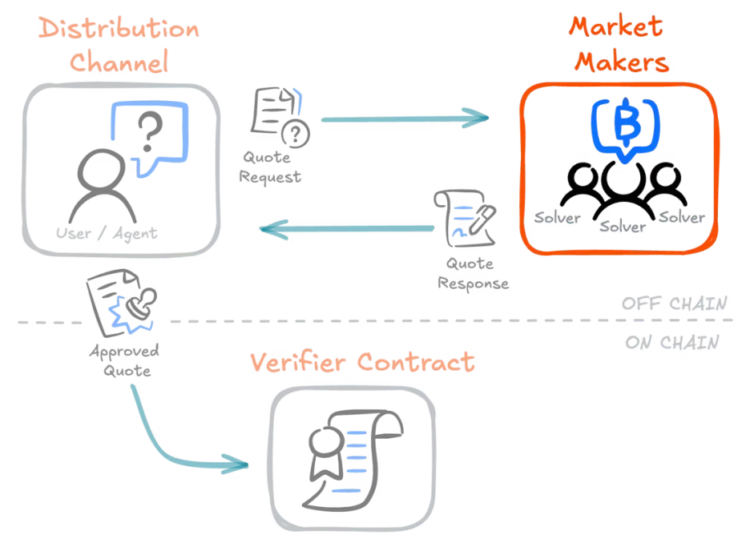
The execution of these cross-chain transactions relies on a competitive bidding mechanism within an off-chain solver network.
- Upon a user initiating an intent request, the solver network, via a Solver Bus, engages in bidding to automatically identify and calculate the optimal execution route and quotation.
- Once the user signs the chosen quotation, the intent is submitted to a Verifier smart contract on the Near chain for final settlement.
Throughout this streamlined process, gas fees are discreetly deducted in the background, making payments feel seamless to the user and significantly invigorating DeFi cross-chain trading activity. This substantial improvement in user experience has led to widespread integration, including with major traffic gateways like Ledger.
However, the potential centralization of the solver network presents a notable risk. Solvers require substantial market-making liquidity and sophisticated algorithmic optimization, leading transaction APIs like 1Click to often rely on trusted exchange agents and top market makers. This dynamic could foster an oligopoly within the solver market, potentially eroding the price advantages inherent in a truly competitive bidding mechanism.
According to DeFi Llama data, Near Intents has been deployed across 25 public chains, encompassing the majority of the crypto market’s key settlement networks. The protocol boasts a Total Value Locked (TVL) exceeding $85 million. Beyond retaining $36.5 million in funds on the Near chain itself, its chain abstraction mechanism has cultivated deep liquidity across other prominent chains like Ethereum, Bitcoin, and Tron. This extensive cross-chain ecosystem breadth has been instrumental in Near Intents accumulating over $20 billion in transaction volume.
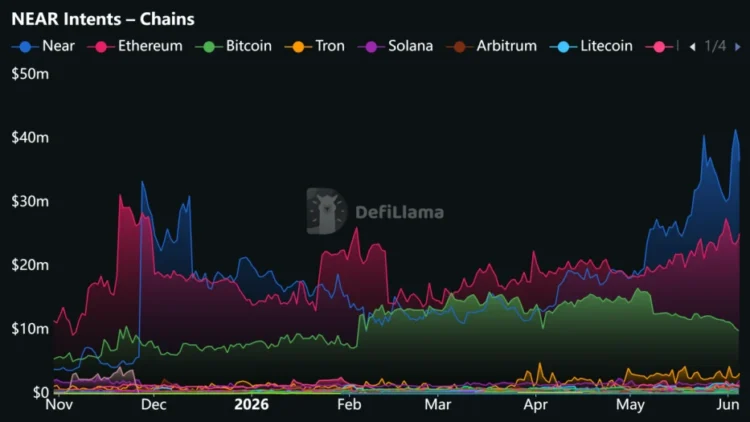
From a profitability perspective, Near Intents has generated over $33 million in protocol fees since its inception, with more than 70% of this revenue contributed in the last two quarters alone. This trend underscores the protocol’s growing profitability as the multi-chain ecosystem continues to expand.
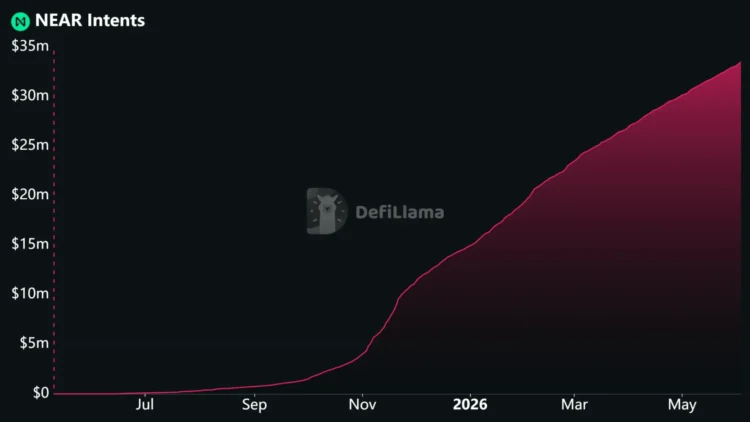
This steadily increasing fee revenue will establish a positive economic feedback loop for NEAR. The vast majority of network fees are burned, introducing a deflationary dynamic to the NEAR token and further strengthening its value capture capabilities.
Confidential Transactions: A Double-Edged Sword for Privacy in DeFi
As on-chain activity proliferates, the demand for privacy is no longer a niche requirement within the crypto market but a critical differentiator, a need Near Protocol has adeptly addressed. Since the introduction of “Confidential Intents” and “Confidential Swaps” in the first quarter of this year, their adoption rate has surged dramatically. Over the past 30 days, Near chain’s total transaction volume reached $209 million, with confidential swap transactions accounting for a substantial $87 million—a remarkable 41.63%. This metric not only reflects robust product adoption but also undeniable market demand.
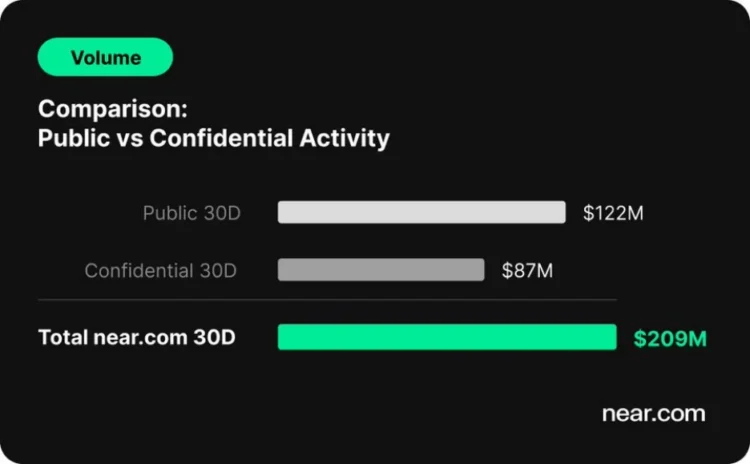
The surge in this service is rooted in Near’s ability to address a long-standing structural pain point in the DeFi market: the highly transparent nature of on-chain ledgers, which exposes the positions and intentions of large traders. This transparency leaves institutions and “whales” vulnerable to severe sandwich attacks (MEV), significant slippage, and strategic leaks when executing large-volume trades.
The Confidential Intents feature introduces programmable privacy technology, allowing users to seamlessly switch to a “confidential mode” on the front-end interface. In this mode, the transaction amount, direction, and position remain entirely concealed from external observers during execution. Only at settlement is verifiable encrypted accounting performed on-chain. This innovation effectively neutralizes malicious bots, safeguarding traders’ commercial secrets. Confidential Swaps thus pave a relatively secure DeFi channel for institutional capital, reducing trading friction and fostering greater integration between the on-chain ecosystem and mainstream finance.
However, the other side of this coin cannot be overlooked. While over 40% of transactions being private unequivocally demonstrates genuine market demand, it also risks attracting intense regulatory scrutiny. Global regulators have maintained relentless pressure on privacy protocols like Tornado Cash. Large, anonymous capital flows are inherently more likely to trigger regulatory enforcement. If regulatory bodies deem the “Confidential Swaps” model to pose a risk of facilitating money laundering, Near could inevitably fall under their purview, potentially becoming one of its most significant future uncertainties.
Reflecting on its nine-year journey, Near Protocol’s growth narrative has unfolded with dramatic twists and turns. Despite enduring fierce public chain competition, volatile market cycles, and shifting narratives, the protocol has continuously adapted and refined its development direction. Today, chain abstraction, Intents, and confidential transactions represent Near’s core areas of exploration. The resurgence of the AI boom has prompted the market to re-evaluate the unique background of this public chain. Nevertheless, whether these innovative endeavors will ultimately help Near establish a more robust and defensible ecosystem moat remains a subject that requires further observation over time.