Author: Frank, PANews
World Cup Whales: Unpacking the High-Stakes World of Smart Money Predictions
The final whistle blew on July 20, marking the conclusion of the North America World Cup – a global spectacle that captivated billions of football fans. Beyond the roar of the stadiums, this mega-event also stirred the wallets of countless speculators in prediction markets. Early in the tournament, an analysis by PA Beacon on the group stage revealed a surprising trend: large-scale “smart money” didn’t exhibit a clear advantage. As of June 17, 2026, after the first 20 matches, pre-match buy-ins totaled $89.5457 million, with a mere 48.5% hit rate by value. Holding these positions to settlement would have resulted in an estimated loss of $1.7594 million, translating to a negative ROI of -2.0%.
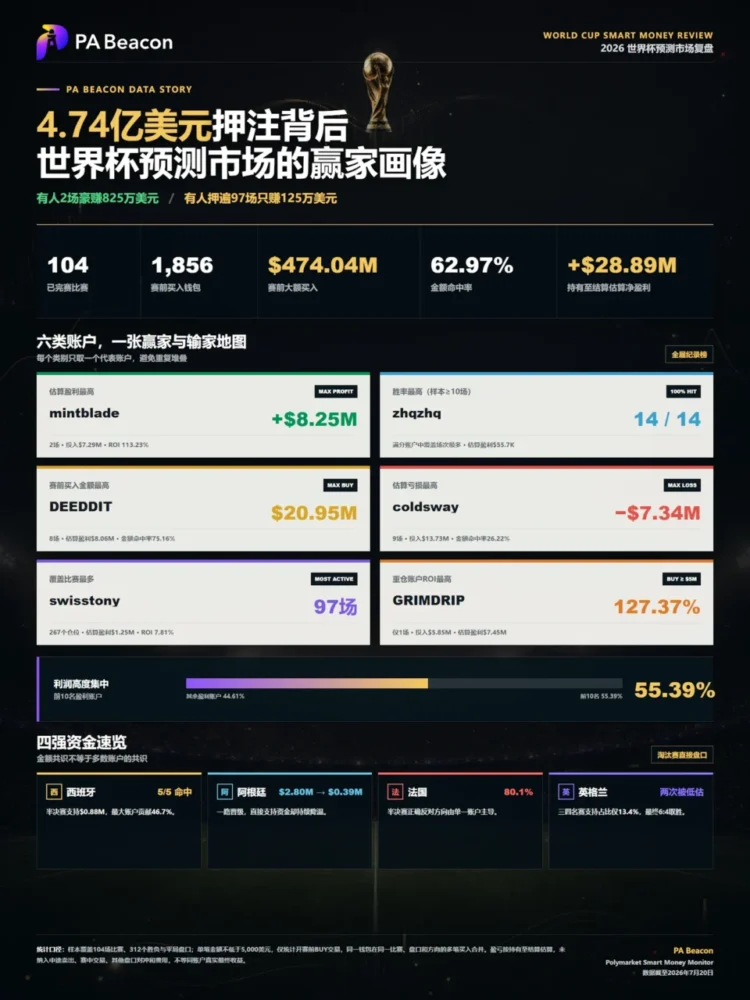
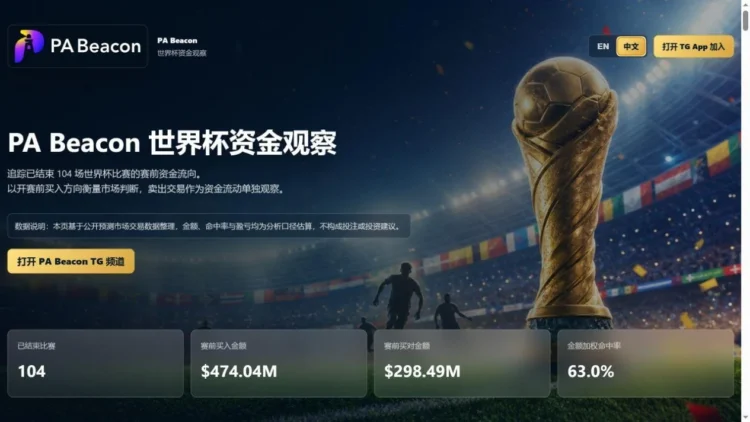
However, a month later, the narrative dramatically shifted. By the end of all 104 matches, PA Beacon’s comprehensive data showed a staggering $474.04 million in pre-match buy-ins. Crucially, $298.49 million of this capital was placed on the correct outcomes, pushing the overall hit rate by value to 62.97%. If all these positions were held until settlement, the total estimated return would be approximately $502.93 million, yielding an impressive net profit of $28.8858 million and an ROI of 6.09%.
This remarkable turnaround from initial losses to substantial profits might suggest that large funds progressively honed their judgment as the tournament unfolded. Yet, a deeper dive into individual account performance reveals a more nuanced reality: a select few wallets, through one or two strategically heavy bets, captured the lion’s share of the profits. Conversely, other accounts, despite participating in nearly every World Cup match and achieving higher hit rates, saw relatively modest returns. The leaderboard for sheer profit, it turns out, is a distinct entity from the leaderboard for consistent accuracy.
Methodology Note: This analysis encompasses 104 matches and 312 win, loss, and draw markets. Transaction data is sourced from the Polymarket Data API, pre-filtered for single buy-in amounts of no less than $5,000, and only includes pre-match BUY transactions. Multiple buys by the same wallet for the same match, market, and direction are aggregated. Profit and loss are estimated based on holding positions until settlement and do not account for mid-game sales, in-play trading, hedging across other markets, or platform fees. Therefore, these figures may not represent an account’s true final profit or loss.
Large Funds Stage a Comeback, Yet Profits Remain Highly Concentrated
Out of 1,856 wallets involved in pre-match betting, an estimated 1,003 (54.04%) generated a profit, while 853 incurred losses. The profitable accounts collectively amassed $99.6338 million, while the losing accounts collectively forfeited $70.7480 million. After offsetting, these “smart money” participants achieved a net profit of $28.8858 million.
Even more striking is the extreme concentration of these profits. The top 5 most profitable accounts alone collectively earned $37.7064 million, representing a significant 37.85% of the total gross profits. Expanding to the top 10 accounts, their combined earnings reached $55.1869 million, accounting for a dominant 55.39% of all profits. This reveals a critical insight: the overall 6.09% ROI for large funds does not signify widespread, stable advantages across the board. Instead, it highlights how a handful of heavy-betting winners disproportionately elevated the average performance.
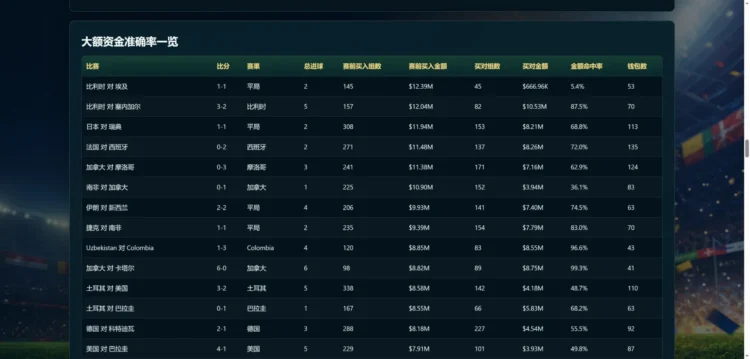
Furthermore, the variance in outcomes between matches was immense. The Belgium vs. Egypt match, for instance, attracted $12.3905 million in pre-match buy-ins, yet only $0.6670 million was placed on the correct outcome, resulting in a dismal 5.4% hit rate by value. In stark contrast, the Belgium vs. Senegal game saw $12.0438 million invested pre-match, with an impressive $10.5326 million correctly predicting the result, leading to an 87.5% hit rate. Despite similar capital scales, the outcomes were radically different, underscoring that sheer volume of funds does not equate to accuracy. Ultimately, the direction of the bet, the odds, and the position size remained the decisive factors for profitability.
A Few Heavy Bets Created the Most Prominent Winners
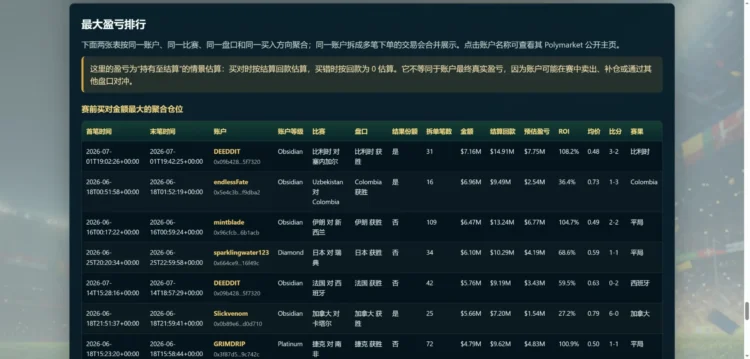
The account named “mintblade” serves as a quintessential example of this high-risk, high-reward strategy. This account participated in just 2 matches across 3 aggregated positions, investing $7.2889 million. It reaped an estimated profit of $8.2535 million, achieving an astounding ROI of 113.23% and a 100% hit rate by value. A single match, Iran vs. New Zealand, contributed a massive $6.7738 million to its profit, accounting for 82.1% of its total estimated World Cup earnings.
The logic behind this particular trade was straightforward yet bold. “Mintblade” purchased “Iran not to win” for $6.4705 million at an average price of approximately $0.49. The match ultimately ended in a 2-2 draw, causing the position to settle at $1, resulting in an estimated return of $13.2443 million. Following this success, the account then bought “Uruguay not to win” and a smaller share of a draw in the Saudi Arabia vs. Uruguay match, earning an additional $1.4797 million. These two perfectly executed bets propelled “mintblade” into the ranks of the World Cup’s most profitable accounts. The audacity and conviction behind such heavy wagers in these specific matches raise intriguing questions about the decision-making process.
Even more extreme was the address associated with “GRIMDRIP.” This account participated in only one match, Czech Republic vs. South Africa, simultaneously buying into “Czech Republic not to win” and “match draw.” The final score of 1-1 meant both positions were correct. An investment of $5.8490 million yielded an estimated profit of $7.4497 million, boasting an ROI of 127.37%. Behind these colossal bets lies an apparent certainty about the match outcomes, leading to speculation that the substantial profits of these addresses might stem from undisclosed insights or information.
Account “DEEDDIT” represents another style of heavy betting. This participant covered 8 matches across 9 aggregated positions, investing $20.9493 million and realizing an estimated profit of $8.0636 million. A crucial moment came in the Round of 32 when Belgium defeated Senegal 3-2. “DEEDDIT” had invested $7.1610 million in Belgium to win, earning an estimated $7.7495 million from this single bet. Later, in the semi-final where France lost 0-2 to Spain, the account bought “France not to win,” adding another $3.4259 million to its profits.
However, “DEEDDIT” was not infallible. The account incorrectly predicted draws in matches such as Mexico vs. Ecuador and Switzerland vs. Colombia, incurring several significant losses totaling over $4.3 million. The largest single profit accounted for a staggering 96.1% of its total World Cup net profit. While highly ranked, its success was heavily reliant on the Belgium vs. Senegal match.
Accounts like “sparklingwater123” and “endlessFate” exhibited similar characteristics. The former covered just 2 matches, investing $8.5005 million for an estimated profit of $7.7469 million. The latter covered 5 matches, investing $11.4454 million to earn an estimated $6.1929 million. These “whales” frequently bet on “not to win” or a draw when the odds for a favored team were perceived as inflated. Their strategy wasn’t a mechanical opposition to favorites but a concentrated expression of judgment in specific matches. Overall, the operations of these colossal bettors might involve sophisticated hedging or arbitrage across multiple platforms.
The Diligent vs. The Daring: When Volume Doesn’t Outperform Concentration
While not a standout on the profit leaderboard, the account “swisstony” was undoubtedly the king of participation frequency. This account’s predictions spanned an incredible 97 matches, involving 267 aggregated positions. With pre-match buy-ins totaling $15.9912 million, it achieved a respectable hit rate of 79.29%, yielding an estimated profit of $1.2482 million and an ROI of 7.81%. Despite correctly predicting far more matches than “mintblade” and “GRIMDRIP,” its total profit amounted to only about 15% of the former’s earnings.
The core difference lay in the position structure. “Swisstony’s” largest single estimated profit was $0.2227 million, with its largest loss at $0.3058 million. Its most profitable position only accounted for 17.84% of its World Cup net profit. This account did not rely on a single, game-changing bet but instead accumulated gains through smaller positions across a vast number of matches. While less dramatic, this approach offers a more compelling indicator of an account’s sustained predictive advantage.
Accounts “AV23IUa” and “Latina” also fall into the category of profitable accounts with broader market coverage. “AV23IUa” participated in 46 matches with 46 positions, investing $2.1245 million for an estimated profit of $0.9060 million and an ROI of 42.65%. “Latina” covered 11 matches, investing $3.4293 million to earn an estimated $1.2920 million, with a hit rate of 88.64%. Neither of these accounts concentrated their profits on a single match.
Another interesting case is “zhqzhq.” By the metric of having more than half of its funds in the correct direction for each match, this account correctly predicted all 14 matches it covered. However, an investment of $1.0182 million generated only $0.0557 million in estimated profit, resulting in a modest ROI of 5.47%. Despite a very high hit rate, the returns were low, primarily because the bets were often placed when the match outcome was already highly certain.
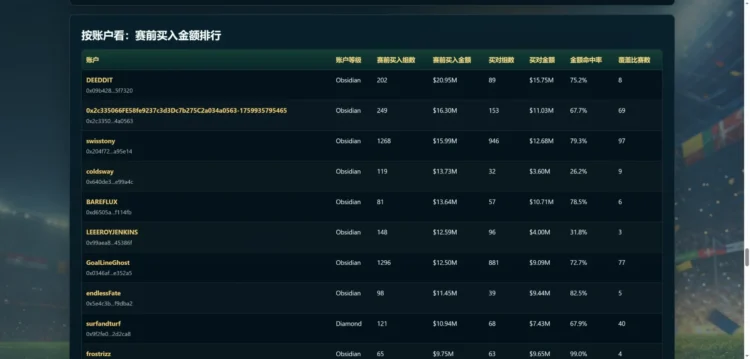
Beyond the winners, the losing accounts provide a stark counterpoint. “LEEEROYJENKINS” initially saw an estimated profit of $4.7976 million from the Australia vs. Turkey match. However, a subsequent heavy bet on Belgium to win against Egypt proved catastrophic. The match ended in a 1-1 draw, resulting in an estimated single-match loss of $8.3943 million. This single misstep completely wiped out previous significant gains, culminating in an estimated World Cup journey loss of $3.2464 million.
The majority of losing players, however, were characterized by a series of incorrect predictions. Account “coldsway” invested $13.7255 million across 9 matches but achieved a hit rate of only 26.22%, ultimately incurring an estimated loss of $7.3437 million, making it the biggest loser at the account level. Account “FlickRaw” participated in just 2 matches, incorrectly predicting both, leading to a complete loss of its $4.7983 million investment.
These cases underscore that even these “whales” are, at their core, high-stakes gamblers. A single, excessively large and incorrect position can easily negate the cumulative gains from numerous previous correct bets, highlighting the inherent volatility and risk in such speculative markets.
Whales’ Crystal Ball: France Overestimated, Spain Most Consistent
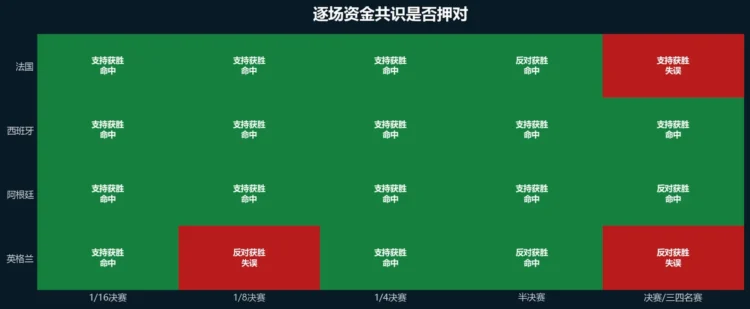
As the tournament progressed into its final stages, the remaining four teams—France, England, Argentina, and Spain—garnered immense attention as top contenders for the championship. The large-scale betting patterns on these teams offer a revealing glimpse into the true predictive prowess of these “whales.”
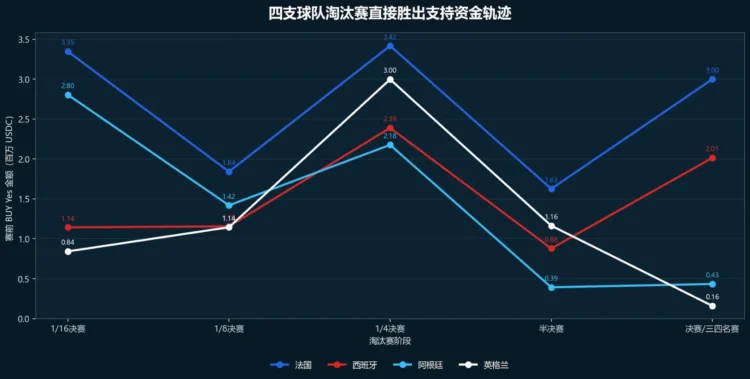
Spain: Among the four teams, Spain was the sample with the most consistent “smart money” judgment. In all five knockout matches, the side with larger funds correctly predicted the outcome. However, the intensity of support wasn’t a linear ascent: from the Round of 32 to the Quarter-finals, funds supporting Spain to win rose from $1.143 million to $2.390 million. Yet, in the semi-final against France, support dropped to $0.879 million, with a median buy-in cost of just $0.297. Spain ultimately won 2-0, making this match one with the largest odds-based profit potential. This $0.879 million, however, was not a broad consensus; the largest account contributed 46.7%, and the top five accounts accounted for 73.5%. Five consecutive correct predictions indicate that a few heavy-betting funds consistently chose the right direction, even when the broader market’s judgment faltered.
Argentina: Argentina’s funding curve presented a contrasting picture. Despite the team’s inspiring run to the final, direct support funds steadily declined. In the Round of 32, support amounted to $2.804 million with a median cost of $0.86, but by the semi-finals, it had dwindled to $0.393 million at a median cost of $0.315. Before the final, funds supporting Argentina to win were only $0.434 million, while opposing funds reached $1.518 million, with support accounting for just 22.2%. In this instance, the funds shifted early to “not to win” and were proven correct. However, the top five opposing accounts constituted 92.5% of the funds on that side, with the largest account alone making up 44.4%, indicating that this conclusion was still driven by a few dominant players.
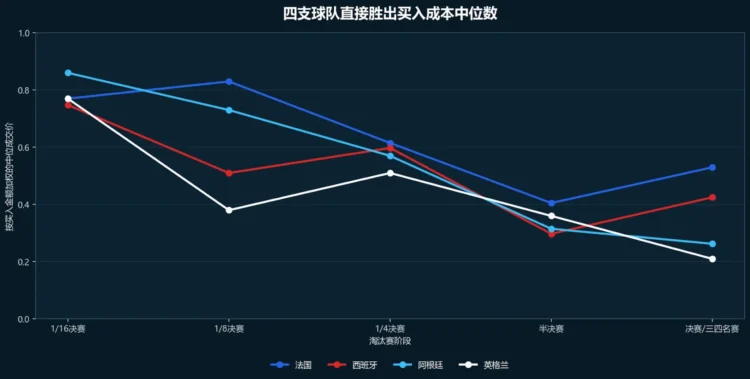
France: France showcased the most pronounced example of “a few being correct while the crowd was wrong.” In the semi-final against Spain, funds supporting France to win totaled $1.626 million, while opposing funds soared to $7.194 million. Ultimately, the larger funds prevailed, but this capital composition was predominantly from a single wallet contributing approximately $5.76 million, accounting for 80.1% of the opposing funds. By the third/fourth-place play-off, funds dramatically swung back towards France: $2.9997 million supported France to win, with only $0.1793 million opposing, representing 94.4% in favor. France, however, lost 4-6 to England.
England: England emerged as the team most frequently underestimated. In the Round of 16 against Mexico, funds supporting England were $1.144 million, while opposing funds were $1.187 million. The consensus favored “not to win,” yet England advanced with a 3-2 victory. In the third/fourth-place play-off against France, funds supporting England amounted to only $0.159 million, compared to $1.032 million opposing, with support at a mere 13.4% and a median buy-in cost of just $0.210. England ultimately triumphed 6-4. However, neither of these instances represented a collective misjudgment by “smart money”: in the third/fourth-place match, the top five accounts opposing England constituted 98.3% of the funds on that side, with the largest account alone making up 60.4%. This highlights how a few heavy-betting accounts skewed the collective consensus towards the incorrect direction.
As the fervor of the North America World Cup fades, this 40-day “prediction carnival” draws to a close. A review of the on-chain data unveils a stark and unforgiving world of speculation: here, the sheer volume of capital doesn’t guarantee prescience, and even “smart money” can fall victim to collective bias. Some found overnight riches from audacious bets on upsets, while others, despite meticulous planning, were undone by a single, heavily weighted error.
Peering beyond the veil of “survivor bias,” the most dazzling tales of profit are, at their core, thrilling high-stakes gambles. Just as there are no eternal champions on the football pitch, the same holds true for the volatile world of speculative markets.
(The above content is excerpted and reproduced with authorization from partner PANews. Original Link)
Disclaimer: This article is for market information purposes only. All content and views are for reference only and do not constitute investment advice, nor do they represent the views and positions of BlockTempo. Investors should make their own decisions and trades. The author and BlockTempo shall not be held responsible for any direct or indirect losses incurred by investors’ transactions.