Bitcoin’s $68,000 Stress Test: Can the Summer Rally Endure?
Bitcoin’s modest rebound throughout July is now poised for its most significant “stress test” yet. Yesterday, the leading cryptocurrency impressively breached the $66,000 mark, hitting a new multi-month high and extending its rally to over 15% since early July lows. However, as BTC’s price edges closer to the formidable $68,000 resistance zone, a critical question looms: Can this momentum persist, or will it succumb to profit-taking and the market’s characteristic “summer lull” of light trading?
The Crucial $68,000 Hurdle: A Multi-Layered Resistance
Why is the $68,000 level so pivotal? According to a recent Bitfinex market report, this threshold aligns precisely with the “average buying cost” for investors who entered the market over the past five months. This makes it a potential make-or-break point, determining whether bullish sentiment can continue its advance or if the rally will simply fizzle out.
Analysts highlight that short-term traders, many of whom have been holding positions at a paper loss, are likely to view a return to their cost basis as an opportunity to exit. This anticipated wave of break-even selling could generate significant new pressure, potentially impeding Bitcoin’s upward trajectory.
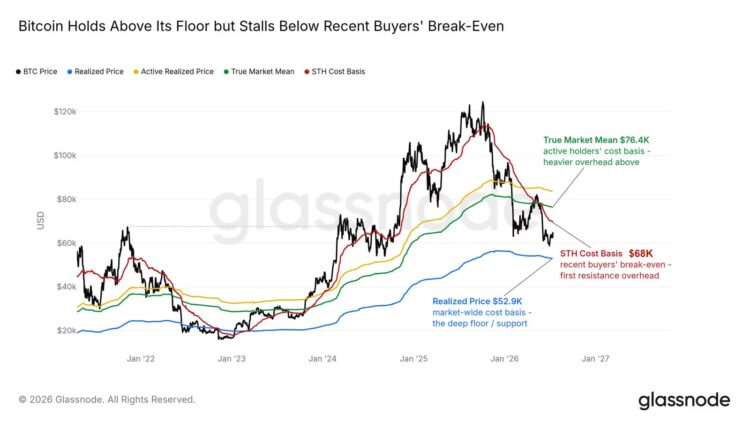
Adding to its significance, the $68,000 level also coincides with the previous local peak observed in mid-June. Following a failed attempt to overcome this barrier, Bitcoin experienced a sharp decline, plummeting below $58,000 and establishing the low point of the recent correction cycle. Consequently, market participants widely regard this price as a critical technical resistance.
Bitfinex analysts anticipate substantial market volatility: “We expect considerable market turbulence when the price retests this resistance zone for the first time.”
Market Structure Improves, But Full Recovery Awaits Stronger Momentum
Despite the substantial overhead resistance, the Bitfinex team has also identified encouraging signs of gradual improvement in market fundamentals. After several months of subdued activity, the spot market is beginning to show signs of life. Notably, capital flows into US Bitcoin spot ETFs have transitioned from consistent outflows to a more moderate pattern of net inflows.
However, the report also underscores a key concern: overall market demand has not yet fully recovered. Buying power remains considerably lower than the levels witnessed earlier this year. Compared to the fervent enthusiasm seen in Q1, both current ETF inflows and corporate acquisitions (such as those by MicroStrategy) have yet to regain their previous vigor.
Bitfinex cautions that while the gloom of Q2 has somewhat lifted and investor sentiment has received a boost, the overall market “has not fully healed.” Data reveals that Bitcoin currently commands nearly 67% of the trading volume in the cryptocurrency spot market, a significant increase from approximately 50% a year ago. This high concentration of capital in the flagship cryptocurrency suggests that investors are currently favoring “defensive strategies” and are hesitant to allocate funds into smaller altcoins.
The “Summer Slumber”: Institutional Retreat and Dwindling Volumes
Echoing these sentiments, cryptocurrency data analytics firm K33 Research highlights a similar trend. Vetle Lunde, Head of Research at K33, points to a noticeable decline in institutional investor engagement. Open interest in CME Bitcoin futures has fallen to its lowest levels since 2023, signaling a significant pullback from institutional players.
Furthermore, open interest in perpetual contracts across overseas markets remains stagnant. This indicates that even with the recent price bounce, speculative traders show little appetite for increasing their leverage.
The spot market also reflects this subdued activity. K33 data shows that Bitcoin’s 30-day trading volume is currently only about 62% of its annual average. Historically, late July is often one of the quietest trading periods of the year, a pattern that appears to be repeating.
Over the past week, the average daily trading volume in the Bitcoin spot market hovered around $2.3 billion, still near this year’s lows. Crucially, even as prices have continued their ascent, trading volumes have not seen a corresponding increase.
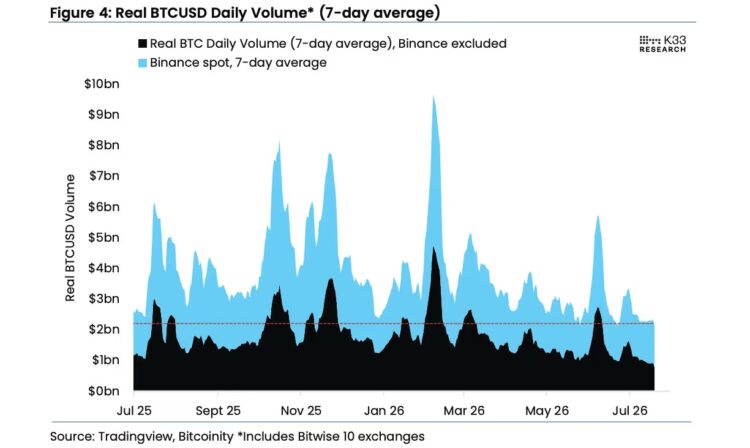
K33 characterizes the current market atmosphere as a “typical summer slumber, albeit one with positive signals.”
Despite the generally quiet trading environment, K33 acknowledges an improvement in capital flows for US Bitcoin spot ETFs. Following substantial outflows in May and June, this month has seen net outflows on only about one-third of trading days. This marks a significant reduction in selling pressure compared to June, when approximately 90% of trading days experienced net outflows.
However, K33 posits that the current scenario is more indicative of sellers stepping back rather than a robust return of major bullish forces. Overall market trading volume remains depressed, and fresh capital has yet to generate new upward momentum. Vetle Lunde concludes: “This is a very typical summer trading pattern for the cryptocurrency market, and it appears this seasonal trend is playing out again this year.”
Disclaimer: This article is provided for market information purposes only. All content and views are for reference only and do not constitute investment advice. They do not represent the views and positions of BlockTempo. Investors should make their own decisions and trades. The author and BlockTempo will not bear any responsibility for direct or indirect losses resulting from investor trades.