Authored by Fenrir for CryptoCity
OpenSea’s ERC-8257: Powering the Autonomous AI Agent Economy with On-Chain Tools
The burgeoning field of Artificial Intelligence is on the cusp of a revolutionary shift, moving from human-directed tools to fully autonomous agents. Recognizing this paradigm shift, OpenSea has unveiled a groundbreaking Ethereum standard, ERC-8257. Dubbed the “Agent Tool Registry,” this innovative standard aims to establish a dedicated on-chain system for AI Agents to discover, acquire, subscribe to, and utilize digital tools, mirroring the human experience of an App Store.
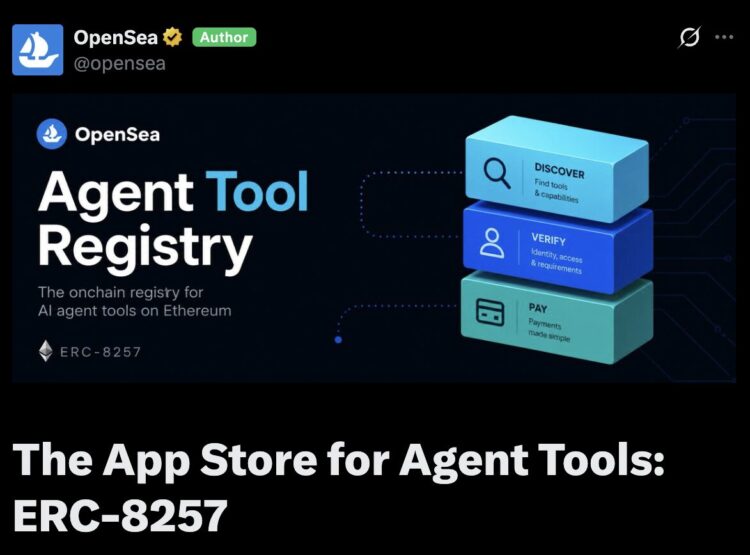
Currently, the landscape of AI tools is fragmented. They are scattered across disparate platforms like GitHub, buried within technical documentation, or confined to centralized ecosystems. This lack of a unified, open registration layer and standardized permissioning mechanisms creates significant hurdles for AI. Even with API access, agents struggle to identify available tools, understand permission requirements, or seamlessly navigate payment processes.
ERC-8257 offers an elegant solution by bringing this entire workflow on-chain. Developers can register their tools, specifying pricing, access permissions, and usage rules. Crucially, AI Agents can then autonomously evaluate these conditions, execute payments, and even acquire necessary NFTs or subscription tokens to unlock functionality.
The OpenSea team firmly believes that as AI Agents gain autonomous execution capabilities, a dedicated marketplace and economic system for their tools become not just beneficial, but essential.
NFTs Evolve: Unlocking Access in the AI-Driven World
One of the most compelling aspects of ERC-8257 is its transformative redefinition of NFT utility. Historically, NFTs have primarily served as digital collectibles, social identifiers, or membership passes. However, within this new framework, NFTs are poised to become direct access credentials for AI Agents, functioning as digital “tool passes.”
Imagine an AI Agent attempting to use an NFT valuation tool, only to receive a “403 Permission Denied” error, alongside a prompt indicating that holding a specific NFT grants preferential pricing or full feature access. The AI Agent would then autonomously navigate to OpenSea, purchase the required NFT, and resubmit its request, seamlessly gaining access to the tool.
This entire sequence – from NFT acquisition and on-chain verification to API access – is executed autonomously by the AI, requiring no human intervention. This fundamental shift extends the utility of NFTs beyond community and identity, integrating them directly into the burgeoning AI economic ecosystem.
In the future, ownership of a particular NFT could dictate an AI’s ability to access specialized research tools, real-time trading signals, premium data APIs, advanced on-chain analytics services, or even exclusive features within closed AI models.
ERC-8257: The Foundational Economic Layer for AI Agents
OpenSea envisions ERC-8257 as a cornerstone protocol within the broader AI Agent economy. Within this overarching architecture, the MCP (Machine-readable Content Protocol) informs AI about available tools, ERC-8004 defines AI identities, while ERC-8257 handles tool access and permission verification. For payments, protocols like x402 can be integrated to facilitate on-chain transactions.
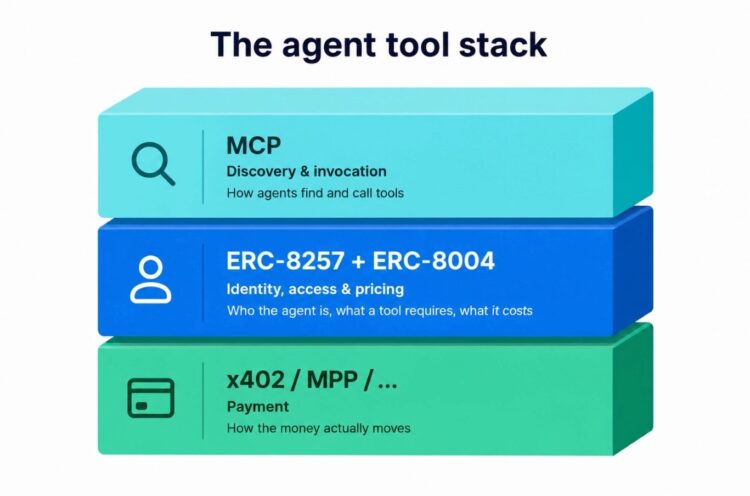
Designed with an extensible architecture akin to Uniswap v4 Hooks and Seaport Zones, ERC-8257 empowers developers to craft highly customized verification conditions. These conditions can range from NFT ownership and whitelists to subscription statuses, DAO voting rights, staked token quantities, or even advanced Zero-Knowledge Proofs (ZK Proofs).
To accelerate adoption, OpenSea has also released a dedicated tool-sdk, enabling developers to rapidly create AI tools, configure permissions, and deploy them across various cloud environments. ERC-8257 is already live on both Ethereum and Base, and OpenSea actively encourages developers to contribute to the standard’s evolution, aiming for a robust and comprehensive 1.0 release.
The Convergence of AI and Blockchain: From Concept to Practical Application
The profound significance of ERC-8257 extends far beyond just NFTs or tool marketplaces. It marks a pivotal moment where blockchain begins to function as the essential economic and permissioning layer for AI Agents.
Historically, AI tools have relied on traditional Web2 mechanisms: API keys, centralized accounts, and conventional payment systems. However, AI itself lacks the inherent ability to possess bank accounts, credit cards, or traditional identity verification. Blockchain offers a powerful alternative. AI Agents can now independently manage digital wallets, control assets, verify NFT-based identities, process payments, and automatically gain tool access based on predefined conditions.
This innovation transforms the concept of “AI finding tools, paying for them, and completing tasks autonomously” into a tangible reality. The OpenSea team envisions a future brimming with specialized AI tool marketplaces, offering services like on-chain analytics, predictive pricing, research subscriptions, trading signals, data APIs, and comprehensive automation services.
In essence, the challenge ERC-8257 addresses bears a striking resemblance to the initial vision of the App Store. The key difference, however, is that the next wave of truly massive users may no longer be humans, but intelligent AI Agents.
(This content is an authorized excerpt and reproduction from our partner, CryptoCity. Original article link.)
Disclaimer: This article is provided for market information purposes only. All content and views are for reference only and do not constitute investment advice. It does not represent the views and positions of the author or BlockBeats. Investors should make their own decisions and transactions. The author and BlockBeats will not bear any responsibility for direct or indirect losses resulting from investor transactions.