The CashCat Catalyst: How a Meme Coin Propelled Robinhood Chain’s On-Chain Debut Beyond RWA and DeFi
In a surprising twist, just a week after its mainnet launch, the Robinhood Chain ecosystem experienced an explosive surge in activity. This wasn’t driven by its anticipated Real-World Asset (RWA) or sophisticated on-chain finance offerings, but by the unexpected viral success of a humble cat-themed meme coin: CashCat. This unforeseen phenomenon has not only fueled rapid growth in transaction volumes and capital influx but has also thrust Robinhood Chain firmly into the market spotlight.
CEO’s Endorsement Ignites CashCat Meme Mania
For any nascent public blockchain, the initial challenge is always achieving a ‘cold start’ for its ecosystem. Despite Robinhood Chain benefiting from the vast user base of its parent company—approximately 28 million users—the majority are not native to the crypto space. The critical task lies in transforming this extensive user foundation into active on-chain participants. Drawing lessons from the successful trajectories of chains like Solana and BNB Chain, meme coins have consistently proven to be powerful catalysts for stimulating trading activity, attracting liquidity, and capturing market attention. True to form, shortly after Robinhood Chain’s mainnet went live, on-chain memes quickly became a magnet for capital, with CashCat emerging as the undeniable leader.
CashCat’s compelling narrative isn’t purely whimsical; it’s rooted in Robinhood’s own history. During its foundational stages, Robinhood explored naming its app ‘Cash Cat,’ inspired by an image of a serene cat perched atop a mound of money, symbolizing prosperity and good fortune. While the name was ultimately deemed insufficiently ‘professional’ for the initial app, the imagery resonated deeply within the community. With the launch of Robinhood Chain, CASHCAT naturally assumed the mantle of an unofficial mascot token, swiftly becoming a market sensation.
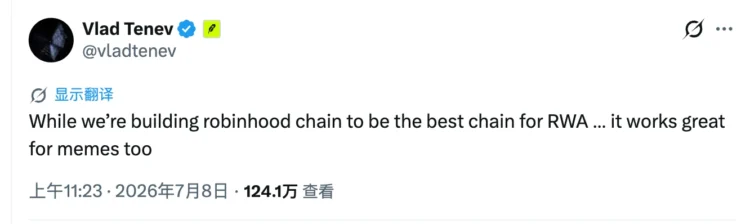
The real spark, however, came from an unexpected source: Robinhood CEO Vlad Tenev himself. On July 8th, Tenev began by following social media accounts associated with $CASHCAT. He then posted a tweet stating, “While Robinhood Chain is building the optimal chain for RWA, it is also very suitable for Meme coin trading.” Though he refrained from directly naming CASHCAT, the market universally interpreted this as a resounding endorsement of the on-chain meme ecosystem. The tweet rapidly garnered over a million views, further amplifying the market’s enthusiasm.
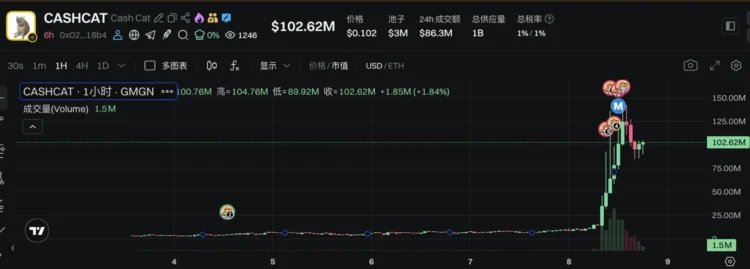
The impact was immediate and dramatic. GMGN data revealed CashCat’s market capitalization skyrocketing from a few million dollars to over $100 million within a single day, accompanied by a daily trading volume exceeding $81 million, solidifying its position as one of the chain’s hottest meme assets. This meteoric rise generated substantial wealth effects; for instance, on-chain analytics platform Lookonchain reported a trader turning a mere $838 investment in CASHCAT into an approximate $1.05 million unrealized profit in just 20 days. Such staggering returns fueled intense FOMO (Fear Of Missing Out), drawing a continuous influx of capital and new traders.
Dune data further illustrates this surge: Robinhood Chain’s official bridge Total Value Locked (TVL) soared to $60.3 million, with a remarkable single-day net inflow of approximately $44.86 million on July 8th—a new record since the mainnet launch. Concurrently, on-chain DEX trading volume peaked at nearly $150 million on the same day, with Uniswap V3 capturing a dominant 82.4% market share. Notably, even Uniswap founder Hayden Adams publicly acquired CASHCAT, adding another layer of legitimacy and excitement to the frenzy.
Robinhood’s long-standing openness to meme coins is well-documented, with its trading platform already listing popular tokens like Dogecoin, PEPE, WIF, BONK, PENGU, and POPCAT. As a hub for retail investors, particularly younger demographics, its user base possesses a natural affinity for meme assets. This predisposed environment made Robinhood Chain exceptionally fertile ground for a meme-driven breakthrough. However, while meme coins excel at generating short-term traffic, liquidity, and attention, the enduring value of an ecosystem ultimately hinges on the sustained engagement of developers, the utility of applications, and the fulfillment of genuine financial demands.
Beyond the Meme Hype: Robinhood Chain’s On-Chain Finance Ambition
While meme coins have captured immediate headlines, Robinhood Chain’s strategic vision is firmly centered on on-chain finance. Since its mainnet launch on July 2nd, the chain has rapidly amassed a substantial volume of on-chain assets. Dune data indicates that as of July 8th, Robinhood Chain’s total on-chain assets had swelled to approximately $340 million, marking an impressive 164.34% increase since its debut.
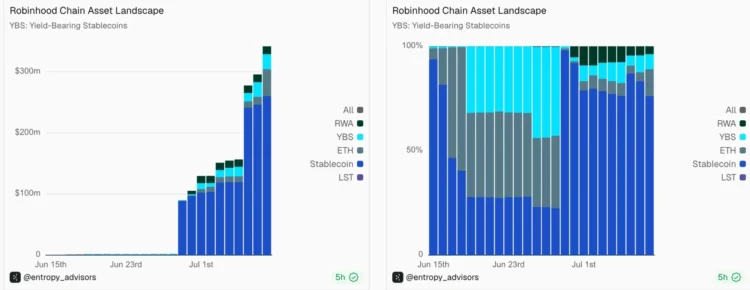
Stablecoins form the bedrock of this growing asset base, with over $260 million currently circulating on Robinhood Chain, representing 76.1% of all on-chain assets. USDG stands out as the primary liquidity driver, accounting for a commanding 78.8% of the total stablecoin volume, significantly outpacing USDe. This rapid accumulation of USDG liquidity is largely attributed to Robinhood’s flagship product, Robinhood Earn, which is specifically tailored for USDG. This DeFi yield product offers an attractive 7% APY. Users deposit USDG into the Morpho Vault, where funds are strategically deployed across various lending markets. Borrowers leverage assets like Spark, Ethena sUSDe, and Maple syrupUSDG to borrow USDG, paying interest that fuels the yield, thereby continuously incentivizing USDG’s on-chain presence. Official data confirms Robinhood Earn’s success, with cumulative deposits reaching $24.43 million and 1,688 participating users since its inception.
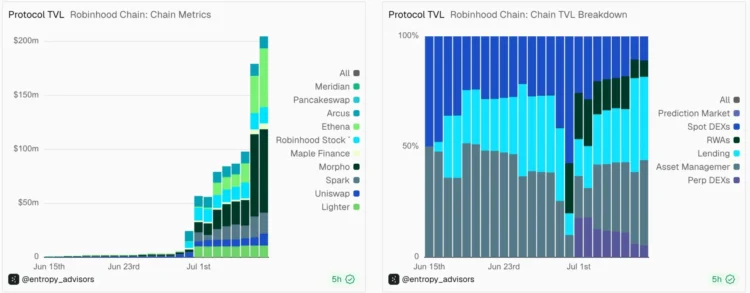
This swift capital inflow has directly propelled the growth of on-chain protocol TVL. According to Dune, Robinhood Chain’s protocol TVL surged from $56.07 million on its mainnet launch day to an impressive $205 million by July 8th—a more than 3.6-fold increase in a remarkably short period. The distribution of these protocols highlights lending as a dominant force: Morpho, a lending protocol, commands the largest share of liquidity with a TVL of $77.34 million (approximately 37.7% of total TVL). Ethena follows closely at $54.45 million (around 26.6%). Other notable contributors include Spark, Robinhood Stock Tokens, Uniswap, Arcus, and Lighter. In terms of application scenarios, asset management (38.6%) and lending (37.7%) are the predominant use cases, while spot DEX, RWA, Perp DEX, and prediction markets currently hold smaller, albeit growing, proportions.
The Real-World Asset (RWA) segment, a core long-term focus for Robinhood Chain, is still in its nascent stages. Currently, RWA assets total approximately $12.84 million, less than 4% of the chain’s total on-chain assets. The vast majority of these are tokenized stocks, with support for 101 different equities. Other asset classes, such as ETFs, commodities, and US Treasury bonds, are present but on a smaller scale.
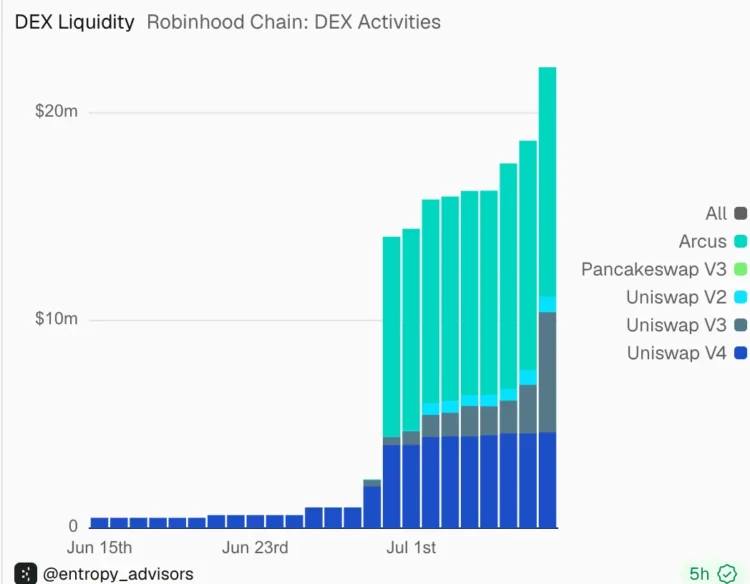
The DEX ecosystem, however, is demonstrating robust growth. Liquidity on Robinhood Chain’s DEXes rapidly expanded from several million dollars in early July to approximately $22.19 million. Arcus, developed by the dYdX team, has emerged as the leading liquidity provider, potentially driven by anticipation of future token airdrops, while Uniswap’s various versions host the remaining liquidity.
Concurrently with the capital influx, on-chain user activity has significantly escalated. As of July 8th, Robinhood Chain had processed 9.76 million transactions, with a remarkable 79.2% occurring post-mainnet launch. The cumulative number of on-chain addresses exceeded 143,000, with 88.6% representing new addresses created after the mainnet went live.
The Road Ahead: From Hype to Sustainable Value
While Robinhood Chain has undeniably achieved substantial capital settlement and user engagement in a remarkably short period since its mainnet launch, the current ecosystem growth remains heavily reliant on Robinhood Earn, with liquidity largely concentrated within a few protocols and specific use cases. Meme coins have successfully generated significant market traffic and attention for Robinhood Chain. However, the ultimate test for its next phase will be whether its ambitious on-chain finance initiatives can successfully take the baton, converting fleeting hype into a robust, sustainable, and value-driven decentralized ecosystem.
(The above content is excerpted and reproduced with authorization from partner PANews, original link)
Disclaimer: This article is for market information purposes only. All content and views are for reference only and do not constitute investment advice, nor do they represent the views and positions of BlockTempo. Investors should make their own decisions and trades. The author and BlockTempo will not bear any responsibility for direct or indirect losses resulting from investor trades.